



- -25.39%

Recommended price

€60.78

 Richiedi info sul prodotto
Estimated delivery: 2-5 working days

Information on returns and shipments

Payment methods

Treatment indicated in adults for the short-term treatment of jet lag.
Melatonin Noxarem is used for the short-term treatment of jet lag in adults. Jet lag refers to the symptoms caused by time differences when crossing different time zones (travelling east or west).
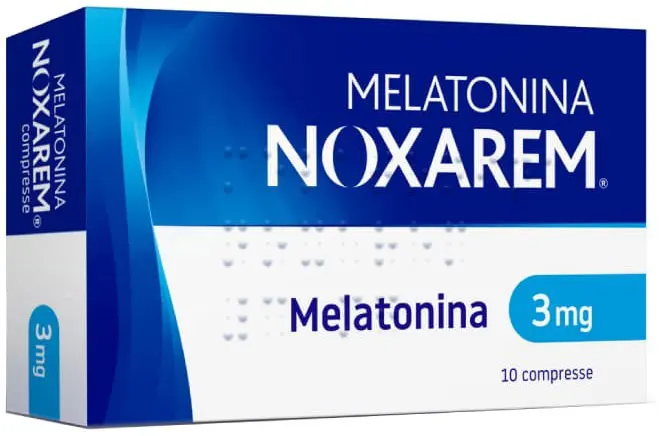
3 mg: Each tablet contains 3 mg of melatonin.
5 mg: Each tablet contains 5 mg of melatonin.
Calcium hydrogen phosphate dihydrate, Microcrystalline cellulose, Magnesium stearate, Colloidal anhydrous silica, Pregelatinized starch.
The standard dose is one 3 mg tablet per day, to be taken at the local time of the start of the night's sleep, starting from arrival at the destination and for a maximum of 4 days. A 5 mg tablet may be taken instead of a 3 mg tablet at the local time of the onset of bedtime if the standard 3 mg dose does not provide adequate symptom relief. The 5 mg tablet should not be taken in addition to the 3 mg tablet, but a higher dose may be taken on subsequent days. The maximum daily dose is 5 mg once daily. The dose that provides adequate symptom relief should be taken for the shortest possible period of time. Since taking melatonin at inappropriate times may have no effect or may cause an adverse effect on resynchronization following jet lag, melatonin should not be taken before 8:00 PM or after 4:00 AM (local time at the destination). Elderly: Since the pharmacokinetics of exogenous (immediate-release) melatonin are generally similar in young adults and elderly people, there are no specific dosage recommendations for the elderly. Renal impairment: Experience with the use of melatonin in patients with renal impairment is limited. Caution should be exercised when taking melatonin in patients with renal impairment. Melatonin is not recommended for patients with severe renal impairment. Hepatic impairment: There are no empirical data on the use of melatonin in patients with hepatic impairment. Limited data suggest that plasma clearance of melatonin is significantly reduced in patients with cirrhosis. Melatonin is not recommended for patients with hepatic impairment. Paediatric population: The safety and efficacy of melatonin in children and adolescents aged 0 to 18 years have not been established. No data are available.
Method of administration: Oral use.
Tablets should be swallowed with a glass of water. Consuming food at or near the time of melatonin intake should not affect the efficacy or safety of melatonin; however, it is recommended that you avoid food approximately 2 hours before and 2 hours after taking melatonin.
Drowsiness
Melatonin may cause drowsiness. Therefore, the product should be used with caution if drowsiness could pose a safety risk.
Autoimmune diseases
There are no clinical data on the use of melatonin in subjects with autoimmune diseases. Therefore, the use of melatonin is not recommended in patients with autoimmune diseases.
Hepatic and renal impairment
Empirical data on the safety and efficacy of melatonin use in patients with hepatic or renal impairment are limited. Melatonin is not recommended for patients with hepatic impairment or severe renal impairment.
Cardiovascular conditions
Data on adverse events related to blood pressure and heart rate caused by melatonin in populations with cardiovascular conditions and concomitant treatment with antihypertensive drugs are limited. It is unclear whether these adverse effects are attributable to melatonin itself or to interactions between melatonin and other drugs. The use of melatonin is not recommended in patients with cardiovascular conditions and concomitant treatment with antihypertensive drugs.
Concomitant use of anticoagulants
Caution should be exercised when taking melatonin concomitantly with anticoagulant drugs, including warfarin and new direct-acting anticoagulants, as melatonin may enhance the effect of these drugs and cause an increased risk of bleeding.
Summary of the safety profile
The most frequently reported adverse effects when taking melatonin short-term for the treatment of jet lag are somnolence, headache, and dizziness/disorientation. Somnolence, headache, dizziness, and nausea are also the most frequently reported adverse effects. frequently when typical clinical doses of melatonin have been taken for periods of several days or weeks by healthy subjects and patients.
Tabulation of adverse reactions
The following adverse reactions to melatonin in general have been reported in clinical trials or spontaneous case reports. Within each frequency grouping, undesirable effects are presented in order of decreasing seriousness.
| System organ class | Very common (≥1/10) | Common (≥1/100, <1> | Uncommon (≥1/1,000, <1> | Rare (≥1/10,000, <1> | Not known: (frequency cannot be estimated from the available data) | ||
| Infections and infestations | herpes zoster | ||||||
| Pathologies of the blood and lymphatic system | leukopenia, thrombocytopenia | ||||||
| Immune system disorders | hypersensitivity reaction | ||||||
| Metabolism and nutrition disorders | hypertriglyceridemia, hypocalcemia, hyponatremia | ||||||
| Disorders Psychiatric disorders | Irritability, nervousness, restlessness, insomnia, abnormal dreams, nightmares, anxiety | Mood changes, aggression, agitation, crying spells, stress symptoms, disorientation, early morning awakening, increased libido, depressed mood, depression | |||||
| Nervous system disorders | migraine, headache, lethargy, psychomotor hyperactivity, dizziness, somnolence | syncope, memory impairment, disturbance in attention, dreaming, restless legs syndrome, poor quality sleep, paraesthesia | |||||
| Eye disorders | reduced visual acuity, blurred vision, increased lacrimation | ||||||
| Ear and labyrinth disorders | positional vertigo, vertigo | ||||||
| Cardiac disorders | angina pectoris, palpitations | ||||||
| Vascular disorders | hypertension | hot flushes | |||||
| Gastrointestinal disorders | abdominal pain, abdominal pain upper, dyspepsia, mouth ulceration, dry mouth, nausea | gastroesophageal reflux disease, gastrointestinal disorder, oral mucosal blistering, tongue ulceration, gastrointestinal disorder, vomiting, abdominal sounds abnormal, flatulence, salivary hypersecretion, bad breath, abdominal discomfort, gastric disorder, gastritis | |||||
| Hepatobiliary disorders | hyperbilirubinaemia | ||||||
| Skin and subcutaneous tissue disorders | Dermatitis, night sweats, pruritus, rash, generalised pruritus, dry skin | Eczema, erythema, hand dermatitis, psoriasis, generalised rash, pruritic rash, nail disorder | angioedema, mouth oedema, tongue oedema | ||||
| System disorders Musculoskeletal and connective tissue disorders | Pain in extremity | Arthritis, muscle spasms, neck pain, night cramps | |||||
| Renal and urinary disorders | Glycosuria, proteinuria | Polyuria, hematuria, nocturia | |||||
| Reproductive system and breast disorders | Symptoms of menopause | Priapism, prostatitis | Galactorrhoea | ||||
| General disorders and administration site conditions | asthenia, chest pain | fatigue, pain, thirst | |||||
| Investigations | abnormal liver function tests, increased weight | increased liver enzymes, abnormal blood electrolytes, abnormal laboratory tests |
Reporting of adverse reactions Suspected Reporting of suspected adverse reactions that occur after authorization of the medicinal product is important, as it allows continued monitoring of the benefit/risk balance of the medicinal product.
Hypersensitivity to the active substance or to any of the excipients.
Cases of daily doses of up to 300 mg of melatonin have been reported in the literature without clinically significant adverse reactions. In case of overdose, drowsiness is likely to occur. Clearance of the active substance occurs within 12 hours of ingestion. No special treatment is necessary.
Pregnancy
For melatonin, no clinical data on exposed pregnancies are available. Animal studies do not indicate direct or indirect harmful effects with respect to pregnancy, embryonal-foetal development, parturition or development. Postnatal. Exogenous melatonin readily crosses the human placenta. Due to the lack of clinical data, the use of the medicine is not recommended in women who are pregnant or intending to become pregnant.
Breastfeeding
Endogenous melatonin has been identified in human breast milk, so exogenous melatonin is probably excreted in breast milk. There are data from animal models, including rodents, sheep, cattle, and primates, demonstrating the passage of melatonin from the mother to the fetus through the placenta or milk. Therefore, melatonin should not be used during breastfeeding.
Fertility
There are no data available on the possible adverse effects of short-term use of melatonin on human fertility.
10 tablets of 3 mg
This product has been on sale since 07/05/2024
In the last 30 days, the product's lowest price was 11,29 €
UN BUON PRODOTTO


Estimated delivery: 2-5 working days

Estimated delivery: 2-5 working days

Estimated delivery: 2-5 working days

Estimated delivery: 2-5 working days
