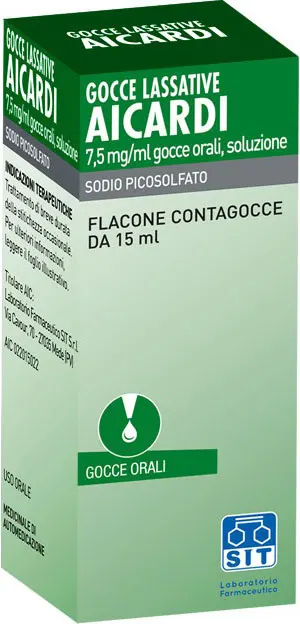
Laxative drops for constipation.
Indications
Aicardi Laxative Drops 7.5 mg/ml Oral Drops, Solution is a medicine used for the short-term treatment of occasional constipation.
Composition
Active ingredients: 1 ml contains 7.5 mg of Sodium Picosulfate.
Excipients: Sodium methyl parahydroxybenzoate, non-crystallizing liquid sorbitol and purified water.
Directions for use and Dosage
Adults: 5-10 drops or more, in a little water.
Children from 3 to 12 years: 2–5 drops in a little water, after consulting your doctor.
Do not exceed the recommended doses.
The correct dose is the minimum sufficient to produce easy evacuation of soft stools.
It is advisable to initially use the minimum recommended doses.
Take preferably in the evening.
Laxatives should be used as infrequently as possible and for no more than seven days.
Use for longer periods of time requires a doctor's prescription after adequate evaluation of the individual case.
Method of administration
Swallow together with an adequate quantity of water (a large glass).
A diet rich in liquids favors the effect of the medicine.
Warnings
Abuse of laxatives (frequent or prolonged use or excessive doses) can cause serious side effects. cause persistent diarrhea with consequent loss of water, mineral salts (especially potassium) and other essential nutrients.
In more severe cases, dehydration or hypokalemia may occur, which may lead to cardiac or neuromuscular dysfunction, especially in case of concomitant treatment with cardiac glycosides, diuretics or corticosteroids.
Cases of dizziness and/or syncope have been reported in patients taking medicinal products containing sodium picosulfate.
The available data on these cases suggest that the events could be related to defecation syncope (or syncope attributable to evacuation effort), or to a vasovagal response to abdominal pain related to constipation, and not necessarily to the intake of sodium picosulfate itself.
Abuse of laxatives, especially contact laxatives (stimulant laxatives), can cause serious side effects. cause dependence (and, therefore, the possible need to gradually increase the dosage), chronic constipation and loss of normal intestinal functions (intestinal atony).
The treatment of chronic or recurrent constipation always requires medical intervention for diagnosis, prescription of drugs and monitoring during therapy.
Consult your doctor when the need for a laxative arises from a sudden change in previous bowel habits (frequency and characteristics of bowel movements) that lasts more than two weeks or when the use of the laxative fails to produce effects.
It is also advisable for elderly or unhealthy subjects to consult their doctor before using the medicine.
Pediatric population
Do not administer to children under 3 years of age.
From 3 to 12 years of age, consult your doctor before taking the product. Aicardi Laxative Drops oral drops, solution contains
- sodium methyl parahydroxybenzoate: may cause allergic reactions (possibly delayed);
- sorbitol: patients with rare hereditary problems of fructose intolerance should not take this medicine.
Contraindications
Aicardi Laxative Drops is contraindicated in patients with:
- Hypersensitivity to the active substance or to any of the excipients.
- Acute or unknown abdominal pain, severe and painful acute abdominal conditions (such as appendicitis).
- Nausea or vomiting.
- Paralytic ileus, intestinal or biliary tract obstruction or stenosis.
- Rectal bleeding of unknown origin.
- Severe dehydration, abdominal colic, diarrhoea, cachexia (due to the risk of excessive purgative effect in such cases).
- Acute inflammation of the gastrointestinal tract.
- Gallstones.
- Liver failure.
- Children under 3 years of age.
- Generally contraindicated during pregnancy and breastfeeding.
Interactions
The association with magnesium citrate anticipates the onset of the laxative effect, which can occur after as early as 3 hours.
Laxatives can reduce the residence time in the intestine, and therefore the absorption, of other drugs administered orally at the same time.
Therefore, avoid taking laxatives and other drugs at the same time: after taking a medicine, wait at least 2 hours before taking the laxative.
Milk or antacids can alter the effect of the medicine; Leave an interval of at least one hour before taking the laxative.
Continued use of sodium picosulfate may increase the response of patients to oral anticoagulants and alter glucose tolerance.
Concomitant use of diuretics or adrenocorticosteroids and excessive doses of sodium picosulfate may lead to an increased risk of electrolyte imbalance.
This imbalance, in turn, may lead to increased sensitivity to cardiac glycosides.
Concomitant administration of antibiotics may reduce the laxative effect of sodium picosulfate.
Side effects
Like all medicines, Aicardi Laxative Drops can cause serious side effects. cause side effects, although not everybody gets them.
Adverse reactions are listed below by system organ class and frequency, using the following categories:
- Very common ≥ 1/10;
- Common ≥ 1/100, < 1/10;
- Uncommon ≥ 1/1,000, < 1/100;
- Rare ≥ 1/10,000, < 1/1,000;
- Very rare < 1/10,000;
- Not known: Frequency cannot be estimated from the available data. be defined on the basis of available data.
Immune system disorders
Not known: hypersensitivity
Nervous system disorders
Not known: syncope, dizziness.
Gastrointestinal disorders
Not known: diarrhoea, abdominal cramps, abdominal pain and abdominal discomfort, vomiting, nausea, isolated cramp-like pain or abdominal colic, more severe. frequent in cases of severe constipation.
Skin and subcutaneous tissue disorders
Not known: skin reactions such as angioedema, drug eruption, rash, pruritus
Reporting of suspected adverse reactions
Reporting suspected adverse reactions that occur after authorisation of the medicinal product is important, as it allows continued monitoring of the benefit/risk balance of the medicinal product.
Healthcare professionals are asked to report any suspected adverse reactions via the national reporting system.
Overdose
Signs and symptoms
Following the intake of high doses of the drug, watery stools (diarrhea), abdominal cramps and a significant loss of fluids, potassium and other electrolytes may occur.
The resulting loss of fluids and electrolytes (especially potassium) must be replaced.
Cases of colonic mucosal ischemia have been reported with doses of sodium picosulfate considerably higher than the dosage recommended for the treatment of occasional constipation.
Sodium picosulfate, like other laxatives, in overdose causes chronic diarrhea, abdominal pain, hypokalemia, secondary hyperaldosteronism, and renal calculi.
Renal tubular damage, metabolic alkalosis, and muscle weakness secondary to hypokalemia have also been described in association with chronic laxative abuse.
Treatment
If treatment is performed shortly after ingestion of sodium picosulfate, absorption can be reduced or prevented by inducing vomiting or gastric lavage.
Losses of fluid and electrolytes must be replaced.
This is particularly important in the elderly and young.
It may be necessary to reconstruct the laxative. The administration of antispasmodics may be useful.
Pregnancy and breastfeeding
There are no adequate and well-controlled studies on the use of the medicine during pregnancy or breastfeeding.
Therefore, the medicine should be used only when necessary, under the direct supervision of a doctor, after evaluating the expected benefit for the mother in relation to the possible risk to the fetus or infant.
The medicine is generally contraindicated during pregnancy and breastfeeding.
Format
15 ml dropper bottle
Product Code:FRCM139460





 Richiedi info sul prodotto