



- -41.54%

Recommended price

€8.77

 Richiedi info sul prodotto

Information on returns and shipments

Payment methods


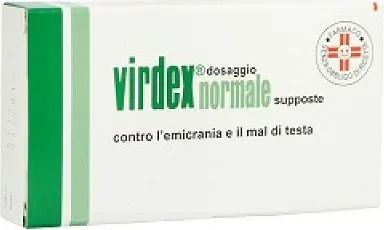
Virdex Normale, a drug for the symptomatic treatment of migraine
Virdex Normale is indicated for the symptomatic treatment of acute migraine attacks.
Each suppository contains: Active ingredients: Ergotamine Tartrate 0.5 mg, Caffeine 100 mg, Aminophenazone 250 mg.
Semisynthetic glycerides.
Hypersensitivity to the active ingredient or to any of the excipients, peripheral vascular disease, coronary artery disease, hypertension, impaired renal and hepatic function, pregnancy and breastfeeding, sepsis, granulocytopenia and acute intermittent porphyria, renal insufficiency. Glucose-6-phosphate dehydrogenase; children under 12 years of age. History of gastrointestinal bleeding or perforation related to previous active treatments or history of recurrent peptic ulcer/hemorrhage (two or more distinct episodes of proven ulceration or bleeding). Severe heart failure. Pregnancy and breastfeeding.
Normal series suppositories: 1 suppository at the first warning of a migraine attack, followed by 1 suppository one hour later, up to a daily total of 5 suppositories in acute cases. Do not exceed the recommended dose.
In hypersensitive individuals, high or prolonged doses of the product may cause blood damage. It is advisable to avoid concomitant alcohol intake, as its effect may be enhanced. The occasional red coloration of the urine is not pathological; it is due to the presence of rubazonic acid, a harmless metabolite of pyrazolones. After a short period of treatment without results, consult your doctor. The use of VIRDEX should be avoided in conjunction with NSAIDs, including selective COX-2 inhibitors. Undesirable effects may be minimized by using the lowest effective dose for the shortest duration necessary to control symptoms (see paragraphs below on gastrointestinal and cardiovascular risks). Elderly: Elderly patients have an increased frequency of adverse reactions to NSAIDs, especially gastrointestinal bleeding and perforation, which may be fatal. Gastrointestinal bleeding, ulceration and perforation: Gastrointestinal bleeding, ulceration and perforation, which can be fatal, have been reported with all NSAIDs at anytime during treatment, with or without warning symptoms or a previous history of serious gastrointestinal events. In the elderly and in patients with a history of ulcers, particularly if complicated with haemorrhage or perforation (see section 4.3), the risk of gastrointestinal bleeding, ulceration, or perforation is higher with increasing doses of NSAIDs. These patients should start treatment on the lowest available dose. Concomitant use of protective agents (misoprostol or proton pump inhibitors) should be considered for these patients and also for patients taking low-dose aspirin or other drugs that may increase the risk of gastrointestinal events (see section 4.5 and below). Patients with a history of gastrointestinal toxicity, particularly the elderly, should report any unusual gastrointestinal symptoms (especially gastrointestinal bleeding), particularly in the initial stages of treatment. Caution should be advised in patients receiving concomitant medications which could increase the risk of ulceration or bleeding, such as oral corticosteroids, anticoagulants such as warfarin, selective serotonin reuptake inhibitors, or antiplatelet agents such as aspirin (see section 4.5). If gastrointestinal bleeding or ulceration occurs in patients receiving VIRDEX, the treatment should be discontinued. NSAIDs should be administered with caution to patients with a history of gastrointestinal disease (ulcerative colitis, Crohn's disease) as these conditions may be exacerbated (see section 4.8). Caution should be exercised in patients with a history of hypertension and/or heart failure as fluid retention and edema have been reported in association with NSAID therapy. Serious skin reactions, some of them fatal, including exfoliative dermatitis, Stevens-Johnson syndrome, and toxic epidermal necrolysis, have been reported very rarely in association with the use of NSAIDs (see section 4.8). Patients appear to be at highest risk early in the course of therapy, with the onset of the reaction occurring in the majority of cases within the first month of treatment. VIRDEX should be discontinued at the first appearance of skin rash, mucosal lesions, or any other sign of hypersensitivity. Caution is advised (discuss with your doctor or pharmacist) before initiating treatment in patients with a history of hypertension and/or heart failure, as fluid retention, hypertension, and edema have been reported in association with NSAID therapy. Cardiovascular and cerebrovascular effects: Clinical studies and epidemiological data suggest that the use of some NSAIDs (particularly at high doses and for long-term treatment) may be associated with a modestly increased risk of arterial thrombotic events (e.g., myocardial infarction or stroke). There are currently insufficient data to exclude a similar risk for Aminophenazone when administered at a daily dose of up to 5 suppositories.
Numbness and tingling of the fingers, hands, and feet, muscle pain in the extremities, leg weakness, epigastric pain, transient tachycardia or extrasystole or bradycardia, nausea, vomiting, localized edema, pruritus, hyperstimulation syndrome. VIRDEX may cause drowsiness and allergic reactions of varying severity and location, including blood hypersensitivity (leukopenia, rarely agranulocytosis). If fever recurs during treatment, or mucosal and skin changes occur, discontinue therapy and consult your doctor. Caffeine hyperstimulation syndrome may occur in susceptible individuals, with excitation, insomnia, tremor, increased diuresis, nausea, vomiting, cardiac arrhythmia, and scotoma. Gastrointestinal: The most commonly observed adverse events are gastrointestinal in nature. Peptic ulcers, perforation, or gastrointestinal bleeding, sometimes fatal, particularly in the elderly, may occur (see section 4.4). Nausea, vomiting, diarrhea, flatulence, constipation, dyspepsia, abdominal pain, melaena, hematemesis, ulcerative stomatitis, exacerbation of colitis and Crohn's disease have been reported following administration of VIRDEX (see section 4.4). Less frequently, gastritis has been observed. Edema, hypertension, and cardiac failure have been reported in association with treatment with NSAIDs. Bullous reactions including Stevens-Johnson syndrome and toxic epidermal necrolysis (very rare). Clinical trial and epidemiological data suggest that use of some NSAIDs (particularly at high doses and in long-term treatment) may be associated with a small increased risk of arterial thrombotic events (e.g., myocardial infarction or stroke) (see section 4.4).
Inhibition of prostaglandin synthesis may adversely affect the pregnancy and/or embryo/foetal development. Results of epidemiological studies suggest an increased risk of miscarriage and of cardiac malformation and gastroschisis after use of a prostaglandin synthesis inhibitor in early pregnancy. The absolute risk for cardiac malformations increased from less than 1% to approximately 1.5%. The risk has been believed to increase with dose and duration of therapy. In animals, administration of prostaglandin synthesis inhibitors has been shown to result in increased pre- and post-implantation loss and embryo-fetal mortality. Furthermore, an increased incidence of various malformations, including cardiovascular, has been reported in animals administered prostaglandin synthesis inhibitors during the organogenetic period. During the third trimester of pregnancy, all prostaglandin synthesis inhibitors may expose the fetus to: – cardiopulmonary toxicity (with premature closure of the ductus arteriosus and pulmonary hypertension); – renal dysfunction, which may progress to renal failure with oligohydramnios; the mother and newborn, at the end of pregnancy, to: – possible prolongation of bleeding time, and antiplatelet effect, which may occur even at very low doses; – inhibition of uterine contractions resulting in delayed or prolonged labor.
Pack of 5 suppositories.
This product has been on sale since 25/09/2017
In the last 30 days, the product's lowest price was 8,34 €

Estimated delivery: 2-5 working days

Estimated delivery: 2-5 working days


Estimated delivery: 2-5 working days

Estimated delivery: 2-5 working days

Estimated delivery: 2-5 working days

Estimated delivery: 2-5 working days