



- -41.54%

Recommended price

€8.77

 Richiedi info sul prodotto
Estimated delivery: 2-5 working days

Information on returns and shipments

Payment methods

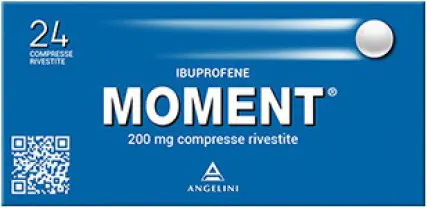
Moment Analgesic-Anti-Inflammatory
Moment belongs to the class of analgesic-anti-inflammatory drugs, that is, medicines that fight pain and inflammation.
Pains of various origins and nature (headache, toothache, neuralgia, osteo-articular and muscular pain, menstrual pain). Adjuvant in the symptomatic treatment of fever and influenza.
Hypersensitivity to the active substance (ibuprofen), to other antirheumatics (e.g. acetylsalicylic acid, etc.) or to any of the excipients of the product.
Children under 12 years of age
Pregnancy and breastfeeding (see "What to do during pregnancy and breastfeeding")
Active or severe gastroduodenal ulcer or other gastropathies.
History of gastrointestinal bleeding or perforation related to previous active treatments or history of recurrent peptic ulcer/haemorrhage (two or more distinct episodes of proven ulceration or bleeding).
Severe heart failure.
Severe hepatic or renal insufficiency.
• Ibuprofen should be used with caution by asthmatics and, more particularly, by those who have experienced bronchospasm after the use of acetylsalicylic acid or other NSAIDs (nonsteroidal anti-inflammatory drugs), as well as by those with a previous medical history of gastrointestinal bleeding or ulceration.
• The use of Moment should be avoided in conjunction with NSAIDs, including selective COX-2 inhibitors.
• Undesirable effects can be minimized by using the lowest effective dose for the shortest duration necessary to control symptoms.
• There is a risk of impaired renal function in dehydrated adolescents.
• In the elderly and in patients with a history of ulcers, particularly if complicated with haemorrhage or perforation (see “When it should not be used”), the risk of gastrointestinal bleeding, ulceration or perforation is higher with increasing doses of NSAIDs. These patients should start treatment on the lowest available dose. Concomitant use of protective agents (misoprostol or proton pump inhibitors) should be considered for these patients and also for patients taking low-dose aspirin or other drugs likely to increase the risk of gastrointestinal events (see below and “Which medicinal products or foods can alter the effect of the medicinal product”).
• Patients with a history of gastrointestinal toxicity, particularly the elderly, should report any unusual gastrointestinal symptoms (especially gastrointestinal bleeding), particularly in the initial stages of treatment.
• NSAIDs should be administered with caution to patients with a history of gastrointestinal disease (ulcerative colitis, Crohn's disease) as these conditions may be exacerbated (see "Undesirable effects").
• If gastrointestinal bleeding or ulceration occurs in patients taking Moment, the treatment should be withdrawn.
• Caution should be exercised in patients receiving concomitant medications which could increase the risk of ulceration or bleeding, such as oral corticosteroids, anticoagulants such as warfarin, selective serotonin reuptake inhibitors or anti-platelet agents such as aspirin (see "Which medicinal products or foods can alter the effect of the medicinal product").
• Medicines such as these may be of interest to patients taking Moment. Medicines such as Moment may be associated with a small increased risk of heart attack (myocardial infarction) or stroke: any risk is more likely with high doses and prolonged treatment. Do not exceed the recommended dose or duration of treatment (3 days).
• If you have heart problems, or a history of stroke, or think you may be at risk of these conditions (for example, if you suffer from high blood pressure, diabetes, or high cholesterol, or if you smoke), you should discuss your treatment with your doctor or pharmacist.
Inform your doctor or pharmacist if you have recently taken any other medicines, even those obtained without a prescription.
• If you are taking coumarin-type anticoagulants (warfarin, dicoumarol, etc.), use Moment only after consulting your doctor.
• Do not combine Moment with acetylsalicylic acid or other NSAIDs.
• Corticosteroids: increased risk of gastrointestinal ulceration or bleeding (see “Precautions for use”).
• Anticoagulants: NSAIDs may enhance the effects of anticoagulants, such as warfarin (see “Precautions for use”).
• Antiplatelet agents and selective serotonin reuptake inhibitors (SSRIs): increased risk of gastrointestinal bleeding (see “Precautions for use”).
• Diuretics, ACE inhibitors and Angiotensin II antagonists: NSAIDs may reduce the effect of diuretics and other antihypertensive drugs. In some patients with compromised renal function (e.g., dehydrated patients or elderly patients with compromised renal function), the co-administration of an ACE inhibitor or an angiotensin II antagonist and agents that inhibit the cyclo-oxygenase system may lead to further deterioration of renal function, including possible acute renal failure, which is usually reversible. These interactions should be considered in patients taking Moment concomitantly with ACE inhibitors or angiotensin II antagonists. Therefore, the combination should be administered with caution, especially in elderly patients.
• Patients should be adequately hydrated, and monitoring of renal function should be considered after initiation of concomitant therapy.
• Some medicines such as anticoagulants and antiplatelet drugs (e.g., acetylsalicylic acid, warfarin, ticlopidine), antihypertensives (ACE inhibitors, e.g., captopril, beta-blockers, angiotensin II antagonists), and other medicines may interact with ibuprofen treatment. Consult your doctor before using ibuprofen with other medicines.
In pregnant or breastfeeding women, Moment should only be used after consulting your doctor and evaluating the risk/benefit ratio in your case.
Consult your doctor if you suspect you are pregnant or if you are planning to become pregnant.
Pregnancy
Inhibition of prostaglandin synthesis may cause side effects. negatively affect pregnancy and/or embryonic/fetal development.
Results of epidemiological studies suggest an increased risk of miscarriage, cardiac malformation, and gastroschisis after use of a prostaglandin synthesis inhibitor in early pregnancy. The absolute risk of cardiac malformations increased from less than 1% to approximately 1.5%. The risk was believed to increase with dose and duration of therapy. In animals, administration of prostaglandin synthesis inhibitors has been shown to result in increased pre- and post-implantation loss and embryo-fetal mortality.
Furthermore, an increased incidence of various malformations, including cardiovascular, has been reported in animals administered prostaglandin synthesis inhibitors during the organogenetic period.
During the third trimester of pregnancy, all prostaglandin synthesis inhibitors may expose:
the fetus to:
- cardiopulmonary toxicity (with premature closure of the ductus arteriosus and pulmonary hypertension),
- renal dysfunction, which may progress to renal failure with oligo-hydroamniosis,
the mother and newborn, at the end of pregnancy, to:
- possible prolongation of bleeding time, and anti-aggregating effect which may increase the risk of developing pulmonary hypertension. may occur even at very low doses,
- inhibition of uterine contractions resulting in delayed or prolonged labor.
MOMENT contains:
• sorbitol: if you have been told by your doctor that you have an intolerance to some sugars, contact your doctor before taking this medicine,
• the colorant Ponceau 4R (E124): may cause an intolerance to some sugars. cause allergic reactions.
Adults and adolescents over 12 years: 1-2 capsules, two-three times a day.
Caution: Do not exceed the dose of 6 capsules per day without medical advice.
Elderly patients should stick to the minimum dosages indicated above.
When and for how long
Take the medicine on a full stomach (preferably after breakfast, lunch or dinner).
After three days of treatment without appreciable results, consult your doctor.
Consult your doctor if the disorder occurs repeatedly or if you have noticed any recent changes in its characteristics.
If the use of the medicine is necessary for more than one month, consult your doctor.
... The most commonly observed side effects are gastrointestinal in nature.
Peptic ulcers, perforation or gastrointestinal bleeding, sometimes fatal, particularly in the elderly, may occur (see “It is important to know that”).
After administration of Moment, the following have been reported: feeling of heaviness in the stomach, nausea, vomiting, diarrhoea, flatulence, constipation, dyspepsia, abdominal pain, melaena, haematemesis, ulcerative stomatitis, exacerbation of colitis and Crohn's disease (see “It is important to know that”). Less frequently, gastritis has been observed.
Cardiovascular effects
Edema, hypertension and cardiac failure have been reported in association with treatment with NSAIDs. Medicines such as these may cause serious side effects. such as Moment may be associated with a modest increased risk of heart attack (myocardial infarction) or stroke.
These phenomena generally tend to regress when treatment is stopped.
Following the instructions contained in the package leaflet reduces the risk of side effects. If any of the side effects gets serious, or if you notice any side effects not listed in this leaflet, please tell your doctor or pharmacist.
Expiry: see the expiry date on the packaging.
Do not use the medicine after the expiry date stated on the packaging.
The expiry date refers to the product in its intact packaging, stored correctly.
Keep the medicine out of the reach and sight of children.
Store below 25°C.
It is important to always have the information on the medicine available, therefore keep both the box and the package leaflet.
Medicines should not be disposed of via wastewater or household waste. Ask your pharmacist how to dispose of medicines no longer used. This will help protect the environment.
Each capsule contains:
Active ingredient: ibuprofen 200 mg. Excipients: Macrogol 600, potassium hydroxide, gelatin, partially dehydrated liquid sorbitol, purified water, Ponceau 4R (E124), lecithin, fractionated coconut oil.
Packaging: 200 mg, 24 coated tablets.
This product has been on sale since 25/09/2017
In the last 30 days, the product's lowest price was 9,16 €
Beh conosciamo tutti i benefici di moment come antidolorifico
Molto utile in presenza di emicrania.
Fa passare il mal di testa
Perfetto
Fa il suo dovere

Estimated delivery: 2-5 working days

Estimated delivery: 2-5 working days


Estimated delivery: 2-5 working days

Estimated delivery: 2-5 working days

Estimated delivery: 2-5 working days

Estimated delivery: 2-5 working days