




- -25.11%

Recommended price

€10.86
 Richiedi info sul prodotto

Information on returns and shipments

Payment methods

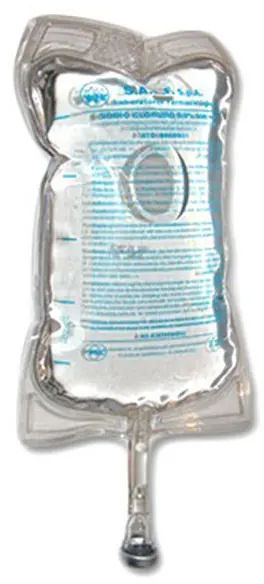
Solution for infusion in bag for fluid replenishment.
Sodium Chloride 0.9% is a drug used for the replenishment of fluids and sodium chloride.
Active ingredients
1000 ml contain: sodium chloride 9 g mEq/l: Na+ 154 mEq/l: Cl- 154
Theoretical osmolarity (mOsm/l): 308 pH: 4.5 - 7.0 1 g of NaCl = 394 mg of Na+ or 17.1 mEq or 17.1 mmol of Na+ and Cl- 1 mmol Na+ = 23 mg Na+
Excipients
Water for injections.
The medicinal product must be administered by intravenous infusion.
Treatment of isotonic fluid depletion (extracellular dehydration)
Adults and adolescents: 500 ml to 3 litres in 24 hours.
Neonatals and children (up to 12 years of age): 20 to 100 ml in 24 hours and per kg of body weight, depending on age and total body weight.
The dosage should be appropriately reduced in patients with renal insufficiency.
Treatment of sodium deficiency
The dose depends on age, weight, clinical conditions, electrolyte profile and osmolarity, and is related to the calculated sodium deficit.
In conditions of severe sodium depletion and in the treatment of severe symptoms related to chronic hyponatremia, administer hypertonic sodium chloride solutions to increase the plasma sodium concentration by 1-2 mmol/l/hour.
Make sure that the correction does not exceed 10-12 mmol/l in 24 hours and 18 mmol/l in 48 hours.
If sodium chloride solutions, and in particular 0.9% solutions, are used as diluents for the intravenous administration of drugs that must be diluted beforehand, check beforehand the compatibility of such drugs with sodium chloride and its highest concentration. suitable for administration in the RCP of the medicinal product to be diluted.
If the concentration is not indicated, use the 0.9% solution.
Sodium salts should be administered with caution in patients with hypertension, heart failure, peripheral or pulmonary edema, reduced renal function, pre-eclampsia, or other conditions associated with sodium retention.
Use with great caution in patients with congestive heart failure, severe renal insufficiency and in clinical conditions in which edema with salt retention exists; in patients treated with corticosteroids or corticotropins.
Continued administration without the addition of potassium may cause serious side effects. cause hypokalemia.
Use with caution in children.
During the infusion, it is good practice to monitor fluid balance, electrolytes, plasma osmolarity and acid-base balance.
The solution must be clear, colorless and free of visible particles.
Use immediately after opening the container.
The container is for a single, uninterrupted administration and any residue cannot be discarded. be used.
Hypernatremia.
Hydrosaline plethora.
The following are the undesirable effects of sodium chloride, organized according to the MedDRA system organ class.
There are insufficient data to establish the frequency of the individual effects listed.
Fluid and electrolyte balance disorders
Hypernatremia, hypervolemia, hyperchloremia (which may cause a loss of bicarbonates with consequent acidosis)
Nervous system disorders
Headache, dizziness, restlessness, fever, irritability, weakness, muscle stiffness, convulsions, coma, death
Psychiatric disorders
Drowsiness, confusional states
Respiratory, thoracic disorders and mediastinal disorders
Dyspnea, respiratory arrest.
Gastrointestinal disorders
Thirst, decreased salivation, nausea, vomiting, diarrhea, abdominal pain.
Cardiac disorders
Tachycardia.
Eye disorders
Decreased lacrimation.
Renal and urinary disorders
Renal failure.
Vascular disorders
Hypotension, hypertension, pulmonary and peripheral edema.
General disorders and administration site conditions
Infection at the infusion site, local pain or reaction, venous irritation, thrombosis or venous phlebitis extending from the infusion site, extravasation.
Symptoms
The administration of excessive doses of isotonic and hypertonic sodium chloride solutions can cause lead, depending on the patient's clinical conditions, to hypernatremia, hyperchloremia and/or hypervolemia.
Hypernatremia (mainly associated with the administration of hypertonic solutions) and excessive sodium retention where there is defective sodium excretion at the renal level cause dehydration of the internal organs, particularly the brain, and the accumulation of extracellular fluids with edema that can affect the cerebral, pulmonary and peripheral circulation with the appearance of pulmonary and peripheral edema.
The accumulation of chloride ions causes a reduction in the concentration of bicarbonate ions leading to acidosis.
Treatment
In case of accidental excessive infusion, treatment must be suspended and the patient must be kept under observation to evaluate the appearance of any signs and symptoms related to the drug administered, ensuring the patient receives the relevant symptomatic and supportive measures as needed.
In case of overdose, therapy must be aimed at restoring physiological sodium ion concentrations.
In these cases, intravenous administration of 5% glucose or hypotonic or isotonic sodium chloride solutions is recommended (as they are hypotonic for the hypernatremic patient).
In case of high natremia, loop diuretics can be used.
A natremia above 200 mmol/l may require the use of dialysis.
Although no effects on fetal development have been observed, the medicine should be administered only if really necessary and only after having evaluated the risk/benefit ratio with your doctor.
The medicine is compatible with breastfeeding.
Store in a tightly closed container.
Do not freeze or refrigerate. Refrigerate.
The solution must be clear, colorless and free from visible particles.
100 ml bag
This product has been on sale since 25/03/2021
In the last 30 days, the product's lowest price was 2,05 €

Estimated delivery: 1-3 business days

Estimated delivery: 1-3 business days

Estimated delivery: 1-3 business days

Estimated delivery: 1-3 business days

Estimated delivery: 1-3 business days

Estimated delivery: 1-3 business days

Estimated delivery: 1-3 business days