




- -26.56%

Recommended price

€15.86
Get free shipping with a minimum spend of 69,00 €. Or by purchasing one of the selected products. Discover them now!
 Richiedi info sul prodotto

Information on returns and shipments

Payment methods


Laxative tablets for the treatment of occasional constipation.
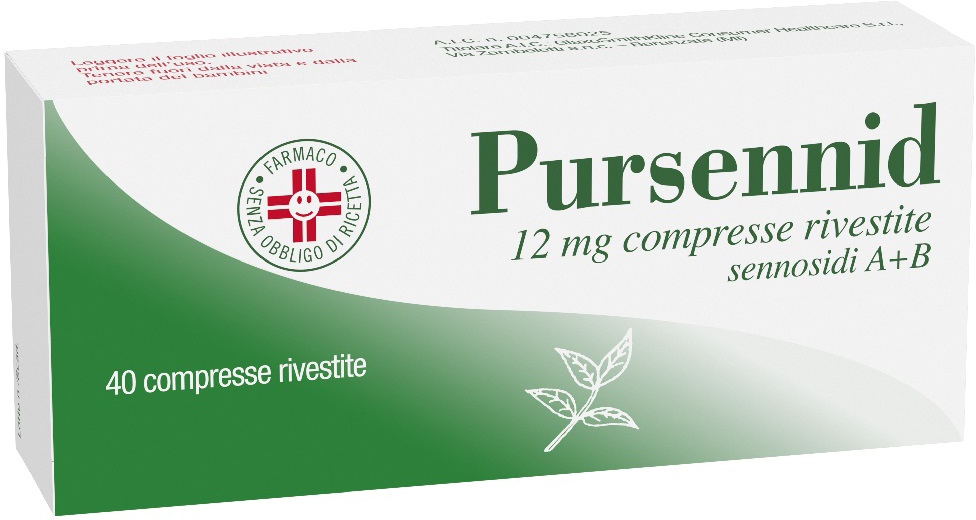
Pursennid 12 mg is a laxative tablet useful for the short-term treatment of occasional constipation.
Active ingredients
One coated tablet contains 12 mg of Sennosides A + B (as calcium salts).
Excipients
Lactose monohydrate; stearic acid; talc; corn starch; anhydrous glucose; sucrose; gum arabic; colloidal anhydrous silica; titanium dioxide, cetyl palmitate.
After a short period of treatment without noticeable results, consult your doctor.
The correct dose is the minimum sufficient to produce easy evacuation of soft stools.
It is advisable to initially use the minimum recommended doses.
When necessary, the dose can then be increased, but never exceed the maximum indicated.
Pediatric population:
Contraindicated in children under 10 years of age.
Method of administration:
Preferably take in the evening.
Pursennid's effect occurs after 6-12 hours.
If administered in the evening, the effect of Pursennid appears the following morning.
Laxatives should be used as infrequently as possible and for no more than seven days.
Use for longer periods requires a doctor's prescription after an appropriate evaluation of the individual case.
Swallow with an adequate amount of water (a large glass).
A diet rich in liquids promotes the effect of the medicine.
The established dose should not be exceeded.
Prolonged indiscriminate use of laxatives can lead to habituation and deterioration of intestinal function.
The lowest effective dosage for the restoration of normal intestinal function should be used.
If no improvement in the intestinal function has been achieved, the dosage may be increased. Increased under medical supervision.
Products containing senna and sennosides should be used only if a therapeutic effect cannot be achieved through dietary changes or the administration of bulking agents.
The use of these drugs requires medical supervision:
Information about excipients:
Hypersensitivity to the active substance or to any of the excipients.
Contraindicated in the following medical conditions:
Contraindicated in children under 10 years of age.
Concomitant use of other drugs that induce hypokalemia (e.g., diuretics, adrenocorticosteroids, and licorice) may increase electrolyte imbalance.
Side Effects
This medicine may cause mild abdominal discomfort such as abdominal pain, cramps, and irritation of the colon and gastric mucosa.
Other effects such as dehydration, hypotension, fatigue, myopathy, stomach pain, hyponatremia, renal disorders, secondary hyperaldosteronism, hypocalcemia, and hypomagnesemia have also been reported.
These adverse reactions are usually reversible once the laxative is discontinued.
Prolonged use or overdose of this medicine may cause nausea, diarrhea with excessive loss of electrolytes, especially potassium. (hypokalaemia).
There is also a possibility of developing megacolon.
During treatment, a yellow-brownish (pH-dependent) discoloration of the urine due to metabolites may occur, which has no clinical significance.
Habituation has been reported after prolonged treatment.
Adverse reactions are listed below by system organ class and frequency.
Frequencies are defined as: very common (≥ 1/10); common (≥ 1/100, <1/10); uncommon (≥ 1/1,000, <1/100); rare (≥ 1/10,000, <1/1,000); very rare (<1/10,000), or not known (frequency cannot be estimated from the available data).
Table 4-1 Undesirable effects from post-marketing experience
| Frequency of adverse event | Adverse event |
| Gastrointestinal disorders | |
| Not known | Megacolon |
| Abdominal pain | |
| Diarrhea | |
| Nausea | |
| Abdominal discomfort | |
| General disorders and administration site conditions | |
| Not known | Fatigue Drug tolerance |
| Musculoskeletal and connective tissue disorders | |
| Not known | Myopathy |
| Renal and urinary disorders | |
| Not known | Kidney problems |
| Not known | Chromaturia |
| Metabolism and nutrition disorders | |
| Not known | Hyperaldosteronism |
| Hypocalcaemia | |
| Hypomagnesemia | |
| Dehydration | |
| Hypokalaemia | |
| Hyponatraemia | |
| Decreased blood electrolytes | |
| Vascular disorders | |
| Not known | Hypotension |
The adverse events listed above are based on spontaneous post-marketing reports and represent a less precise estimate of the incidence that would be obtained in clinical trials.
Paediatric population: The same frequency, type, and severity of adverse events are expected in children as in adults.
Symptoms
The most important symptoms related to overdose/excessive use are abdominal colic and severe diarrhea resulting in fluid and electrolyte losses, which must be replaced.
Diarrhea in particular can cause potassium loss, which can lead to cardiac disorders and muscle weakness, particularly when cardiac glycosides, diuretics, adrenocorticosteroids, or licorice root should be administered concomitantly.
Management
Treatment should be supportive with generous amounts of fluids.
Electrolytes, especially potassium, should be monitored.
This is particularly important in the elderly.
Chronic overdose of anthraquinone-based drugs can cause toxic hepatitis.
Pregnancy
There are no reports of adverse effects or harm during pregnancy or on the fetus at the recommended dosage regimen.
However, following experimental data regarding the genotoxic risk of several anthraquinones, emodin, and aloe-emodin, use during pregnancy is not recommended.
Breastfeeding
Use during Breastfeeding is not recommended as there are insufficient data on the excretion of metabolites in breast milk.
Small amounts of metabolites (rhein) are excreted in breast milk.
No laxative effect on breast-fed infants has been reported.
Fertility
Preclinical studies with sennosides do not indicate any particular risks for fertility at therapeutically relevant doses.
40 coated tablets of 12 mg
This product has been on sale since 25/03/2021
In the last 30 days, the product's lowest price was 10,56 €
In base alla mia esperienza è un prodotto utilissimo, e l'acquisto tramite questo canale è decisamente più economico.
Prodotto eccellente e risolutivo per lo scopo per cui è stato formulato.
Molto utili
Ottimo prodotto
Veramente valido


