



- -23.47%

Recommended price

€22.19

 Richiedi info sul prodotto
Estimated delivery: 1-3 business days

Information on returns and shipments

Payment methods

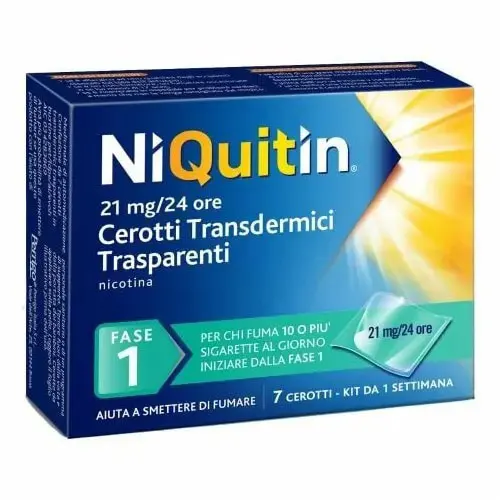
NiQuitin is indicated to relieve nicotine withdrawal symptoms, including cravings, as an aid to smoking cessation.
NiQuitin is indicated to relieve nicotine withdrawal symptoms, including cravings, as an aid to smoking cessation. If possible, when quitting smoking, NiQuitin should be used in conjunction with a behavioral support program.
NiQuitin clear transdermal patches are indicated for adults and adolescents aged 12 years and over.
NiQuitin clear transdermal patches may be used in children and adolescents aged 12 years and over. be used in combination with oral forms of nicotine (NiQuitin mini lozenges/NiQuitinmint) in smokers who have relapsed after nicotine replacement therapy (NRT), or when NRT monotherapy is not sufficient to control the craving, or as the treatment of choice in smokers with a strong dependence, such as those who smoke 10 or more cigarettes a day.
Adolescents should not discontinue the NRT combination regimen.
NiQuitin is a transdermal delivery system, available in 22 cm² transparent patches, containing 114 mg of nicotine, equivalent to 5.1 mg/cm² of nicotine and releasing 21 mg of nicotine in 24 hours.
Active substance depot: ethylene vinyl acetate copolymer. Backing: polyethylene terephthalate/ethylene vinyl acetate. Permeable membrane: polyethylene film. Adhesive layer and protective liner: polyisobutylene adhesive laminate. Printing ink: 3015Z-009L White Ink.
Adults (18 years and over):
The patches should be used as follows. Before starting therapy, subjects who are candidates for transdermal nicotine must wish to stop smoking. When attempting to quit, every effort should be made not to smoke while taking NiQuitin.
It is recommended that NiQuitin be used in conjunction with behavioral therapy, as this has been shown to be beneficial as part of smoking cessation therapy.
In some cases (for example, in heavy smokers or those who have relapsed after NRT, or when NRT is not sufficient to control the urge to smoke), it may be helpful to use more than one form of NiQuitin at the same time. For example, smokers who have difficulty controlling the urge to smoke when using the patch alone can use NiQuitin/NiQuitinmint mini lozenges to counteract the sudden urge to smoke.
NiQuitin clear transdermal patches can be used alone or in combination with NiQuitin mini lozenges/NiQuitinmint (see the combination therapy dosage detailed below).
NiQuitin should be applied once daily, at the same time and preferably upon waking, and left in place for 24 hours continuously.
NiQuitin therapy normally starts with the application of one 21 mg/24 hour patch and is then tapered according to the following treatment schedule:
NiQuitin clear transdermal patches treatment schedule:
Moderate smokers (smoking less than 10 cigarettes per day) are recommended to start therapy with the second phase (14 mg) for 6 weeks and taper to the 7 mg/24 hour patch for the final 2 weeks.
People using NiQuitin 21 mg/24 hours who experience excessive side effects that do not resolve within a few days should switch to the 14 mg/24 hour patch. This dosage should be maintained for the remaining 6 weeks before switching to NiQuitin 7 mg/24 hours for 2 weeks. If symptoms persist, seek advice from your healthcare professional.
For optimal results, treatment should be completed over 10 weeks (8 weeks for moderate smokers or those who have reduced their dosage as above).
Treatment with NiQuitin can be extended beyond 10 weeks if necessary to maintain abstinence; however, anyone using the patches for more than 9 months should consult their healthcare professional.
People who continue or start smoking again can undergo further courses of treatment with NiQuitin.
Combination therapy: Treatment with NiQuitin clear transdermal patches in combination with NiQuitin mini lozenges/NiQuitinmint:
Smokers can combine transdermal patches and oral forms of nicotine. The combination of transdermal patches and oral nicotine forms provides better efficacy than using transdermal patches alone.
Treatment should begin by determining the dose of the patch, according to the same rules as for monotherapy (see below), in combination with a dose of oral nicotine.
The recommended daily intake of oral preparations, when combined with patches, is around 5-6 pieces. When used in combination, the maximum daily dose for the 4 mg oral forms is 10 pieces and for the 1.5 mg/2 mg oral forms it remains 15 pieces. If an extension is required, consult your healthcare professional.
Due to the lack of data, adolescents should not discontinue combination NRT therapy.
NiQuitin is contraindicated in children under 12 years.
Method of administration:
A new, clear NiQuitin transdermal patch should be applied to a clean, dry, hairless area of skin. The patch should be applied immediately after removing the protective sachet. The patch should be kept sealed in its protective sachet until use.
The patch should be pressed firmly onto the skin with the palm of the hand for 10 seconds. Areas where there are skin folds should be avoided. Avoid application to broken, inflamed, or irritated skin.
After 24 hours, the used patch should be removed and a new patch applied to a different area of skin. The patch should not be left on for more than 24 hours. 24 hours. You can reuse the same skin area after at least 7 days.
Use only one patch at a time.
The patches can be removed before bed if desired. However, we recommend using them for 24 hours continuously to optimize the effect against morning cravings.
Particular care must be taken when using the patch to avoid contact with the eyes and nose.
Wash your hands after application with water only, as soap can irritate the skin. increase nicotine absorption.
The well-established dangers of smoking outweigh the risks associated with the use of NRT in virtually all circumstances.
Special precautions:
Special warnings and precautions for the use of combination therapy with NiQuitin transparent transdermal patches and oral forms of NiQuitin/NiQuitinmint: These are the same for each individual treatment (see the SmPCs for each oral preparation used in combination). Combination NRT therapy should not be used in subjects with known cardiovascular disease without a risk/benefit assessment by a healthcare professional.
No clinically relevant interactions between nicotine replacement therapy and other drugs have been demonstrated, however, nicotine may enhance the haemodynamic effect of adenosine. Healthcare professionals are reminded that quitting smoking itself may be harmful. require the adjustment of some pharmacological therapies.
Hypersensitivity to the active substance or to any of the excipients.
NiQuitin should not be used:
Adverse reactions are listed below by system organ class and frequency. Frequencies are defined as: very common (>1/10), common (>1/100 to <1/10), uncommon (>1/1,000 to <1/100), rare (>1/10,000 to <1/1,000), very rare (<1/10,000), not known (frequency cannot be estimated from the available data).
The most frequent side effects associated with the use of NiQuitin are skin reactions at the application site. NiQuitin may It may also cause other side effects related to the pharmacological actions of nicotine or the effects of smoking withdrawal.
Some of the reported symptoms, such as depression, irritability, nervousness, agitation, mood swings, anxiety, drowsiness, difficulty concentrating, insomnia, and sleep disturbances, may be related to smoking withdrawal. People who stop smoking by any method may develop asthenia, headache, dizziness, cough or flu-like symptoms.
The side effects listed below have been reported in clinical trials or spontaneously during the post-marketing experience.
Immune system disorders
Psychiatric disorders
Nervous system disorders
Cardiac disorders
Respiratory, thoracic and mediastinal disorders
Gastrointestinal disorders
Skin and subcutaneous tissue disorders
Musculoskeletal and connective tissue disorders
General disorders and administration site conditions
In case of a clinically significant increase in cardiovascular or other effects attributable to nicotine, the dosage of NiQuitin should be reduced or its application discontinued.
Paediatric population (12 to 17 years of age): There are no specific data on adverse events for this population. However, the frequency, type and severity of adverse reactions in adolescents are expected to be the same as in adults, based on a pharmacokinetic study that demonstrated a similar pharmacokinetic profile in the adolescent age group compared to adults.
Reporting of suspected adverse reactions: Reporting suspected adverse reactions after authorisation of the medicinal product 1 is important, as it allows continued monitoring of the benefit/risk balance of the medicinal product. Healthcare professionals 2 are asked to report any suspected adverse reactions via the national reporting system 3 .
¹ Most local reactions are mild and resolve rapidly after removal of the patch. Pain or a sensation of heaviness in the limb or at the area where the patch was applied (e.g. chest) may occur.
² Observe in patients taking anticonvulsant therapy or with a history of epilepsy.
Pregnancy:
Breastfeeding:
Fertility:
Pack of 7 patches
This product has been on sale since 18/03/2025
In the last 30 days, the product's lowest price was 33,87 €

Estimated delivery: 1-3 business days

Estimated delivery: 1-3 business days

Estimated delivery: 1-3 business days


