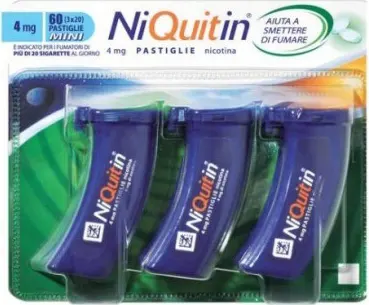
Lozenges to reduce nicotine withdrawal symptoms.
Indications
NiQuitin Mini is indicated in the treatment of tobacco dependence to reduce nicotine withdrawal symptoms, including cravings, during a quit attempt. Permanent cessation of tobacco use is the ultimate goal. NiQuitin Mini should preferably be used in conjunction with a behavioral support program.
Ingredients
Active ingredients per lozenge: nicotine 4 mg (as nicotine resinate).
Excipients:Mannitol (E421) Sodium alginate Xanthan gum Potassium bicarbonate Calcium polycarbophil Sodium carbonate anhydrous Potassium acesulfame Taste-masking flavor 031431 Peppermint flavor 022173 Menthol flavor 020184 Magnesium stearate.
Directions for use and Dosage
The dosage of the lozenge to be taken depends on the smoking habits of each individual. NiQuitin Mini 4 mg is suitable for smokers who smoke more than 20 cigarettes a day. Place one lozenge in your mouth and allow it to dissolve. Move it around your mouth occasionally until it dissolves completely (about 10 minutes). Do not chew or swallow the lozenge whole. Do not eat or drink while holding it in your mouth. Supportive behavioral therapy generally improves success rates.
Adults:Smokers using NiQuitin Mini should make every effort to stop smoking completely during treatment. Take one lozenge whenever you feel a strong urge to smoke. Use a sufficient number of lozenges each day, usually 8-12, up to a maximum of 15. Continue using the lozenges for up to 6 weeks to break the habit, then gradually reduce their use. When daily consumption is 1-2 lozenges, treatment should be discontinued. To help you stay smoke-free after treatment, you can take one lozenge in situations where you are strongly tempted to smoke. Anyone taking lozenges for more than 9 months is advised to seek further advice and help from a doctor or pharmacist.
Children and adolescents: NiQuitin Mini can be used by adolescents (aged 12 to 17 years inclusive) only under medical supervision. NiQuitin Mini is not recommended for children under 12 years due to a lack of data on safety and efficacy.
Warnings
The risks associated with the use of nicotine replacement therapy (NRT) are far outweighed by the well-known dangers of continued smoking. Patients who are smokers, have had a recent myocardial infarction, unstable or worsening angina, including Prinzmetal's angina, serious cardiac arrhythmias, uncontrolled hypertension, or a recent cerebrovascular event should be encouraged to stop smoking immediately using non-pharmacological interventions (such as psychological support). If this approach fails, the use of NiQuitin Mini may be considered, but, as safety data in this patient group are limited, initiation of therapy should only occur under close medical supervision. Diabetes mellitus: Patients with diabetes mellitus should be advised to monitor their blood glucose levels more frequently than usual after initiating NRT, as the catecholamines released by nicotine can interfere with carbohydrate metabolism. Allergic reactions: Susceptibility to angioedema and urticaria. For patients with the following conditions, the risk-benefit assessment should be performed by a specialist: Renal and hepatic impairment: Use with caution in patients with moderate to severe hepatic impairment and/or severe renal impairment, as the clearance of nicotine and its metabolites may be decreased, potentially increasing adverse effects. Pheochromocytoma and uncontrolled hyperthyroidism: Use with caution in patients with uncontrolled hyperthyroidism and pheochromocytoma, as nicotine causes the release of catecholamines. Gastrointestinal disorders: Nicotine ingestion may exacerbate symptoms in patients with esophagitis and gastric or peptic ulcers, so oral NRT preparations should be used with caution in these patients. Ulcerative stomatitis has also been reported. Danger to young children: Amounts of nicotine tolerated by adult and adolescent smokers can cause serious toxicity in young children, possibly resulting in death. Nicotine-containing products should be kept out of the reach of children to prevent misuse, handling, or ingestion. Quitting smoking: Polycyclic aromatic hydrocarbons in tobacco smoke induce drug metabolism catalyzed by CYP 1A2 (and possibly CYP 1A1). Quitting smoking can therefore slow this metabolism, resulting in increased plasma levels of these drugs. NRT dependence: NRT dependence is rare and, at the same time, less harmful and easier to break than that caused by smoking. During a smoking cessation attempt, the consumer should not alternate NiQuitin Mini with nicotine gum, as pharmacokinetic data indicate greater nicotine availability with NiQuitin Mini compared to gum.
For further information, read the package leaflet carefully.
Pregnancy and Breastfeeding
Smoking during pregnancy is associated with risks such as intrauterine growth retardation, premature birth, or stillbirth. Quitting smoking is the single most effective intervention to improve the health of both the mother who smokes and her baby. The earlier abstinence is achieved, the better. Ideally, it would be possible to quit smoking during pregnancy without the aid of NRT. However, for women who are unable to quit on their own, the doctor may recommend using NRT to support their attempt to quit smoking. The risk to the fetus associated with NRT use is lower than that associated with tobacco smoking, thanks to a lower maximum plasma nicotine concentration and the absence of exposure to polycyclic hydrocarbons and carbon monoxide. However, since nicotine passes to the fetus, altering respiratory movements and having a dose-dependent effect on the fetoplacental circulation, the decision to use NRT should be made as early as possible during pregnancy. The goal should be to use NRT for only 2–3 months. Products that release nicotine intermittently are preferable as they generally provide a lower daily dose of nicotine than patches. However, the latter are recommended for women who experience nausea during pregnancy.
Nicotine from smoking and NRT is found in breast milk. However, the concentration of nicotine to which the baby is exposed with NRT is relatively low and less harmful than the secondhand smoke to which the baby would otherwise be exposed. During breastfeeding, it is ideal to be able to quit smoking without the aid of NRT. However, for women who are unable to quit on their own, the doctor may recommend using NRT as an aid in an attempt to quit smoking. The use of NRT preparations that release nicotine intermittently, compared to patches, may minimize the concentration of nicotine in breast milk since the time between NRT administration and breastfeeding can be more easily prolonged. Women should try to breastfeed immediately before taking NRT.
Storage
Do not store above 30°C. Store in the original packaging to protect from moisture.
Format
60 4 mg tablets.
Product Code:FRCM121413




 Richiedi info sul prodotto