



- -23.47%

Recommended price

€22.19

 Richiedi info sul prodotto

Information on returns and shipments

Payment methods

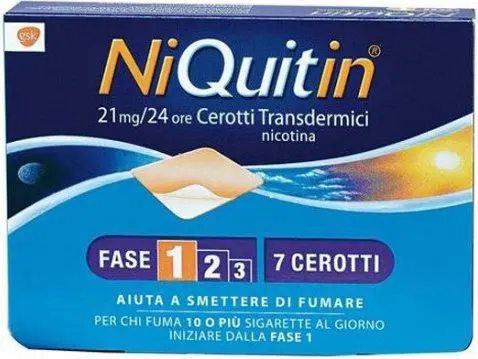
Each 22 cm² transdermal patch contains 114 mg of nicotine, equivalent to 5.1 mg/cm² of nicotine and releases 21 mg of nicotine per 24 hours. For the full list of excipients, see section 6.1.
Active substance depot: ethylene vinyl acetate copolymer. Backing: polyethylene/aluminum/polyethylene terephthalate/ethylene vinyl acetate. Permeable membrane: polyethylene film. Adhesive layer and protective liner: polyisobutylene adhesive laminate. Printing ink: FGN-7214 NT20 Brown ink 465.
NiQuitin is indicated to relieve nicotine withdrawal symptoms, including craving, as an aid to smoking cessation. If possible, when quitting smoking, NiQuitin should be used in conjunction with a behavioral support program. NiQuitin transdermal patches are indicated in adults and adolescents aged 12 years and over.
Hypersensitivity to the active substance or to any of the excipients listed in section 6.1. NiQuitin should not be used by: • children under 12 years; • occasional smokers; • non-smokers.
Dosage Adults (18 years and over) The patches should be used as follows. Candidates for transdermal nicotine should be willing to quit smoking before starting therapy. During a quit attempt, every effort should be made not to smoke while taking NiQuitin. It is recommended that NiQuitin be used in conjunction with behavioral therapy, as this has been shown to be beneficial as part of smoking cessation therapy. NiQuitin should be applied once daily, at the same time, preferably upon waking, and left in place for 24 hours. NiQuitin therapy usually begins with one 21 mg/24-hour patch and is then tapered according to the following treatment schedule:
| Dosage | Duration | |
| first phase: | NiQuitin 21 mg/24 hours | for the first 6 weeks |
| second phase: | NiQuitin 14 mg/24 hours | for the following 2 weeks |
| third phase: | NiQuitin 7 mg/24 hours | for the last 2 weeks |
Moderate smokers (smoking less than 10 cigarettes a day) are recommended to start therapy with the second phase (14 mg) for 6 weeks and taper the dose using the 7 mg/24 hour patch for the final 2 weeks. People using NiQuitin 21 mg/24 hours who experience excessive side effects that do not resolve within a few days should switch to the 14 mg/24 hour patch. This dosage should be maintained for the remaining 6 weeks before switching to NiQuitin 7 mg/24 hours for 2 weeks. If symptoms persist, seek medical advice. For optimal results, treatment should be completed over 10 weeks (8 weeks for moderate smokers or those who have reduced their dosage as above). Treatment with NiQuitin can be extended beyond 10 weeks if necessary to maintain abstinence, however, those using the patches for more than 9 months should consult their healthcare professional. Individuals who continue or start smoking may undergo further treatment with NiQuitin.
Paediatric population
Adolescents (12 to 17 years) should follow the adult treatment schedule above for phases 1, 2, and 3, but as data are limited, the duration of NRT for this age group should not exceed 12 weeks. If an extension is required, consult your healthcare professional. NiQuitin is contraindicated in children under 12 years of age.
Method of administration
NiQuitin transdermal patches should be applied to a clean, dry, hairless area of skin. The patch should be applied immediately after removing the protective sachet. Avoid application to broken, inflamed, or irritated skin. After 24 hours, the used patch should be removed and a new patch applied to a different area of skin. The patch should not be left on for more than 24 hours. The same area of skin can be reused after at least 7 days. Use only one patch at a time. Patches can be removed before bed if desired. However, continuous use for 24 hours is recommended to optimize the effect against morning cravings. Particular care must be taken when using the patch to avoid contact with the eyes or nose. Wash your hands with water only after application as this may cause irritation. Soap may increase nicotine absorption.
Store below 30°C.Warnings: The well-established dangers of smoking outweigh the risks associated with NRT in virtually all circumstances. Patients hospitalized for myocardial infarction, severe arrhythmia, or cardiovascular disorders, who are considered haemodynamically unstable, should be encouraged to stop smoking using non-pharmacological interventions. If this is not possible, NiQuitin may be used, but as safety data are limited for this patient group, initiation of therapy should only occur under medical supervision. Once discharged from hospital, patients can use NRT as normal. If a clinically significant increase in cardiovascular or other effects attributable to nicotine occurs, the dosage of nicotine patches should be reduced or their use discontinued. Diabetes: Blood glucose levels may be more variable when smoking cessation is observed, with or without NRT, since the release of catecholamines due to nicotine can interfere with carbohydrate metabolism, so it is important for patients with diabetes to monitor their blood glucose levels more closely than usual when using this drug. Allergic reactions: Susceptibility to angioedema and urticaria. Atopic or eczematous dermatitis (due to local sensitization caused by the patch): In case of severe or persistent local reactions at the application site (e.g. severe erythema, pruritus, or swelling) or generalized skin reaction (e.g. urticaria or generalized skin rash), patients should be advised to discontinue therapy with NiQuitin and inform their doctor. Contact sensitization: Individuals with contact sensitization should be advised that serious reactions may occur following the use of other nicotine-containing products or smoking. The risk-benefit assessment should be made by a specialist for patients with the following conditions:
• Renal and hepatic impairment: Use with caution in patients with moderate to severe hepatic impairment and/or severe renal impairment as the clearance of nicotine or its metabolites may be impaired. be decreased with a potential increase in adverse effects.
• Pheochromocytoma and uncontrolled hyperthyroidism: Use with caution in patients with uncontrolled hyperthyroidism or pheochromocytoma as nicotine causes the release of catecholamines. Danger for young children: The amount of nicotine tolerated by adult smokers and adolescents can cause serious toxicity in young children with possible fatal outcome. Nicotine-containing products should be kept out of the reach of children to prevent misuse or ingestion.
Patches should be folded in half with the adhesive side facing inward and carefully discarded. Smoking cessation: Polycyclic aromatic hydrocarbons in tobacco smoke induce drug metabolism catalyzed by CYP 1A2 (and possibly CYP 1A1). Stopping smoking may improve the safety of smoking. cause a slowing of metabolism with consequent increase in plasma levels of these drugs.NRT dependence: dependence on nicotine replacement therapy is rare and at the same time less harmful and easier to break than that caused by smoking. Safety in handling: NiQuitin is a potential skin irritant and can cause contact sensitization.InteractionsNo clinically relevant interactions between nicotine replacement therapy and other drugs have been demonstrated, however, nicotine may increase the haemodynamic effect of adenosine. Healthcare professionals are reminded that quitting smoking itself may require adjustment of some pharmacological therapies.Undesirable effectsAdverse reactions are listed below by system organ class and frequency. Frequencies are defined as: very common (>1/10), common (> 1/100 to <1/10), uncommon (1/1000 to <1/100), rare (1/1000 to <1/1000), very rare (<1/10,000), not known (cannot be estimated from the available data). The most frequent adverse reactions associated with the use of NiQuitin are application site reactions. Other adverse events may occur and may be related to the pharmacological effects of nicotine or the effects of smoking withdrawal (see Pharmacodynamic properties). Some of the reported symptoms, such as depression, irritability, nervousness, agitation, mood swings, anxiety, drowsiness, difficulty concentrating, insomnia, and sleep disturbances, may be related to withdrawal symptoms associated with smoking cessation. People who quit smoking by any means may experience fatigue, headache, dizziness, cough, or flu-like symptoms. The undesirable effects listed below have been reported in clinical studies and/or spontaneously during post-marketing experience.
| System Organ Class and Frequency | Adverse Reaction / Event |
| Immune system disorders | |
| uncommon | hypersensitivity* |
| very rare | anaphylactic reactions |
| Psychiatric disorders | |
| very common | sleep disorders, including abnormal dreams and insomnia |
| common | nervousness |
| Nervous system disorders | |
| very common | headache, dizziness |
| common | tremor |
| Cardiac disorders | |
| common | palpitations |
| uncommon | tachycardia |
| Respiratory, thoracic and mediastinal disorders common | dyspnoea, pharyngitis, cough |
| Gastrointestinal disorders | |
| very common | nausea, vomiting |
| common | dyspepsia, abdominal pain upper, diarrhoea, dry mouth, constipation |
| Skin and subcutaneous tissue disorders | |
| common | increased sweating |
| very rare | allergic dermatitis*, contact dermatitis*, photosensitivity |
| Musculoskeletal and connective tissue disorders | |
| common | arthralgia, myalgia |
| General disorders and administration site conditions | |
| very common | application site reactions* |
| common | chest pain*, pain in limb*, pain, asthenia, fatigue/malaise |
| uncommon | flu-like illness |
* The majority of these local reactions are mild and resolve rapidly after removal of the patch. Pain or a feeling of heaviness in the limb or at the site of application of the patch (e.g. chest) may occur. If a clinically significant increase in cardiovascular or other effects attributable to nicotine occurs, the dosage of NiQuitin should be reduced or its use discontinued. Paediatric population (12 to 17 years of age) There are no specific data on adverse events for this population. However, the frequency, type, and severity of adverse reactions in adolescents are expected to be the same as in adults, based on a pharmacokinetic study that demonstrated a similar pharmacokinetic profile in the adolescent group compared to adults.
The minimum lethal dose of nicotine in a man who has not developed tolerance has been estimated to be between 40 and 60 mg. In children, even small amounts of nicotine can be dangerous and can prove fatal. Suspected nicotine poisoning in a child should be considered a medical emergency and treated immediately. Symptoms Signs and symptoms of a nicotine patch overdose are expected to be the same as those of acute nicotine poisoning, including pallor, cold sweats, salivation, nausea, vomiting, abdominal pain, diarrhea, headache, dizziness, hearing and vision disturbances, tremor, confusion, and weakness. Fatigue, hypotension, respiratory failure, rapid, weak, or irregular pulse, circulatory collapse, and seizures (including terminal seizures) may occur with large overdoses. Treatment Overdose by Topical Exposure Immediately remove the transdermal patch(es) in the event of an overdose or if the patient shows signs of overdose. The user should seek medical attention immediately. The affected skin area should be washed with water and dried. Avoid using soap, which can increase nicotine absorption. After removing the patch, nicotine will continue to be released into the bloodstream for several hours as it deposits in the skin. Overdose due to topical exposure Any type of nicotine intake must be stopped immediately. The patient should seek immediate medical attention and be treated symptomatically. If necessary, artificial respiration with oxygen should be performed. Activated charcoal reduces the gastrointestinal absorption of nicotine. Pregnancy and breastfeeding
Pregnancy Smoking during pregnancy is associated with risks such as intrauterine growth retardation, premature birth, or stillbirth. Quitting smoking is the only truly effective intervention to improve both the health of the smoking mother and her baby. The sooner abstinence is achieved, the better. Ideally, it would be possible to quit smoking during pregnancy without the aid of NRT. However, women who are unable to quit on their own may be recommended by their healthcare provider to use NRT to help them quit. The risk associated with NRT use for the fetus is lower than that associated with tobacco smoking, thanks to a lower maximum plasma nicotine concentration and the absence of exposure to polycyclic hydrocarbons and carbon monoxide. However, since nicotine passes to the fetus by altering respiratory movements and has a dose-dependent effect on the placenta/fetus circulation, the decision to use NRT should be made as early as possible during pregnancy. The goal is to use NRT for only 2–3 months. Products that deliver nicotine intermittently are preferable as they generally provide a lower daily dose of nicotine than patches. However, the latter are recommended for women who experience nausea during pregnancy. If patches are used, they should be removed before going to bed.
Breastfeeding Nicotine from smoking and NRT is found in breast milk. However, the concentration of nicotine in the infant following exposure to NRT is relatively low and less harmful than the passive smoking to which the infant would otherwise be exposed. The use of discontinuous-dose NRT preparations, compared to patches, may minimize the concentration of nicotine in breast milk since the time between NRT administration and breastfeeding can be more easily prolonged.
Fertility There are no relevant data available.
This product has been on sale since 25/09/2017
In the last 30 days, the product's lowest price was 40,12 €
I cerotti funzionano egregiamente bene. Da mettere e tenere h24, prima di sostituirlo col successivo. Servono a eliminare al 99% le crisi di astinenza. Ovvio poi ci vuole anche forza di volontà e una certa determinazione. Bisogna inoltre diminuire il la dose lungo le 8/10 settimane di applicazione. Banalmente lo si può fare tagliando i cerotti a due terzi, conservando il terzo rimanente richiudendolo nella busta con un pezzo di nastro. Una scatola la si può usare come fossero due insomma. Intero, due terzi un terzo, cerotto diviso a metà. Quasi si tolgono del tutto. Tenere fede al proposito. Tanto le crisi fisiche non ci saranno più. Saluti. Ottimo venditore.
Ottimo venditore arrivati nel tempo previsto

Estimated delivery: 1-3 business days

Estimated delivery: 1-3 business days

Estimated delivery: 1-3 business days


