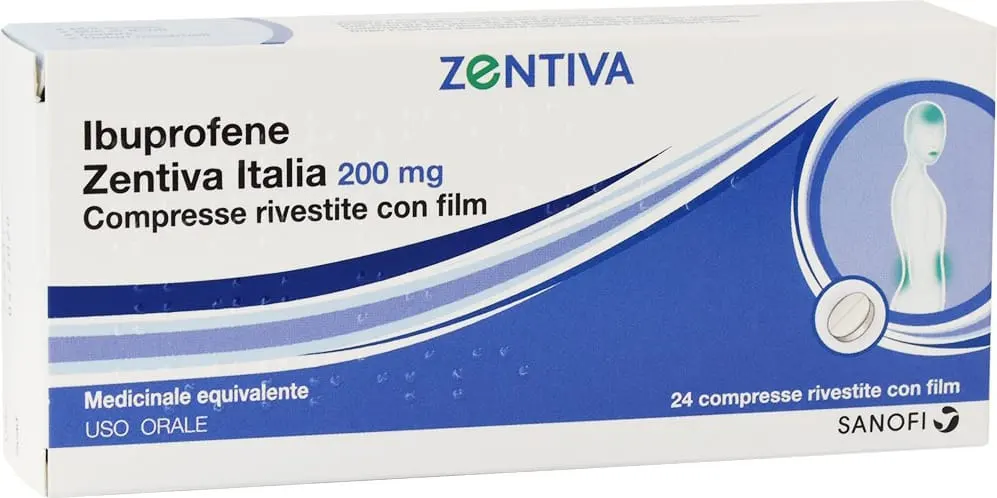
In case of headache and toothache.
Indications
Ibuprofene Zentiva Italia 200Mg is indicated in case of mild to moderate pain, such as headache, including migraine headache, toothache. Primary dysmenorrhea. Fever.
Composition
Active ingredients
Each film-coated tablet contains 200 mg of ibuprofen. For the full list of excipients, see section 6.1.
Excipients
Tablet core Microcrystalline cellulose Colloidal anhydrous silica Hydroxypropylcellulose Sodium laurilsulfate Croscarmellose sodium Talc Film-coating [Opadry (white) 06B28499] Hypromellose Macrogol 400 Titanium dioxide (E171).
How to use and Posology
Undesirable effects may be minimised by using the lowest effective dose for the shortest duration necessary to control symptoms (see section 4.4). This medicine is only indicated for short-term treatment, not exceeding 7 days. If symptoms persist or worsen, consult your doctor. The dose of ibuprofen depends on the age and body weight of the patient. Swallow the tablet with a glass of water during or after meals. Fever and mild to moderate pain Adults and adolescents over 12 years of age (>40 kg): 200–400 mg administered as a single dose or 3–4 times a day at intervals of 4–6 hours. The dosage for migraine headache is: 400 mg administered as a single dose, if necessary 400 mg at intervals of 4–6 hours. The maximum daily dose should not exceed 1200 mg.Children aged 6–12 years (>20 kg): Children aged 6–9 years (20–29 kg): 200 mg 1–3 times daily at intervals of 4–6 hours, as needed. The maximum daily dose should not exceed 600 mg. Children aged 10–12 years (30–40 kg): 200 mg 1–4 times daily at intervals of 4–6 hours, as needed. The maximum daily dose should not exceed 800 mg.Primary dysmenorrheaAdults and adolescents over 12 years of age: 200–400 mg 1–3 times a day at intervals of 4–6 hours, as needed. The maximum daily dose should not exceed 1200 mg.Children and AdolescentsIf the use of the medicine is necessary for more than 3 days in children and adolescents, or in case of worsening of symptoms, a doctor must be consulted.ElderlyNSAIDs should be used with particular caution in elderly patients who are more susceptible to developing dysmenorrhea. subject to adverse events and are at increased risk of life-threatening gastrointestinal bleeding, ulceration, or perforation (see section 4.4). If treatment is considered necessary, the lowest dose should be administered for the shortest duration necessary to control symptoms. Treatment should be re-evaluated at regular intervals and discontinued if no benefit is observed or if intolerance develops. Renal impairmentIn patients with mild to moderate reduction in renal function, the dose should be kept at the lowest possible level for the shortest duration necessary to control symptoms; renal function should be monitored. (For patients with severe renal impairment, see section 4.3). Hepatic impairmentIn patients with mild to moderate reduction in liver function, the dose should be kept at the lowest possible level for the shortest duration necessary to control symptoms; renal function should be monitored. short-term doses necessary to control symptoms; liver function should be monitored. (For patients with severe hepatic impairment, see section 4.3).
Warnings
Read the package leaflet carefully before starting treatment.
Contraindications and undesirable effects
Ibuprofene Zentiva Italia 200 mg is contraindicated in patients with: – hypersensitivity to the active substance or to any of the excipients of Ibuprofene Zentiva Italia 200 mg. – previous hypersensitivity reactions (e.g. asthma, rhinitis, urticaria or angioedema) in response to acetylsalicylic acid or other NSAIDs – history of gastrointestinal bleeding or perforation, related to previous NSAID therapy ... active peptic ulcer/haemorrhage or history of recurrent peptic ulcer (two or more distinct proven episodes of ulceration or bleeding) - severe hepatic or renal insufficiency - severe heart failure (NYHA class IV) - coronary artery disease - last trimester of pregnancy (see section 4.6) - significant dehydration (caused by vomiting, diarrhoea or insufficient fluid intake) - cerebrovascular or other active bleeding - dyshematopoiesis of unknown origin - children under 6 years of age.
Overdose
Toxicity Signs and symptoms of toxicity have generally not been observed at doses below 100 mg/kg in children or adults. However, supportive treatment may be necessary in some cases. Children have been observed to exhibit signs and symptoms of toxicity after ingestion of ibuprofen at doses of 400 mg/kg or greater. Symptoms Most patients who have ingested significant amounts of ibuprofen will experience symptoms within 4–6 hours. The most commonly reported symptoms of overdose include nausea, vomiting, abdominal pain, lethargy, and drowsiness. Central nervous system (CNS) effects include headache, tinnitus, dizziness, convulsions, and loss of consciousness. Nystagmus, metabolic acidosis, hypothermia, renal effects, gastrointestinal bleeding, coma, apnea, diarrhea, and CNS and respiratory depression have also been reported rarely. Disorientation, excitation, fainting, and cardiovascular toxicity including hypotension, bradycardia, and tachycardia have been reported. Renal failure and liver damage are possible in cases of significant overdose. Treatment There is no specific antidote for ibuprofen overdose. Therefore, symptomatic and supportive treatment is indicated in cases of overdose. Particular attention should be paid to monitoring blood pressure, acid-base balance, and any gastrointestinal bleeding. Administration of activated charcoal should be considered within one hour of ingestion of a potentially toxic amount. Alternatively, gastric lavage should be considered in adults within one hour of ingestion of a potentially life-threatening overdose. Adequate diuresis should be ensured, and renal and hepatic function should be closely monitored. The patient should remain under observation for at least four hours following ingestion of a potentially toxic amount. Frequent or prolonged convulsions should be treated with intravenous diazepam. Other supportive measures may be necessary depending on the patient's clinical condition. For further information, contact your local poison control center.
Pregnancy and breastfeeding
Inhibition of prostaglandin synthesis may adversely affect pregnancy and/or embryo-fetal development. Data from epidemiological studies suggest an increased risk of spontaneous abortion, cardiac malformation, and gastroschisis after use of a prostaglandin synthesis inhibitor in early pregnancy. The absolute risk of cardiovascular malformation was increased from less than 1% to approximately 1.5%. The risk is believed to increase with dose and duration of therapy. In animals, administration of a prostaglandin synthesis inhibitor has been shown to result in increased pre- and post-implantation loss and embryo-fetal mortality. Additionally, increased incidences of various malformations, including cardiovascular, have been reported in animals treated with a prostaglandin synthesis inhibitor during the organogenetic period. During the first and second trimesters of pregnancy, Ibuprofene Zentiva Italia 200 mg should not be administered unless clearly necessary. If Ibuprofene Zentiva Italia 200 mg is taken by a woman attempting to conceive or during the first and second trimesters of pregnancy, the dose and duration of treatment should be kept as low as possible. During the third trimester of pregnancy, all prostaglandin synthesis inhibitors may expose the fetus to: – cardiopulmonary toxicity (with premature closure of the ductus arteriosus and pulmonary hypertension); – renal dysfunction, which may progress to renal failure with oligohydramnios; the mother and newborn, at the end of pregnancy, to: – possible prolongation of bleeding time, an antiaggregant effect which may occur even at very low doses; – inhibition of uterine contractions resulting in a delay or prolongation of labor. Consequently, Ibuprofene Zentiva Italia 200 mg is contraindicated during the last trimester of pregnancy. Breastfeeding Ibuprofen is excreted in breast milk, but at therapeutic doses for short-term treatment, the risk of effects on the infant appears to be unlikely. If, however, prolonged treatment is prescribed, the possibility of early weaning should be considered. Fertility There is some evidence that medicinal products that inhibit cyclooxygenase/prostaglandin synthesis may cause impairment of female fertility by an effect on ovulation. This effect is reversible upon discontinuation of treatment.
Format
20 Restrictive Film-Coated Tablets
Product Code:FRCM108995





 Richiedi info sul prodotto