



- -41.54%

Recommended price

€8.77

 Richiedi info sul prodotto
Estimated delivery: 2-5 working days

Information on returns and shipments

Payment methods

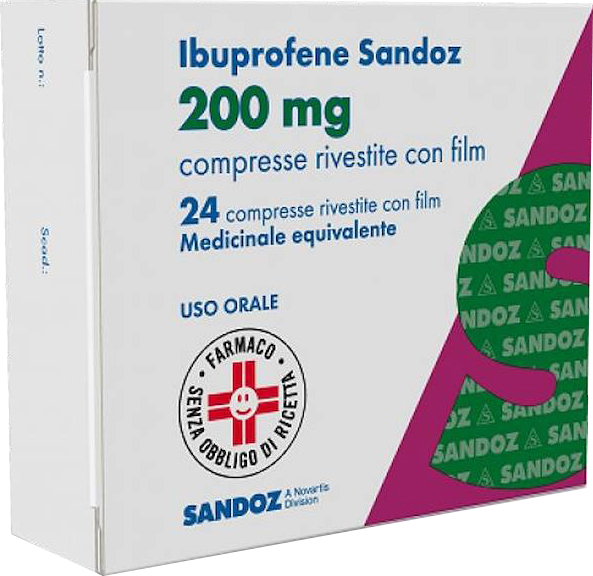
Anti-inflammatory drug based on ibuprofen useful for alleviating pain of various origins and natures.
Ibuprofen Sandoz is a painkiller and anti-inflammatory drug that can be used for the symptomatic treatment of pain of various origins and natures. In particular, it can be used in case of:
Active ingredient
One tablet of Ibuprofene Sandoz contains 200 mg of ibuprofen.
Excipients
Hydrated colloidal silica; talc; sodium carboxymethyl starch; polyvinylpyrrolidone; microcrystalline cellulose; corn starch; erythrosine lake; polyethylene glycol 400; titanium dioxide; hydroxypropylmethylcellulose.
Adults and children over 12 years of age can take 1-2 tablets of Sandoz Ibuprofen 2-3 times a day. Do not exceed the dose of 6 tablets per day. Do not exceed the recommended doses; elderly patients in particular should stick to the minimum doses indicated above. After 3 days of treatment without appreciable results, consult your doctor.
Take Sandoz Ibuprofen on a full stomach.
Children under 12 years of age.
Pregnancy and breastfeeding.
Hypersensitivity to the active substance, to any of the excipients or to other nonsteroidal anti-inflammatory drugs (acetylsalicylic acid, etc.).
History of gastrointestinal bleeding or perforation related to previous active treatments or history of recurrent peptic ulcer/haemorrhage (two or more distinct episodes of proven ulceration or bleeding). Other gastropathies.
Severe hepatic or renal insufficiency.
Severe cardiac insufficiency.
In asthmatic patients the product should be used with caution and a doctor should be consulted before taking the product.
The use of Ibuprofene Sandoz, as with any drug inhibiting the synthesis of prostaglandins and cyclooxygenase, is not recommended in women attempting to conceive. The administration of Ibuprofene Sandoz should be suspended in women who have fertility problems or who are undergoing investigation of fertility. The use of Ibuprofene Sandoz should be avoided in conjunction with COX-2 selective NSAIDs. Undesirable effects may be minimised by using the lowest effective dose for the shortest duration necessary to control symptoms.
Cardiovascular and cerebrovascular effects
Clinical trial and epidemiological data suggest that use of ibuprofen, particularly at high doses (2400 mg/day) and in long-term treatment, may be associated with a small increased risk of arterial thrombotic events (for example, myocardial infarction or stroke). Overall, epidemiological studies do not suggest that low-dose ibuprofen (e.g., 1200 mg/day) is associated with an increased risk of myocardial infarction.
Elderly: Elderly patients have an increased frequency of adverse reactions to NSAIDs, especially gastrointestinal bleeding and perforation, which may be fatal.
Gastrointestinal bleeding, ulceration and perforation
Gastrointestinal bleeding, ulceration and perforation, which can be fatal, have been reported with all NSAIDs at anytime during treatment, with or without warning symptoms or a previous history of serious GI events. The risk of gastrointestinal bleeding, ulceration or perforation is higher with increasing NSAID doses, in the elderly and in patients with a history of ulcer, particularly if complicated with haemorrhage or perforation. These patients should start treatment with the lowest effective dose of NSAIDs. low dose available. Concomitant use of protective agents (misoprostol or proton pump inhibitors) should be considered for these patients and also for patients taking low-dose aspirin or other drugs that may increase the risk of gastrointestinal events. Patients with a history of gastrointestinal toxicity, particularly when elderly, should report any unusual gastrointestinal symptoms (especially gastrointestinal bleeding), particularly in the initial stages of treatment. Caution should be exercised in patients taking concomitant medications which could increase the risk of ulceration or bleeding, such as oral corticosteroids, anticoagulants such as warfarin, selective serotonin reuptake inhibitors, or antiplatelet agents such as aspirin. If gastrointestinal bleeding or ulceration occurs in patients taking Ibuprofen Sandoz, the treatment should be discontinued. NSAIDs should be administered with caution to patients with a history of gastrointestinal disease (ulcerative colitis, Crohn's disease) since they may increase the risk of gastrointestinal ulceration. these conditions may be exacerbated.
Caution is advised (discuss with your doctor or pharmacist) before initiating treatment in patients with a history of hypertension and/or heart failure as fluid retention, hypertension, and edema have been reported in association with NSAID treatment.
Serious skin reactions, some of them fatal, including exfoliative dermatitis, Stevens-Johnson syndrome, and toxic epidermal necrolysis, have been reported very rarely in association with the use of NSAIDs. Patients appear to be at highest risk early in the course of therapy: the onset of the reaction occurs in the majority of cases within the first month of treatment. Ibuprofen Sandoz should be discontinued at the first appearance of skin rash, mucosal lesions, or any other sign of hypersensitivity.
Keep this medicine out of the reach and sight of children.
Corticosteroids: increased risk of gastrointestinal ulceration or bleeding.
Anticoagulants: NSAIDs may increase the effects of anticoagulants, such as warfarin.
Antiplatelet agents and selective serotonin reuptake inhibitors (SSRIs): increased risk of gastrointestinal bleeding.
Diuretics, ACE inhibitors, and Angiotensin II antagonists: NSAIDs may reduce the effect of diuretics and other antihypertensive drugs. In some patients with compromised renal function (e.g., dehydrated patients or elderly patients with compromised renal function), the co-administration of an ACE inhibitor or an angiotensin II antagonist and agents that inhibit the cyclo-oxygenase system may lead to further deterioration of renal function, including possible acute renal failure, which is usually reversible.
These interactions should be considered in patients taking Cibalgina Due Fast concomitantly with ACE inhibitors or angiotensin II antagonists. Therefore, the combination should be administered with caution, especially in elderly patients. Patients should be adequately hydrated, and monitoring of renal function should be considered after initiating concomitant therapy. Patients undergoing treatment with such drugs should consult their doctor before taking the product.
Experimental data indicate that ibuprofen may increase the risk of renal failure. inhibit the effects of low-dose acetylsalicylic acid on platelet aggregation when the drugs are administered concomitantly. However, the limited data and uncertainties regarding their application to the clinical situation do not allow definitive conclusions to be drawn for the continuous use of ibuprofen; there appears to be no clinically relevant effect from occasional use of ibuprofen.
Sometimes, allergic skin rashes (erythema, pruritus, urticaria) may occur.
Gastrointestinal: The most commonly observed adverse events are gastrointestinal in nature. Peptic ulcers, perforation, or gastrointestinal bleeding, sometimes fatal, particularly in the elderly, may occur. Nausea, vomiting, diarrhea, flatulence, constipation, dyspepsia, abdominal pain, melaena, haematemesis, ulcerative stomatitis, exacerbation of colitis and Crohn's disease have been reported following administration of Ibuprofen Sandoz. Gastritis has been observed less frequently. Edema, hypertension and cardiac failure have been reported in association with treatment with NSAIDs. Bullous reactions including Stevens-Johnson Syndrome and Toxic Epidermal Necrolysis (very rare). These phenomena regress rapidly upon discontinuation of treatment. Clinical studies and epidemiological data suggest that the use of ibuprofen (especially at high doses 2400 mg/day) and for long-term treatment may increase the risk of serious side effects. be associated with a modest increase in the risk of arterial thrombotic events (e.g. myocardial infarction or stroke).
Overdose
In case of overdose, gastric lavage and correction of blood electrolytes are indicated. There is no specific antidote for ibuprofen.
The use of Ibuprofene Sandoz is contraindicated during pregnancy and breastfeeding.
Pregnancy
Inhibition of prostaglandin synthesis may adversely affect pregnancy and/or embryo/fetal development. Results of epidemiological studies suggest an increased risk of miscarriage, cardiac malformation, and gastroschisis after use of a prostaglandin synthesis inhibitor in early pregnancy. The absolute risk of cardiac malformations increased from less than 1% to approximately 1.5%. The risk is believed to increase with dose and duration of therapy. In animals, administration of prostaglandin synthesis inhibitors has been shown to result in increased pre- and post-implantation loss and embryo-fetal mortality. Furthermore, an increased incidence of various malformations, including cardiovascular, has been reported in animals administered prostaglandin synthesis inhibitors during the organogenetic period.
During the third trimester of pregnancy, all prostaglandin synthesis inhibitors may expose the fetus to:
- cardiopulmonary toxicity (with premature closure of the ductus arteriosus and pulmonary hypertension);
- renal dysfunction, which may progress to renal failure with oligo-hydroamniosis.
The mother and the newborn, at the end of pregnancy, may be exposed to:
- possible prolongation of bleeding time, and antiaggregant effect which may affect the fetus. may occur even at very low doses;
- inhibition of uterine contractions resulting in delayed or prolonged labor.
24 coated tablets of 200 mg.
This product has been on sale since 25/09/2017
In the last 30 days, the product's lowest price was 5,51 €
validissimo farmaco generico al posto del nurofen
valido sostitutivo del nurofen
Senza considerare l'aiuto dell'ibuprofene in caso di COVID sospetto o conclamato, soprattutto se non c'è un forte rialzo della temperatura (in questo caso più efficace il paracetamolo), a piccole dosi contrasta il peggioramento di malesseri vari che possono sfociare in una influenza anche severa per la quale può essere opportuno avere il consiglio del medico sulle terapie da seguire. Comunque meglio un uso non prolungato e a piccole dosi.
Utile per le emergenze
Buon prodotto

Estimated delivery: 2-5 working days

Estimated delivery: 2-5 working days

Estimated delivery: 2-5 working days

Estimated delivery: 2-5 working days


Estimated delivery: 2-5 working days

Estimated delivery: 2-5 working days