





- -41.54%

Recommended price

€8.77



 Richiedi info sul prodotto
Estimated delivery: 2-5 working days

Information on returns and shipments

Payment methods


Active ingredients
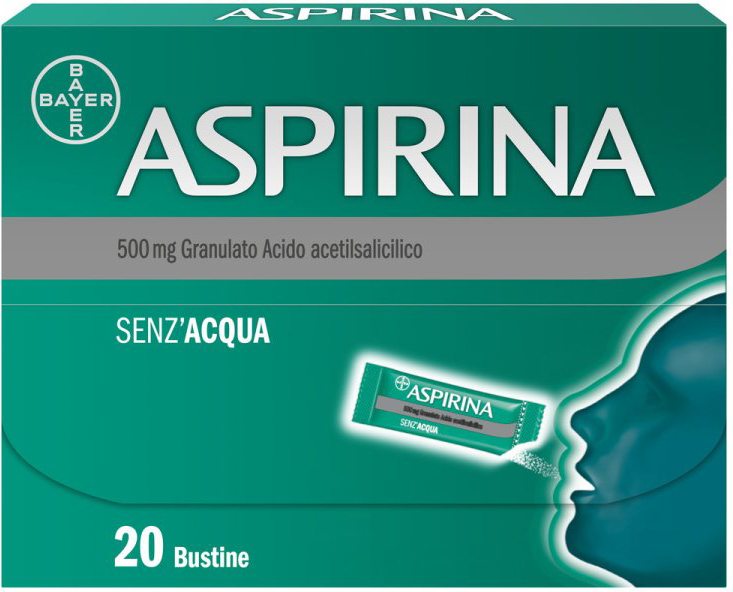
One sachet contains: active ingredient: acetylsalicylic acid 500 mg excipients: aspartame For the full list of excipients, see section 6.1
Excipients
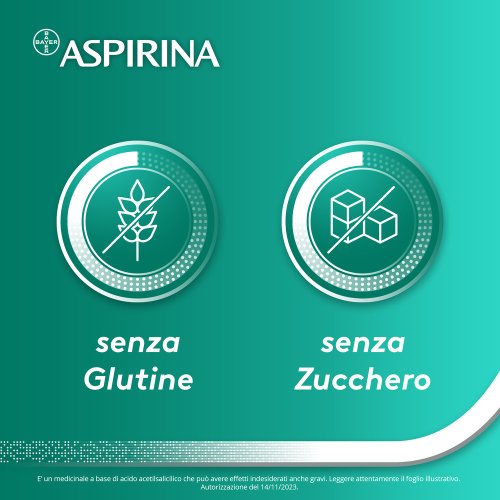
Monosodium citrate, sodium hydrogen carbonate, anhydrous citric acid, mannitol, ascorbic acid, cola flavouring, orange flavouring, aspartame.
Therapeutic indications
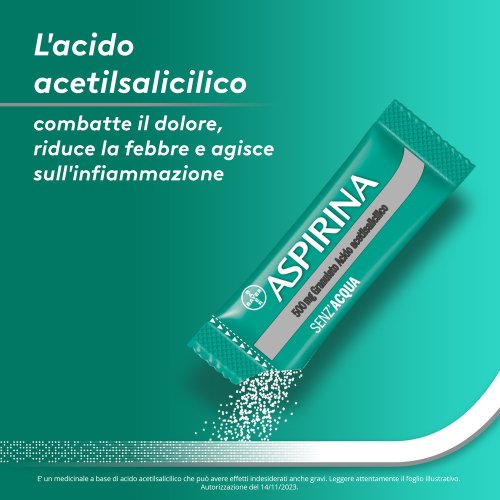
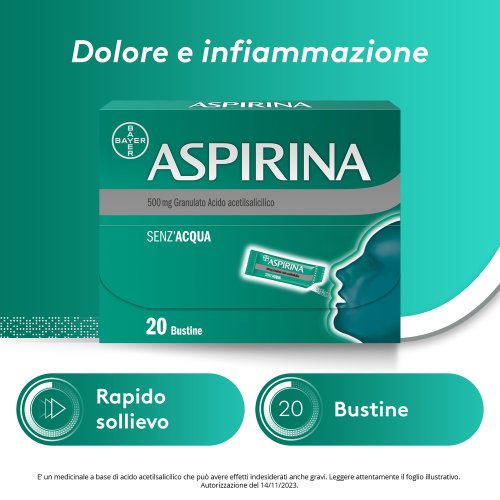
Symptomatic treatment of headache and toothache, neuralgia, menstrual pain, rheumatic and muscular pain. Symptomatic treatment of feverish states and cold and influenza syndromes.
Contraindications
Aspirin 500 mg granules are contraindicated in case of: – hypersensitivity to the active substance (acetylsalicylic acid), to other analgesics (painkillers) / antipyretics (antipyretics) / non-steroidal anti-inflammatory drugs (NSAIDs) or to any of the excipients, – gastroduodenal ulcer, – haemorrhagic diathesis, – severe renal, cardiac or hepatic insufficiency – glucose-6-phosphate dehydrogenase (G6PD/favism) deficiency, – concomitant treatment with methotrexate (at doses of 15 mg/week or more) or with warfarin (see section 4.5), – history of asthma induced by the administration of salicylates or substances with similar activity, in particular nonsteroidal anti-inflammatory drugs, - last trimester of pregnancy and breastfeeding (see section 4.6), - children and adolescents under 16 years of age.
Dosage
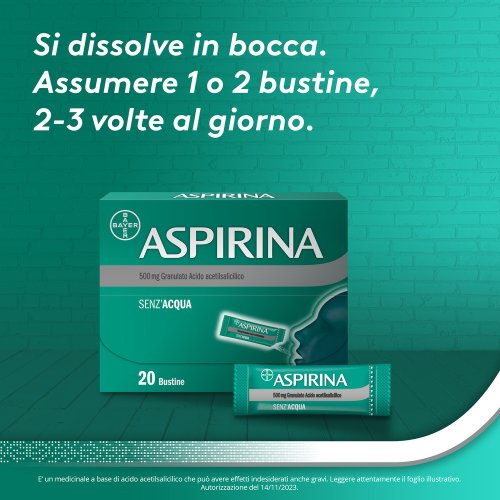
Adults: 1 or 2 sachets of granules as a single dose, repeating the dose if necessary at intervals of 4–8 hours up to 2–3 times a day. Never exceed the maximum dosage of 2 sachets 3 times a day (maximum 6 sachets per day). Aspirin 500 mg granules can be placed directly on the tongue. They dissolve in saliva, allowing them to be used without water. The product is intended for use by adult patients only. Always use the lowest effective dose and increase it only if it is not sufficient to relieve symptoms (pain or fever). Do not exceed the recommended doses: elderly patients in particular should stick to the minimum doses indicated above. Those most at risk of serious side effects, who can use the medicine only if prescribed by a doctor, must carefully follow the instructions (see section 4.4). Use the medicine for the shortest possible period. Do not take the product for more than 3–5 days without medical advice. Consult your doctor if symptoms persist. Take the medicine preferably after main meals or, in any case, on a full stomach. Paediatric population Aspirin 500 mg granules is not indicated for use in the paediatric population (see section 4.4).
Warnings and precautions
Hypersensitivity reactions Acetylsalicylic acid and other NSAIDs can cause hypersensitivity reactions (including asthma attacks, rhinitis, angioedema or urticaria). The risk is higher in subjects who have already shown a hypersensitivity reaction in the past after using this type of drug (see section 4.3) and in subjects who have allergic reactions to other substances (e.g. skin reactions, itching, urticaria). In subjects with asthma and/or rhinitis (with or without nasal polyps) and/or urticaria, reactions may be more frequent and severe. In rare cases, reactions can be very serious and potentially fatal. In the following cases, administration of the drug requires a doctor's prescription after careful evaluation of the risk/benefit ratio: - Subjects at greater risk of hypersensitivity reactions (see above) - Subjects at greater risk of gastrointestinal lesions Acetylsalicylic acid and other NSAIDs can cause serious gastrointestinal side effects (bleeding, ulceration, perforation). For this reason, these drugs should not be used by subjects suffering from gastrointestinal ulcers or gastrointestinal bleeding. It is also prudent for those who have suffered from gastrointestinal ulcers or gastrointestinal bleeding in the past to avoid its use. The risk of gastrointestinal lesions is a dose-related effect, as gastrolesivity is greater in subjects who use higher doses of acetylsalicylic acid. Subjects who are used to consuming large quantities of alcohol are also more exposed to the risk of gastrointestinal lesions (bleeding in particular) (see section 4.5). - Subjects with coagulation defects or undergoing treatment with anticoagulants In subjects with coagulation defects or undergoing treatment with anticoagulants, acetylsalicylic acid and other NSAIDs can cause a serious reduction in haemostatic capacity, exposing them to the risk of haemorrhage. - Subjects with impaired renal, cardiac or hepatic function Acetylsalicylic acid and other NSAIDs can cause a critical reduction in renal function and fluid retention; the risk is greater in subjects undergoing treatment with diuretics. This can be particularly dangerous for the elderly and for subjects with impaired renal, cardiac, or hepatic function. - Subjects with asthma: Acetylsalicylic acid and other NSAIDs can cause an aggravation of asthma. - Geriatric age (especially over 75 years): The risk of serious adverse effects is greater in geriatric subjects. Subjects over 70 years of age, especially in the presence of concomitant therapies, should use Aspirin 500 mg granules only after consulting a doctor. Aspirin 500 mg granules should not be used in the pediatric population (see section 4.3). Products containing acetylsalicylic acid should not be used in children and adolescents under 16 years of age with viral infections, regardless of whether or not fever is present. In certain viral infections, especially influenza A, influenza B, and chickenpox, there is a risk of Reye's syndrome, a very rare but life-threatening disease that requires immediate medical attention. The risk may be increased if acetylsalicylic acid is taken concomitantly, although a causal relationship has not been demonstrated. Persistent vomiting in patients with these diseases may be a sign of Reye's syndrome. - Subjects with hyperuricemia/gout: Acetylsalicylic acid may interfere with the elimination of uric acid: high doses have a uricosuric effect, while (very) low doses may reduce its excretion. It should also be considered that acetylsalicylic acid and other NSAIDs may mask the symptoms of gout, delaying its diagnosis. An antagonistic effect with uricosuric drugs is also possible (see section 4.5). - Combinations of drugs not recommended or requiring special precautions or dosage adjustments. The use of acetylsalicylic acid in combination with certain drugs may increase the risk of serious side effects (see section 4.5). Do not use acetylsalicylic acid together with another NSAID or, in any case, do not use more than one NSAID at a time. Fertility. The use of acetylsalicylic acid, as with any drug that inhibits the synthesis of prostaglandins and cyclooxygenase, may interfere with fertility. Female subjects, particularly women who have fertility problems or who are undergoing fertility investigations, should be informed of this (see section 4.6). Sodium. This medicine contains sodium: it may not be suitable for subjects on a low-sodium diet. Aspartame. The aspartame present in the product is a source of phenylalanine and makes the medicine unsuitable for subjects with phenylketonuria. If you are undergoing surgery (even minor, such as tooth extraction) and have used aspirin or another NSAID in the previous few days, you must inform your surgeon due to the possible effects on coagulation. Since aspirin can cause gastrointestinal bleeding, this should be taken into account if occult blood testing is necessary. Before administering any medication, all necessary precautions must be taken to prevent adverse reactions. It is particularly important to rule out previous hypersensitivity reactions to this or other medications and to rule out other contraindications or conditions that may expose you to the risk of potentially serious adverse effects, as listed above. If in doubt, consult your doctor or pharmacist. The product must be taken on a full stomach.
Interactions
Contraindicated combinations (avoid concomitant use – see section 4.3) Methotrexate (doses greater than or equal to 15 mg/week): increased plasma levels and toxicity of methotrexate, the risk of toxic effects is greater if renal function is impaired. Warfarin: seriously increased risk of haemorrhage due to potentiation of the anticoagulant effect. Combinations not recommended (concomitant use of the two drugs requires a doctor's prescription after careful evaluation of the risk/benefit ratio – see section 4.4) Antiplatelet agents: increased risk of haemorrhage due to the addition of the antiplatelet effect. Thrombolytics or oral or parenteral anticoagulants: increased risk of haemorrhage due to potentiation of the pharmacological effect. NSAIDs (excluding topical use): increased risk of serious adverse effects. Methotrexate (doses less than 15 mg/week): the increased risk of toxic effects (see above) must also be considered for treatment with low-dose methotrexate. Selective serotonin reuptake inhibitors (SSRIs): increased risk of upper gastrointestinal bleeding due to a possible synergistic effect. Combinations requiring special precautions or dosage adjustment (concomitant use of the two drugs requires a doctor's prescription after careful risk/benefit assessment - see section 4.4). ACE inhibitors: reduced hypotensive effect, increased risk of renal impairment. Valproic acid: increased effect of valproic acid (risk of toxicity). Antacids: Antacids taken concomitantly with other drugs may reduce their absorption; acetylsalicylic acid excretion increases in alkaline urine. Antidiabetics (e.g., insulin and oral hypoglycemics): Increased hypoglycemic effect; the use of acetylsalicylic acid in patients undergoing antidiabetic treatment must take into account the risk of inducing hypoglycemia. Digoxin: Increased plasma digoxin concentration due to decreased renal elimination. Diuretics: Increased risk of nephrotoxicity of acetylsalicylic acid and other NSAIDs, reduced effect of diuretics. Acetazolamide: Reduced elimination of acetazolamide (risk of toxicity). Phenytoin: Increased effect of phenytoin. Corticosteroids (excluding topical ones and those used to treat adrenocortical insufficiency): a) increased risk of gastrointestinal lesions, b) due to the increased elimination of salicylates induced by corticosteroids, plasma salicylate levels are reduced. Conversely, salicylate overdose may occur after discontinuation of corticosteroid treatment. Metoclopramide: increased effect of acetylsalicylic acid due to increased absorption rate. Uricosurics (e.g., probenecid, benzbromarone): decreased uricosuric effect. Zafirlukast: increased plasma concentration of zafirlukast. Aspirin 500 mg granules contain buffering systems that may reduce the effects of the thyroid hormone levothyroxine. Alcohol (see section 4.4) The combined effects of alcohol and acetylsalicylic acid cause increased damage to the gastrointestinal mucosa and prolonged bleeding time. However, it is advisable not to administer other oral medications within 1 or 2 hours of using the product.
Side effects
The most frequently observed side effects involve the gastrointestinal tract and may occur in approximately 4% of subjects taking acetylsalicylic acid as an analgesic-antipyretic. This percentage increases significantly in subjects at risk of gastrointestinal disorders. These disorders can be partially alleviated by taking the medicine on a full stomach. Most side effects are dependent on both the dose and the duration of treatment. The side effects observed with acetylsalicylic acid are generally common to other NSAIDs. Blood and lymphatic system disorders: Prolonged bleeding time, anemia due to gastrointestinal bleeding, decreased platelet count (thrombocytopenia) in extremely rare cases. Acute and chronic post-haemorrhagic/iron deficiency anemia (due, for example, to occult microhaemorrhages) may occur following haemorrhage, with associated alterations in laboratory parameters and related clinical signs and symptoms such as asthenia, pallor, and hypoperfusion. Nervous system disorders: Headache, dizziness. Rarely: Reye's syndrome (*) Rarely to very rarely: cerebral haemorrhage, especially in patients with uncontrolled hypertension and/or on anticoagulant therapy, which, in isolated cases, can be life-threatening. Ear and labyrinth disorders: Tinnitus (ringing/buzzing/ringing/whistling in the ears). Respiratory, thoracic, and mediastinal disorders: Asthma syndrome, rhinitis (profuse rhinorrhea), nasal congestion (associated with hypersensitivity reactions). Epistaxis. Cardiac disorders: Cardiorespiratory distress (associated with hypersensitivity reactions). Eye disorders: Conjunctivitis (associated with hypersensitivity reactions). Gastrointestinal disorders: Gastrointestinal bleeding (occult), gastric discomfort, heartburn, gastrointestinal pain, gum bleeding. Vomiting, diarrhea, nausea, crampy abdominal pain (associated with hypersensitivity reactions). Rarely: gastrointestinal inflammation, gastrointestinal erosion, gastrointestinal ulceration, haematemesis (vomiting blood or coffee-ground material), melaena (passage of black, tarry stools), esophagitis. Very rarely: haemorrhagic gastrointestinal ulcer and/or gastrointestinal perforation with associated clinical signs and symptoms and laboratory changes. Hepatobiliary disorders: Rarely: Hepatotoxicity (usually mild and asymptomatic hepatocellular injury) manifested by increased transaminases. Skin and subcutaneous tissue disorders: Rash, edema, urticaria, pruritus, erythema, angioedema (associated with hypersensitivity reactions). Renal and urinary disorders: Impaired renal function (in the presence of altered renal haemodynamics), urogenital bleeding. Systemic disorders and administration site conditions: Perioperative haemorrhages, haematomas. Immune system disorders: Rarely: Anaphylactic shock with associated alterations in laboratory parameters and clinical manifestations. (*) Reye's Syndrome (RS) RS initially manifests itself with vomiting (persistent or recurrent) and other signs of brain damage of varying degrees: from listlessness, drowsiness, or personality changes (irritability or aggressiveness) to disorientation, confusion, or delirium, up to convulsions or loss of consciousness. The variability of the clinical picture must be taken into account: vomiting may also be absent or replaced by diarrhea. If these symptoms arise in the days immediately following an episode of influenza (or flu-like illness, chickenpox, or another viral infection) during which acetylsalicylic acid or other salicylate-containing medicines were administered, the doctor's attention must immediately be drawn to the possibility of RS. Reporting of suspected adverse reactions Reporting suspected adverse reactions that occur after authorization of the medicinal product is important, as it allows continuous monitoring of the benefit/risk balance of the medicinal product. Healthcare professionals are asked to report any suspected adverse reactions via the national reporting system of the Italian Medicines Agency. Website: http://www.agenziafarmaco.gov.it/it/responsabili.
Pregnancy and breastfeeding
Fertility The use of acetylsalicylic acid, as with any drug inhibiting prostaglandin synthesis and cyclooxygenase, may interfere with fertility. Female subjects, particularly women who have fertility problems or who are undergoing fertility investigations, should be informed of this (see section 4.4). Pregnancy Inhibition of prostaglandin synthesis may adversely affect pregnancy and/or embryo/fetal development. Results of epidemiological studies suggest an increased risk of miscarriage and of cardiac malformation and gastroschisis after use of a prostaglandin synthesis inhibitor in early pregnancy. The absolute risk of cardiac malformations was increased from less than 1% to approximately 1.5%. The risk has been estimated to increase with dose and duration of therapy. In animals, administration of prostaglandin synthesis inhibitors has been shown to result in increased pre- and post-implantation loss and embryo-fetal mortality. Furthermore, an increased incidence of various malformations, including cardiovascular, has been reported in animals administered prostaglandin synthesis inhibitors during the organogenetic period. During the first and second trimesters of pregnancy, acetylsalicylic acid should not be administered unless clearly necessary. If drugs containing acetylsalicylic acid are used by a woman attempting to conceive, or during the first and second trimesters of pregnancy, treatment should be as short as possible and the dose as low as possible. During the third trimester of pregnancy, all prostaglandin synthesis inhibitors may expose: • the fetus to: - cardiopulmonary toxicity (with premature closure of the ductus arteriosus and pulmonary hypertension), - renal dysfunction, which may progress to renal failure with oligo-hydroamniosis, • the mother and the unborn child, at the end of pregnancy, to: - possible prolongation of bleeding time, an antiaggregant effect that may occur even at very low doses, - inhibition of uterine contractions resulting in delayed or prolonged labor. Consequently, acetylsalicylic acid is contraindicated during the third trimester of pregnancy. Breastfeeding: Aspirin 500 mg granules are contraindicated during breastfeeding (see section 4.3).
This product has been on sale since 25/09/2017
In the last 30 days, the product's lowest price was 9,83 €
Grazie alla sua formulazione da prendere sublinguale agisce più velocemente che altri analoghi prodotti
La più efficace e si può assumere anche a stomaco vuoto!
Questo prodotto era introvabile in tante farmacie della mia zona e online, farmacosmoSuper!!!
Utile antinfiammatorio

Estimated delivery: 2-5 working days

Estimated delivery: 2-5 working days

Estimated delivery: 2-5 working days

Estimated delivery: 2-5 working days


Estimated delivery: 2-5 working days

Estimated delivery: 2-5 working days