Food supplement for the trophism of nervous tissue.
Indications
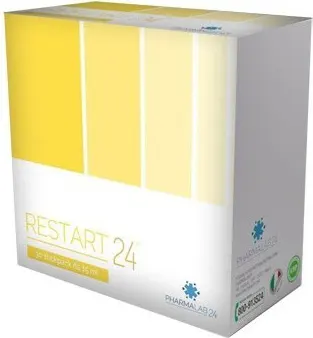
Restart24 is a food supplement created specifically as an adjuvant for the trophism of nervous tissue.
Its formulation has been studied on the basis of international scientific literature, the ingredients it contains have individually demonstrated an action in this sense, the rationale of the product is to unify in a single supplement multiple active ingredients in mutually correct concentrations, allowing them to act synergistically.
Restart24 is composed of:
- Sulforaphane: is a molecule naturally present in cruciferous vegetables, particularly in common broccoli. Its glucosylated form, glucoraphanin, is present, which is transformed into sulforaphane through the enzyme myrosinase, present in the microflora of the gastrointestinal tract. Sulforaphane appears to massively increase the expression of Heat Shock Proteins at the neuronal level, these neuroprotective proteins play a key role in preserving neuronal health.
- Palmitoylethanolamide (PEA): is the amide of palmitic acid, an endogenous analgesic endocannabinoid naturally produced by our body, which has a dual mechanism of action. On the one hand, it has a specific pain-relieving and anxiolytic effect by binding to CB endocannabinoid receptors, acting exactly like external cannabinoids but without the side effects or addiction. On the other hand, it is the natural ligand of the neuronal nuclear receptors PPARalpha, which promote the mRNA transcription of the genes required for the synthesis of the enzymes that make up peroxisomes, thus increasing both their quantity and effectiveness. This massive increase in peroxisomal activity plays a natural role in neuronal detoxification, at the cellular, dendritic, and axonal levels.
- Luteolin: is a molecule from the flavone class found naturally in significant quantities in certain vegetables (carrots, peppers, celery, fennel). Like all flavones, it has both antioxidant properties and anti-inflammatory properties due to its ability to inhibit certain enzymes responsible for the synthesis of pro-inflammatory molecules, such as lipoxygenase and Janus-type kinase. Furthermore, luteolin has the rare property of crossing both the blood-brain and blood-retinal barriers, and therefore exerts its action both in the central nervous system and in the eye.
- EPA/DHA fatty acids: The essential omega-3 fatty acids eicosapentaenoic (EPA) and docosahexaenoic (DHA) are fundamental constituents of neuronal and glial membranes; their synaptogenic and myelinating action has long been known, as have their properties as precursors of some types of eicosanoids, natural anti-inflammatory molecules.
- Alpha-lipoic acid: It is an essential molecule for energy production and cellular respiration, and is present in tissues rich in mitochondria such as muscles, liver tissue, and nervous system. Its main functions are energy-producing, acting as a cofactor in many redox reactions, as a transmembrane electron and acetyl group transporter, and as an active molecule in many neuronal processes.
- Curcumin: is a plant molecule with inhibitory properties for many inflammatory mediators, particularly IL-1, IL-8, and TNF-alpha. It also has an immunomodulatory effect at the intestinal level; its chemical structure also makes it a powerful antioxidant.
- Glutathione: is a tripeptide with very strong antioxidant properties; it is the most powerful antioxidant that our body can produce on its own. At the biochemical level, it is involved in many redox reactions, thanks to the enzyme glutathione peroxidase. Oxidation-reduction reactions are essential both to protect delicate enzymes from the action of endogenous and exogenous peroxides, and to bind, metabolize, and excrete toxic catabolites and heavy metals. Most of glutathione's action occurs in the liver, where it also acts as a hepatoprotector.
- Folic acid: Folic acid, or vitamin B9, is a biochemical compound essential for DNA replication, DNA repair, and homocysteine metabolism in the central and peripheral nervous systems.
- Acetyl-L-carnitine: is an amino acid-derived molecule used in clinical medicine for cerebral vascular lesions. Once metabolized, its function is to transport molecules to and from the mitochondria that will then be used in energy production processes. Acetyl-L-carnitine may also be a precursor to the neurotransmitter acetylcholine, which is involved in many functions, including all motor functions.
- Vitamin E: is a complex of molecules called tocopherols, the main lipophilic antioxidants, essential for maintaining certain body functions. At the brain level, vitamin E protects polyunsaturated fatty acids in membranes from oxidation, maintaining their important functions intact. It also contributes to the maintenance of PPAR receptors, including those that bind to palmitoylethanolamide.
- Vitamin D: is a steroid molecule, essential for certain vital body functions. In particular, as with steroid hormones, it is able to bind to some nuclear receptors that control various types of biosynthesis.
- Vitamin C: Vitamin C, or ascorbic acid, is a molecule with strong antioxidant properties involved in numerous oxidation-reduction and synthetic reactions within the body. At the neuronal level, it actively participates in the hydroxylation of dopamine to form norepinephrine.
- Vitamin B12: It is a molecule with a fairly complex chemical structure containing a cobalt atom at its center. It participates in numerous cellular processes where it is essential for cell proliferation and the formation of red blood cells. It also has a neuroprotective function, and precisely because of this functionality, some authors have suggested the importance of vitamin B12 in many nervous tissue dysfunctions.
- Astaxanthin: is a provitamin A, a lipophilic carotenoid with very high antioxidant power, naturally present in some foods, essential for the protection of the nerve endings most exposed to solar radiation (terminal parts of the optic nerve). Its role in neuroprotection has also been demonstrated.
- Coenzyme Q10: Coenzyme Q10, also called ubidecarone or ubiquinone, is an essential molecule almost omnipresent in the cells of our body, as it intervenes in the oxidative phosphorylation processes within the mitochondria, necessary for producing ATP. For these reasons, it is particularly present in cells that contain mitochondria, such as nervous, muscle, and liver tissue; It is a very powerful inhibitor of cellular senescence and also acts as an antioxidant.
- Glycerophosphorylcholine: is a fundamental molecule for increasing the capacity of intestinal cells to absorb omega-3 fatty acids; it also appears to participate in the synthesis of the neurotransmitter acetylcholine and promote the synthesis of the hormone somatotropin.
- Magnesium chloride: magnesium, a mineral often lacking in Western diets, is a chemical element of fundamental importance for the transport of various substances across cell membranes and is heavily involved in the transmission of cellular electrical impulses, including nerve impulses.
Ingredients
Brassica oleracea L. var. italica (e.g. follium 8% glucoraphanin in HPLC), pamitoylethanolamide (PEA), luteolin, eicosapentaenoic acid (EPA), docosahexaenoic acid (DHA), alpha-R-lipoic acid, turmeric extract conjugated with piperine, L-glutathione, pteroylglutamic acid (folic acid), acetyl-L-carnitine, tocopherol (vitamin E), cholecalciferol (vitamin D), ascorbic acid (vitamin C), cyanocobalamin (vitamin B12), astaxanthin, ubidecarenone (coenzyme Q10), glycerophosphorylcholine, magnesium chloride; flavoring: vanilla; sweetener: date sugar; preservative: potassium sorbate; thickener: xanthan gum; excipients: demineralized water.
Nutritional values
| Ingredients | per stickpack |
Brassica oleracea
of which sulforaphane 8% | 100 mg
8 mg |
| Palmitoylethanolamide | 500 mg |
| Luteolin | 200 mg |
Omega 3 EPA
Omega 3 DHA | 733 mg
200 mg |
| Lipoic acid | 50 mg |
Turmeric extract
conjugated with piperine | 300 mg |
| L-glutathione | 250 mg |
| Folic acid | 0.1 mg |
| Acetyl-L-carnitine | 450 mg |
| Vitamin E | 10 mg |
| Vitamin D | 0.005 mg
equivalent to 200 IU |
| Vitamin C | 1,000 mg |
| Vitamin B12 | 0.001 mg |
| Astaxanthin | 10 mg |
| Coenzyme Q10 | 50 mg |
| Glycerophosphorylcholine | 50 mg |
| Magnesium chloride | 100 mg |
Directions for use and Dosage
It is recommended to take one stickpack per day; it can be swallowed directly or mixed with other foods or drinks.
Warnings
Food supplements should not be used as a substitute for a varied diet.
Do not exceed the recommended daily dose.
Do not dispose of the container in the environment.
Keep out of reach of children.
Do not administer to children under three years of age.
Do not take the product during pregnancy and breastfeeding.
It is advisable to consult your doctor before using the product.
In rare cases, lipoic acid can cause hypoglycemia.
The minimum shelf life refers to the product stored correctly in its intact packaging.
Storage
Store in a cool, dry place (<25°C), away from light and heat.
The minimum shelf life refers to the product stored in its intact packaging.
Shelf life in its intact packaging: 12 months.
Format
30 15 ml stick packs.
Product Code:FRCM113280
Price Trend
This product has been on sale since 18/11/2019
In the last 30 days, the product's lowest price
was 98,46 €





 Richiedi info sul prodotto


