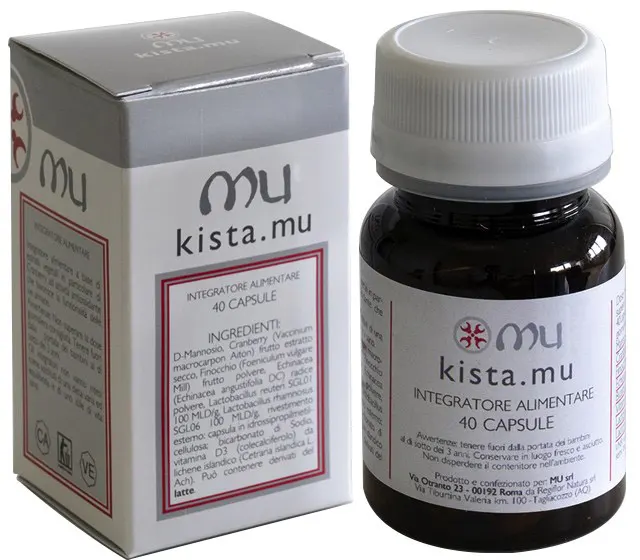
Food supplement indicated in cases of cystitis – recurrent cystitis, recurrent cystitis, urinary inflammation.
Indications
Cystitis is an inflammation of the bladder mucosa caused mostly by facultative anaerobic bacteria that
reach the intestinal bacterial flora by proximity.
Among these bacteria, the most common and well-known,
responsible for the majority of infections, is undoubtedly Escherichia coli, which has on its
surface filamentous appendages called fimbriae or pili that look like tentacles.
At the end of these
structures are protein molecules, adhesins or lectins, which allow bacteria to adhere to the
epithelial cells present on the bladder mucosa and induce inflammation.
Properties of the components of kista.Mu:
- Mannose: D-mannose is a monosaccharide isomer of glucose that, once ingested, is absorbed in the upper tract of the intestine. It is not metabolized, transformed into glycogen, or stored in the liver. Poorly absorbed by the body, after being taken orally it reaches the urinary tract unchanged, where it first binds to the walls and the bacteria, then is expelled in the urine. Bacteria's ability to adhere to D-mannose is greater than their ability to bind to bladder cells, so D-mannose will dislodge both bacteria already anchored to the mucosa and those that have penetrated deeper. Recent studies have also shown that D-mannose also binds to the toxins bacteria produce to reach the inner layer of the mucosa where they nest. D-mannose then binds to lectins, preventing them from binding to bladder cells. Once bound to D-mannose, the bacteria can no longer adhere to the bladder and are eliminated through urination. The product is an alternative to antibiotic treatment when this appears ineffective. It is also effective in preventing chronic recurrent cystitis.
- Vaccinium macrocarpon: Cranberry or American cranberry was used in the past to treat kidney stones and other urinary problems and to prevent scurvy, thanks to its vitamin C content. Currently, cranberry is used to treat type 2 diabetes and chronic fatigue syndrome, as well as being used as a diuretic, antiseptic, and antipyretic. It is particularly indicated for recurrent acute urinary tract infections because it is a powerful antioxidant. It effectively complements the effect of D-mannose by having a very strong inhibitory activity against "mannose-resistant" adhesins.
- Foeniculum vulgare:Fennel is an excellent source of vitamins (A, B, and C), dietary fiber, and many mineral salts (molybdenum, manganese, phosphorus, iron, calcium, potassium, copper, magnesium). It has strong antioxidant activity, helps control cholesterol, and has diuretic, draining, and digestive properties. It has a notable anti-inflammatory effect, useful in the prevention and treatment of intestinal diseases.
- Echinacea angustifolia:The medicinal properties of echinacea are stimulating and strengthening the immune system, especially against colds, but also bacteriostatic, virustatic, and anti-inflammatory. For external use, echinacea has skin-purifying, anti-wrinkle and anti-stretch mark properties, and tones the microcirculation and the entire venous circulation.
- Sodium bicarbonate:The bacteria that cause urinary tract infections live, grow, and multiply in a slightly acidic environment. For this reason, the alkalizing action of bicarbonate on urine is useful for its antibacterial action.
- Vitamin D3:Vitamin D performs important functions for the body. It promotes intestinal and renal absorption of calcium, an essential mineral for proper mineralization and for maintaining the firmness and health of bones and teeth. Other functions have been added to these, giving a new perspective on vitamin D. These include its anti-inflammatory action, the stimulation of proper blood clotting, and the modulation of the immune system.
- Lactobacillus reuteri and Lactobacillus rhamnosus:Vaginal flora plays a fundamental role in preventing urinary tract infections. Under normal conditions, it is rich in lactobacilli, which act as a barrier and make the vaginal environment less favorable to the proliferation of pathogenic bacteria by inhibiting their adhesion to the mucosa. Alterations in the vaginal flora predispose the urinary tract to the onset of infections. Antibiotic therapies alter the vaginal flora. Furthermore, in menopausal women, reduced estrogen levels make the concentration of lactobacilli insufficient. Supplementation with Lactobacillus rhamnosus GR-1 and Lactobacillus reuteri RC-14 has proven to be a very effective means of restoring vaginal flora and reducing the risk of urinary tract infections.
Composition
| The daily dose of 2000 mg, equivalent to 4 capsules, contains: |
| Mannose - powder | 480 mg |
| Vaccinium macrocarpon (cranberry) - fruit | 320 mg |
| Foeniculum vulgare (fennel) - fruit | 160 mg |
| Echinacea angustifolia (echinacea) - roots | 160 mg |
| Bicarbonate of sodium | 158.40 mg |
| Vitamin D3 1.6mcg Lactobacillus reuteri 4 billion Lactobacillus rhamnosus 4 billion External coating: hydroxypropylmethylcellulose capsule |
Directions for use and Dosage
It is recommended to take 2 capsules, with a little water, in the morning after urinating;
and 2 capsules, with a little water, in the evening after urinating.
D-mannose acts by contact and therefore the longer this contact occurs, the better the effects of the therapy will be.
To increase the contact time between the substance and the mucosa, it is advisable to drink little to urinate little and take two capsules in the evening after urinating and two capsules in the morning, also after urinating.
After an acute event, treatment must be followed for at least one month and up to three months in a row, depending on the extent and recurrence of the inflammation.
As a prophylaxis, the same dosage is recommended (two capsules in the evening and two capsules in the morning) for one week a month or 2 days a week for 6-12 months.
Warnings
Do not exceed the recommended daily dose.
Keep out of reach of children under 3 years of age.
Food supplements should not be considered a substitute for a varied diet and a healthy lifestyle.
Contraindications
Pharmacological studies do not report toxicity and, at the recommended doses, no significant side effects have been reported.
Consult your doctor during pregnancy and breastfeeding.
Format
40 capsules
Product Code:FRCM155314
Price Trend
This product has been on sale since
In the last 30 days, the product's lowest price
was 23,84 €





 Richiedi info sul prodotto


