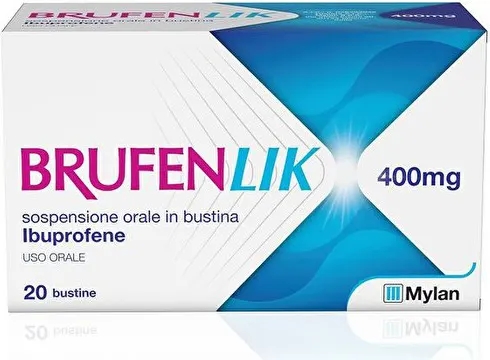
Ibuprofen-based medicine indicated for pain and fever.
Indications
Brufenlik 400 mg is indicated for the short-term symptomatic treatment of mild-moderate pain and/or fever in adults and children over 6 years of age (> 20 kg).
Composition
Active ingredients
Each sachet (10 ml) contains 400 mg of ibuprofen.
Excipients
Glycerol Liquid maltitol E965 Xanthan gum Citric acid Sodium citrate Sodium benzoate E211 Sodium saccharin Purified water Sodium chloride Hypromellose Strawberry flavour containing benzyl alcohol Thaumatin E957
How to use and Dosage
Therapy should be initiated with the lowest effective dose, which may subsequently be adjusted depending on the therapeutic response and any adverse effects.
Dosage
Adults and adolescents over 12 years of age (? 40 kg): The dose of ibuprofen depends on the age and body weight of the patient. The maximum single daily dose for adults and adolescents should not exceed 400 mg of ibuprofen. More than 400 mg at a time does not provide a better analgesic effect. A total dose should not exceed 1,200 mg of ibuprofen in 24 hours. Starting dose: 200 mg or 400 mg of ibuprofen. If necessary, additional doses of 1 or 2 sachets (200 mg to 400 mg ibuprofen) may be taken up to 3-4 times a day at intervals of 4-6 hours. If this medicine is needed for more than 3 days in children and adolescents, or if symptoms worsen, a doctor should be consulted.
| Body weight | 400 mg oral suspension in sachet | Frequency | Maximum daily dose |
| ? 40 kg (Adolescents, adults and elderly) | 1 sachet (400 mg) | Up to 3 or 4 times a day depending on the individual dose | 1200 mg of ibuprofen |
Paediatric population Children 6-12 years (20 kg-39 kg): The maximum total daily dose of ibuprofen is 30 mg per kg of body weight, divided into 3-4 single doses at intervals of 6-8 hours. The maximum recommended daily dose should not be exceeded.
| Age/Body weight | Frequency | Maximum daily dose |
| 6-7 years (20-30 kg) | Up to 3 times a day | 30 mg per kg of body weight |
| 8-12 years (> 30 kg) | Up to 4 times a day | 30 mg per kg of body weight |
Brufenlik is not indicated for children under 6 years of age
Elderly: No specific dose requirements are necessary Dosage adjustments unless renal or hepatic function is impaired, in which case the dosage should be assessed individually. Caution is needed with dosing in this group.
- Renal impairment: No dose reduction is necessary in patients with mild to moderate renal impairment (for patients with severe renal impairment, see section Contraindications).
- Hepatic impairment: No dose reduction is necessary in patients with mild to moderate hepatic impairment (for patients with severe liver dysfunction, see section Contraindications).
Method of administration
For oral use. Mix the contents of the sachet well before ingestion by pressing the top and bottom of the sachet several times with your fingers. The contents of the sachet cannot be divided between doses; the entire contents must be used. For a more rapid onset of action, the dose can be taken on an empty stomach. Patients with gastric sensitivity problems are recommended to take ibuprofen with food.
Contraindications
- Hypersensitivity to the active substance or to any of the excipients listed.
- In patients who have experienced asthma, urticaria or allergic reactions after taking acetylsalicylic acid or other NSAIDs;
- Severe heart failure (NYHA class IV).
- Severe hepatic insufficiency
- Severe renal insufficiency (glomerular filtration rate less than 30 ml/min).
- Disorders leading to increased bleeding tendency or active bleeding.
- History of gastrointestinal bleeding or perforation related to previous NSAID treatment.
- Presence or history of ulcerative colitis, Crohn's disease, recurrent peptic ulcer or gastrointestinal bleeding (defined as two or more distinct episodes of proven ulceration or bleeding).
- During the last trimester of pregnancy.
Undesirable effects
Adverse reactions possibly related to ibuprofen are listed below by frequency and MedDRA system organ class. Frequency groups are classified according to the following categories: very common (≥1/10), common (≥1/100, <1/10), uncommon (≥1/1,000, <1/100), rare (≥1/10,000, <1/1,000), very rare (<1/10,000) and not known (frequency cannot be estimated from the available data):
| System organ class | Frequency | Adverse reactions |
| Infections and infestations | Uncommon | Rhinitis |
| Rare | Aseptic meningitis (see section 4.4) |
| Blood and lymphatic system disorders | Rare | Leucopenia, thrombocytopenia, neutropenia, agranulocytosis, aplastic anaemia and haemolytic anaemia (early signs are: fever, sore throat, superficial mouth ulcers, flu-like symptoms, severe exhaustion, unexplained bleeding and bruising) |
| Immune system disorders | Uncommon | Hypersensitivity |
| Rare | Anaphylactic reaction (symptoms may include swelling of the face, tongue and larynx, shortness of breath, tachycardia, hypotension (anaphylaxis, angioedema or severe shock)) |
| Psychiatric disorders | Uncommon | Insomnia, anxiety |
| Rare | Depression, confusional state |
| Nervous system disorders | Common | Headache, dizziness |
| Uncommon | Paresthesia, somnolence |
| Rare | Optic neuritis |
| Eye disorders | Uncommon | Visual impairment |
| Rare | Toxic optic neuropathy |
| Ear and labyrinth disorders | Uncommon | Hearing impaired, tinnitus, dizziness |
| Respiratory, thoracic and mediastinal disorders | Uncommon | Asthma, bronchospasm, dyspnoea |
| Gastrointestinal disorders | Common | Dyspepsia, diarrhoea, nausea, vomiting, abdominal pain, flatulence, constipation, melaena, haematemesis, gastrointestinal haemorrhage |
| Uncommon | Gastritis, duodenal ulcer, gastric ulcer, mouth ulceration, gastrointestinal perforation |
| Very rare | Pancreatitis |
| Not known | Exacerbation of colitis and Crohn's disease |
| Hepatobiliary disorders | Uncommon | Hepatitis, jaundice, abnormal liver function |
| Very rare | Hepatic failure |
| Skin and subcutaneous tissue disorders | Common | Rash |
| Uncommon | Urticaria, pruritus, purpura, angioedema, photosensitivity reaction |
| Very rare | Severe forms of skin reactions (e.g. erythema multiforme, bullous reactions including Stevens-Johnson syndrome and toxic epidermal necrolysis). |
| Not known | Drug reaction with eosinophilia and systemic symptoms (DRESS syndrome), acute generalized exanthematous pustulosis (AGEP) |
| Renal and urinary disorders | Uncommon | Nephrotoxicity in various forms, e.g. tubulointerstitial nephritis, nephrotic syndrome and renal failure |
| General disorders and administration site conditions | Common | Fatigue |
| Rare | Oedema |
| Patient disorders Cardiac disorders | Very rare | Cardiac failure, myocardial infarction (see also section 4.4) |
| Vascular disorders | Very rare | Hypertension |
Overdose
Toxicity: In children or adults, signs and symptoms of toxicity are generally not observed at doses below 100 mg/kg. However, supportive treatment may be necessary in some cases. Children have been observed to show signs and symptoms of toxicity after ingestion of ibuprofen at doses of 400 mg/kg or more. In cases of severe poisoning, metabolic acidosis may occur.
Symptoms: Most patients who have ingested significant amounts of ibuprofen will experience symptoms within 4 to 6 hours. The most commonly reported symptoms of overdose include nausea, vomiting, abdominal pain, lethargy, and drowsiness. Central nervous system (CNS) effects include headache, tinnitus, dizziness, convulsions, and loss of consciousness. Nystagmus, metabolic acidosis, hypothermia, renal effects, gastrointestinal bleeding, coma, apnea, CNS and respiratory depression have also been reported rarely. Cardiovascular toxicity, including hypotension, bradycardia, and tachycardia, has been reported. Renal failure and liver injury may occur in cases of significant overdose. Large overdoses are generally well tolerated as long as no other medicinal products are involved.
Treatment: There is no specific antidote for ibuprofen overdose. If If the amount ingested in the previous hour exceeds 400 mg/kg, gastric emptying followed by supportive measures is recommended. For the most up-to-date information, contact your local poison control center.
Pregnancy and breastfeeding
Pregnancy: Inhibition of prostaglandin synthesis may have adverse effects on pregnancy and/or embryo-fetal development. Data from epidemiological studies suggest an increased risk of miscarriage, cardiac malformation, and gastroschisis after use of a prostaglandin synthesis inhibitor in early pregnancy. The risk is believed to increase with dose and duration of therapy. In animals, administration of prostaglandin synthesis inhibitors has induced an increase in pre- and post-implantation loss and embryo-fetal mortality. Furthermore, an increased incidence of various malformations, including cardiovascular.
During the first and second trimester of pregnancy, ibuprofen should not be administered unless clearly necessary. If ibuprofen is used by a woman attempting to conceive or during the first and second trimester of pregnancy, the dose and duration of treatment should be kept as low as possible. Brufenlik 400 mg oral suspension in sachet also contains benzyl alcohol and, due to the risk of accumulation and toxicity (metabolic acidosis) associated with high volumes of benzyl alcohol, caution should be exercised in pregnant women.
During the third trimester of pregnancy, all prostaglandin synthesis inhibitors may expose the fetus to: - cardiopulmonary toxicity (with premature closure of the ductus arteriosus and pulmonary hypertension) - renal dysfunction, which may progress to renal failure with oligohydramnios; - At the end of pregnancy, prostaglandin synthesis inhibitors may expose the mother to: - cardiopulmonary toxicity (with premature closure of the ductus arteriosus and pulmonary hypertension); ... prostaglandin synthesis inhibitors may expose the mother to: - cardiopulmonary toxicity (with premature closure of the ductus arteriosus and pulmonary hypertension); - renal dysfunction, which may progress to renal failure with oligohydramnios; - prostaglandin synthesis inhibitors may expose the mother to: - cardiopulmonary toxicity (with premature closure of the ductus arteriosus and pulmonary hypertension); - renal dysfunction and the newborn, at the end of pregnancy, to: - a possible prolongation of bleeding time - an inhibition of uterine contractions, resulting in a delay or prolongation of labor. Consequently, ibuprofen is contraindicated during the third trimester of pregnancy.
Breastfeeding: Ibuprofen is excreted in breast milk, but with therapeutic doses during short-term treatment the risk of influence on the infant seems unlikely. However, Brufenlik 400 mg oral suspension in sachet contains benzyl alcohol and, due to the risk of accumulation and toxicity (metabolic acidosis) associated with high volumes of benzyl alcohol, caution should be exercised in breastfeeding women. If, however, long-term treatment is prescribed, early weaning should be considered.
Fertility: The use of ibuprofen may impair female fertility and is not recommended in women attempting to conceive. In women who have difficulties conceiving or who are undergoing investigation of infertility, discontinuation of ibuprofen treatment should be considered (see section 4.4).
Format
20 sachets of 10 ml
Product Code:FRCM230058





 Richiedi info sul prodotto