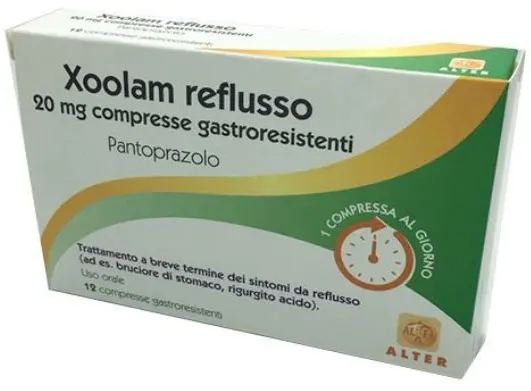
Medicine for the short-term treatment of reflux symptoms.
Indications
Xoolam Reflux is indicated for the short-term treatment of reflux-related symptoms, such as heartburn and acid regurgitation.
Composition
Active substances
Each gastro-resistant tablet contains 20 mg pantoprazole (as sodium sesquihydrate 22.55 mg).
Excipients
Core: Sodium carbonate, Mannitol (E421), Crospovidone, Pregelatinized maize, Calcium stearate.
Intermediate coating: Hypromellose, Triacetin, Titanium dioxide (E171).
Gastro-resistant coating: Methacrylic acid-ethyl acrylate copolymer 1:1, Sodium lauryl sulfate, Polysorbate 80, Triethyl citrate, Talc, Titanium dioxide (E171), Yellow iron oxide (E172), Red iron oxide (E172).
Directions for use and Dosage
Dosage
The recommended oral dose is one gastro-resistant tablet of Xoolam reflux 20 mg per day. It may be necessary to take the tablets for 2-3 consecutive days to achieve improvement in symptoms. Once complete resolution of symptoms has been achieved, treatment should be discontinued. Treatment should not exceed 4 weeks. If no improvement in symptoms is noted within 2 weeks of continuous treatment, medical advice is necessary. Once symptom relief has been achieved, recurrence of symptoms can be controlled by using, when necessary, an on-demand treatment with 20 mg once a day. In cases where on-demand administration cannot be achieved If satisfactory symptom control is maintained, a switch to continuous therapy should be considered.
Paediatric population
The use of Xoolam reflux is not recommended in children due to limited data on safety and efficacy in this age group.
Patients with hepatic impairment
In patients with severely impaired liver function, a daily dose of 20 mg pantoprazole should not be exceeded.
Patients with renal impairment
No dose adjustment is necessary in patients with impaired renal function.
Elderly
No dose adjustment is necessary in elderly patients.
Method of administration
Oral use. The tablets should not be chewed or crushed, and should be taken immediately after administration. swallowed whole with some water 1 hour before a meal.
Warnings
Hepatic impairment
In patients with severe liver impairment, the liver enzymes should be monitored regularly during treatment with pantoprazole, particularly on long-term use. If the liver enzymes rise, treatment should be discontinued.
Co-administration with NSAIDs
The use of Xoolam reflux 20 mg in the prevention of gastroduodenal ulcers induced by non-selective non-steroidal anti-inflammatory drugs (NSAIDs) should be restricted to patients who require continued NSAID treatment and have an increased risk of gastrointestinal complications. The increased risk should be assessed according to the presence of individual risk factors, e.g. advanced age (>65 years), history of gastric or duodenal ulcer or upper gastrointestinal bleeding.
Gastric malignancy
In the presence of any alarm symptom (e.g. significant unintentional weight loss, recurrent vomiting, dysphagia, haematemesis, anaemia or melaena) and when gastric ulcer is suspected or present, malignancy should be excluded, as treatment with pantoprazole may alleviate symptoms and delay diagnosis. If symptoms persist despite adequate treatment, further investigation should be considered.
Co-administration with HIV protease inhibitors
Co-administration of pantoprazole with HIV protease inhibitors for which absorption is dependent on acidic intragastric pH, such as atazanavir, is not recommended due to significant reduction in their bioavailability.
Influence on vitamin B12 absorption
Pantoprazole, as all acid-blocking medicines, may reduce the absorption of vitamin B12 (cyanocobalamin) due to hypo- or achlorhydria. This should be considered in patients with reduced body stores or risk factors for reduced vitamin B12 absorption on long-term therapy or if corresponding clinical symptoms are observed.
Long-term treatment
In long-term treatment, especially when exceeding a treatment period of 1 year, patients should be kept under regular surveillance.
Gastrointestinal infections caused by bacteria
Treatment with Xoolam reflux may lead to a slightly increased risk of gastrointestinal infections caused by bacteria such as Salmonella and Campylobacter or C. difficile. Hypomagnesaemia. Severe hypomagnesaemia has been reported in patients treated with PPIs like pantoprazole for at least three months, and in most cases for a year. Serious symptoms of hypomagnesemia, such as fatigue, tetany, delirium, seizures, dizziness, and ventricular arrhythmia, may be insidious at first and may be overlooked. In most patients, hypomagnesemia improves after magnesium replacement and discontinuation of the PPI. For patients on prolonged therapy or who take PPIs with digoxin or drugs that can cause hypomagnesemia (e.g., diuretics), healthcare professionals should consider measuring magnesium levels before starting PPI treatment and periodically during treatment.
Bone Fractures
Proton pump inhibitors, especially if used in high doses and over long periods (> 1 year), may modestly increase the risk of hip, wrist and spine fracture, predominantly in the elderly or in presence of other recognized risk factors. Observational studies suggest that proton pump inhibitors may increase the overall risk of fracture by 10% to 40%. This increase may be partly due to other risk factors. Patients at risk of osteoporosis should receive care according to current clinical practice guidelines and should consume adequate vitamin D and calcium. Subacute cutaneous lupus erythematosus (SCLE). Proton pump inhibitors are associated with extremely rare cases of SCLE. If lesions occur, especially on sun-exposed skin, and if accompanied by arthralgia, the patient should seek immediate medical attention, and the healthcare professional should consider discontinuing Xoolam reflux treatment. The development of SCLE following treatment with a proton pump inhibitor may be life-threatening. increase the risk of SCLE with other proton pump inhibitors.
Interference with laboratory tests
An increased Chromogranin A (CgA) level may interfere with investigations for neuroendocrine tumors. To avoid this interference, treatment with Xoolam reflux should be stopped for at least 5 days before CgA measurements (see section 5.1). If CgA and gastrin levels have not returned to reference range after the initial measurement, measurements should be repeated 14 days after stopping treatment with the proton pump inhibitor.
Undesirable effects
Approximately 5% of patients can be expected to experience adverse drug reactions (ADRs). The most commonly reported ADRs are diarrhoea and headache, both occurring in approximately 1% of patients. The following table lists adverse reactions reported with pantoprazole, ranked under the following frequency classification: very common (>1/10); common (>1/100, <1/10); uncommon (>1/1,000, <1/100); rare (>1/10,000, <1/1,000); very rare (<1/10,000), not known (cannot be estimated from the available data). For all adverse reactions reported from post-marketing experience, it is not possible to apply any Adverse Reaction frequency and therefore they are mentioned with a frequency of “not known”. Within each frequency grouping, adverse reactions are presented in order of decreasing seriousness. Table 1. Adverse reactions with pantoprazole in clinical trials and post-marketing experience
| Frequency System organ classification | Uncommon | Common | Rare | Very rare | Not known |
| Blood and lymphatic system disorders | | | Agranulocytosis | Thrombocytopenia; Leukopenia; Pancytopenia | |
| Immune system disorders | | | Hypersensitivity (including reactions anaphylactic conditions and anaphylactic shock) | | |
| Metabolism and nutrition disorders | | | Hyperlipidaemias and lipid increases (triglycerides, cholesterol); Weight changes | | Hyponatraemia; Hypomagnesaemia (see section 4.4); Hypocalcaemia in association with hypomagnesaemia; Hypokalaemia |
| Psychiatric disorders | Sleep disorders | | Depression (and all aggravations) | Disorientation (and all aggravations) | Hallucinations; Confusion (especially in predisposed patients, as well as worsening of these symptoms in case of pre-existence) |
| Nervous system disorders | Headache; Dizziness | | Taste disturbances | | Paresthesia |
| Eye disorders | | | Vision disturbances / blurred vision | | |
| Pathologies gastrointestinal | Diarrhea; Nausea/vomiting; Abdominal distension and bloating; Constipation; Dry mouth; Abdominal pain and discomfort | Gland polyps (benign) | | | Microscopic colitis |
| Hepatobiliary disorders | Increased levels of liver enzymes (transaminases, γ-GT) | | Increased bilirubin | | Hepatocellular injury; Jaundice; Hepatocellular failure |
| Skin and subcutaneous tissue disorders | Rash / exanthema / eruption; Pruritus | | | Urticaria; Angioedema | | Stevens-Johnson syndrome; Lyell syndrome; Erythema multiforme; Photosensitivity Subacute cutaneous lupus erythematosus (see section 4.4) |
| Musculoskeletal and connective tissue disorders | Fracture of the hip, wrist or spine (see section 4.4). | | Arthralgia; Myalgia | | Muscle spasm as a consequence of electrolyte imbalance |
| Renal and urinary disorders | | | | | Interstitial nephritis (with possible progression to renal failure) |
| Reproductive system and breast disorders | | | Gynecomastia | | |
| Systemic disorders and administration site conditions | Asthenia, fatigue and malaise | | Increased body temperature; Peripheral edema | | |
Reporting of suspected adverse reactions. Reporting suspected adverse reactions after authorisation of the medicinal product is important. It allows continued monitoring of the benefit/risk balance of the medicinal product.
Overdose
There are no known symptoms of overdose in humans. Systemic exposures of up to 240 mg administered intravenously over 2 minutes were well tolerated. Since pantoprazole is extensively protein bound, it is not readily dialysable. In case of overdose with clinical signs of intoxication, no specific therapeutic recommendations can be made, except symptomatic and supportive treatment.
Pregnancy and breastfeeding
Pregnancy
A moderate amount of data on pregnant women (between 300 and 1000 pregnancy outcomes) indicate no malformative or fetal/neonatal toxicity with Xoolam reflux. Studies in animals have shown reproductive toxicity (see section 5.3). As a precautionary measure, it is preferable to avoid the use of Xoolam reflux during pregnancy.
Breastfeeding
Animal studies have shown excretion of pantoprazole in breast milk. There is insufficient information on the excretion of pantoprazole in human breast milk, but excretion in human breast milk has been reported. Therefore, a decision on whether to continue/discontinue breast-feeding or to continue/discontinue therapy with Xoolam reflux should be made taking into account the benefit of breast-feeding for the child and the benefit of Xoolam reflux therapy for the mother.
Fertility
There was no evidence of impaired fertility following the administration of pantoprazole in animal studies.
Format
Pack of 12 Tablets of 20 mg
Product Code:FRCM216805





 Richiedi info sul prodotto