Symptomatic treatment of seasonal allergic rhinitis.
Indications
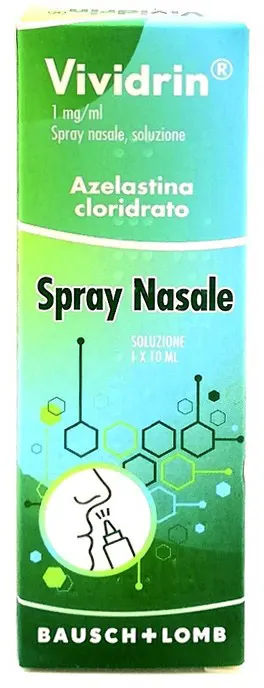
Vividrin Nasal Spray is indicated for the symptomatic treatment of seasonal allergic rhinitis (e.g. hay fever) and for acute exacerbations of perennial allergic rhinitis in adults, adolescents and children aged 6 years and over.
Composition
Active substances
Each ml of solution contains 1 mg of azelastine hydrochloride. One spray (0.14 ml) contains 0.14 mg azelastine hydrochloride equivalent to 0.13 mg azelastine.
Excipients
Hypromellose 2910, Disodium edetate, Citric acid anhydrous, Disodium phosphate dodecahydrate, Sodium chloride, Purified water.
Directions for use and Dosage
Route of administration: Topical - nasal mucosa.
One spray (0.14 ml) in each nostril, twice a day (0.56 mg azelastine hydrochloride).
There are no specific studies in the elderly. For children aged 6 years and over, one spray (0.14 ml) in each nostril, twice a day (0.56 mg azelastine hydrochloride).
Azelastine hydrochloride should not be administered to children under 6 years of age due to a lack of data on safety and efficacy.
Method of administration: Nasal use. Precautions to be taken into account before handling or administering the medicinal product: Spray with the head in an upright position.
Before first use, press the pump mechanism several times (3-4 times) until a uniform spray is produced.
When azelastine has not been used for 6 days or more, the pump mechanism should be reactivated by pressing down and releasing enough times to produce a fine mist.
After administration, clean the nozzle and replace the protective cap.
Warnings
The spray must be used with the head in an upright position.
Contraindications
Children under 6 years of age. Hypersensitivity to the active substance or to any of the excipients.
Interactions
No interaction studies have been performed with azelastine nasal spray.
Undesirable effects
Frequencies are defined as: Very common (>1/10), Common (>1/100, <1/10), Uncommon (>1/1,000, <1/100), Rare (>1/10,000, <1/1,000), Very rare (<1/10,000), Not known (frequency cannot be estimated from the available data). Immune system disorders. Very rare: hypersensitivity reactions.
Nervous system disorders. Common: bitter taste typical of the drug which may affect the ability to drive and use machines. be felt after administration (often due to an incorrect method of application, resulting from excessive tilting of the head backwards during administration) which, in rare cases, may cause nausea; Very rare: dizziness, somnolence (disturbance of sleep, drowsiness). Respiratory, thoracic and mediastinal disorders. Uncommon: mild, transient irritation of the inflamed nasal mucosa may occur with symptoms such as stinging, itching, sneezing, and nosebleeds.
Gastrointestinal disorders. Rare: nausea. Systemic disorders. Very rare: tiredness (exhaustion, fatigue), dizziness or weakness.
Skin and subcutaneous tissue and immune system disorders. Very rare: rash, itching, urticaria. Reporting of suspected adverse reactions.
Reporting suspected adverse reactions that occur after authorization of the medicinal product is important, as it allows continued monitoring of the benefit/risk balance of the medicinal product.
Overdose
Results of animal studies demonstrate that toxic doses can cause symptoms affecting the Central Nervous System, such as excitation, tremor, convulsions.
If they occur in humans, symptomatic and supportive treatment should be implemented as there is no specific antidote.
In case of recent overdose, gastric lavage is recommended.
Overdose reactions are not expected with the nasal route of administration.
Pregnancy and breastfeeding
Pregnancy: There are no or limited amount of data from the use of azelastine in pregnant women.
Reproductive toxicity has been observed in animals at high oral doses.
Therefore, caution should be exercised when using azelastine during pregnancy.
Breastfeeding: It is not known whether azelastine/metabolites are excreted in human milk.
Since many medicinal products are excreted in human milk, caution should be exercised when administering azelastine to breastfeeding women.
Fertility: Effects on fertility have been observed in animal studies.
Storage
Do not refrigerate or freeze. Do not store above 25°C.
For storage conditions after first opening the medicinal product:
Format
10 ml
Product Code:FRCM146606




 Richiedi info sul prodotto