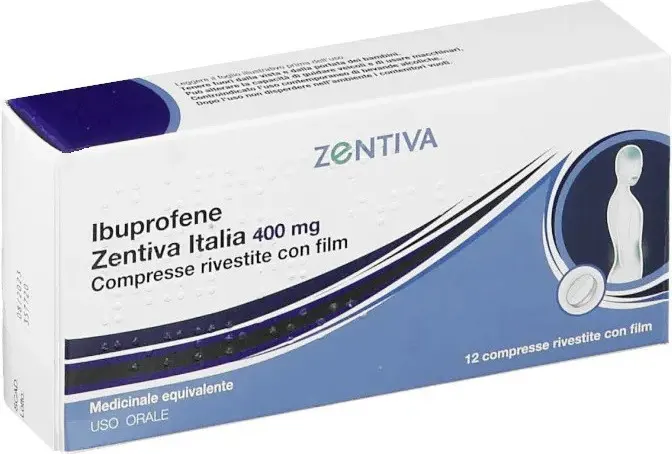
Ibuprofene Zenvita Italia contains ibuprofen, a medicine that belongs to a class of medicines called NSAIDs (non-steroidal anti-inflammatory drugs) that work by reducing pain, inflammation and fever.
Indications
Ibuprofene Zentiva Italia 400 mg is used in adults and adolescents from 12 years of age to provide relief from:
- mild to moderate pain (such as headache, including migraine, toothache, and fever)
- menstrual cramps (dysmenorrhea).
Talk to your doctor if you do not feel better or if you feel worse after 3 days (in adolescents) or after 7 days (in adults).
Composition
Active substances
Each Film-coated tablet contains 400 mg ibuprofen.
Excipients
Tablet core: Microcrystalline cellulose Colloidal anhydrous silica Hydroxypropylcellulose Sodium laurilsulfate Croscarmellose sodium Talc Film-coating [Opadry (white) 06B28499] Hypromellose Macrogol 400 Titanium dioxide (E171)
How to use and Dosage
Always use this medicine exactly as described in this leaflet or as your doctor or pharmacist has told you. Check with your doctor or pharmacist if you are not sure.
Side effects may be minimised by using the lowest effective dose for the shortest time necessary to control symptoms. Therefore, do not exceed the recommended dose or duration of treatment.
How to take Ibuprofen Zentiva
The dose of ibuprofen depends on age and body weight.
Adults and adolescents over 12 years of age (≥ 40 kg): for fever and mild to moderate pain
it is recommended to take ½ - 1 tablet administered in a single dose or 3-4 times a day at intervals of 4-6 hours.
For Menstrual pain (primary dysmenorrhea)
It is recommended to take ½ - 1 tablet 1-3 times a day at intervals of 4-6 hours, as needed. The maximum daily dose should not exceed 3 tablets (1200 mg).
The dosage for headaches due to migraine is: 1 tablet administered as a single dose; if necessary, continue taking 1 tablet at intervals of 4-6 hours.
The maximum daily dose should not exceed 3 tablets (1200 mg).
Warnings
Keep this medicine out of the sight and reach of children.
Do not use this medicine after the expiry date which is stated on the carton after EXP. The expiry date refers to the last day of that month.
This medicine does not require any special storage conditions.
Do not throw away any medicines via wastewater or household waste. Ask your pharmacist how to throw away medicines you no longer use. This will help protect the environment.
Side effects
The most commonly observed adverse effects are gastrointestinal in nature. Peptic ulcers, perforation, or gastrointestinal bleeding, even fatal, may occur, particularly in the elderly. Nausea, vomiting, diarrhea, flatulence, constipation, dyspepsia, abdominal pain, melaena, hematemesis, ulcerative stomatitis, exacerbation of colitis and Crohn's disease have been reported after administration. Gastritis has been observed less frequently. Adverse effects are mainly dose-dependent. In particular, the risk of gastrointestinal bleeding depends on the dosage and duration of treatment. For other known risk factors. Clinical studies suggest that the use of ibuprofen, especially at high doses (2400 mg/day), may increase the risk of gastrointestinal bleeding. be associated with a modest increased risk of arterial thrombotic events (e.g. myocardial infarction or stroke). Edema, hypertension, and heart failure have been reported in association with NSAID treatment.
Undesirable effects are less frequent when the maximum daily dose is 1200 mg. The evaluation of adverse reactions is generally based on the following frequency: Very common (> 1/10) Common (> 1/100, < 1/10) Uncommon (> 1/1,000 to < 1/100) Rare (> 1/10,000 to < 1/1,000) Very rare (< 1/10,000), not known (frequency cannot be estimated from the available data).
Interactions
Concomitant use of ibuprofen with the following substances should be avoided:
- Acetylsalicylic acid: Concomitant administration of ibuprofen and acetylsalicylic acid is generally not recommended due to the potential for increased adverse effects. Experimental data suggest that ibuprofen may increase the risk of serious side effects. competitively inhibit the effect of low-dose aspirin on platelet aggregation when the two drugs are administered concomitantly. Although there are uncertainties regarding the extrapolation of these data to the clinical situation, the possibility that regular, long-term use of ibuprofen may reduce the cardioprotective effect of low-dose aspirin cannot be excluded. No clinically relevant effect is considered likely following occasional use of ibuprofen.
- Other NSAIDs: Due to synergistic effects, the concomitant use of multiple NSAIDs may increase the risk of gastrointestinal ulcers and bleeding. Therefore, the concomitant administration of ibuprofen with other NSAIDs should be avoided.
- Anticoagulants: NSAIDs may enhance the effects of anticoagulants, such as warfarin or heparin. In case of concomitant treatment, monitoring of coagulation status is recommended.
- Ticlopidine: NSAIDs should not be combined with ticlopidine due to the risk of additive effect on the inhibition of platelet function. Methotrexate: NSAIDs inhibit the tubular secretion of methotrexate and certain metabolic interactions may occur resulting in reduced methotrexate clearance. Administration of IBUPROFENE ZENTIVA ITALIA 400 mg 24 hours before or after methotrexate administration may result in elevated methotrexate concentrations and an increase in its toxic effects. Therefore, the concomitant use of NSAIDs and high doses of methotrexate should be avoided. Furthermore, the potential risk of interactions with low-dose methotrexate treatment should be taken into account, particularly in patients with impaired renal function. In combination treatment, renal function must be monitored.
Ibuprofen (like other NSAIDs) should only be taken with caution in combination with the following substances::
- Moclobemide: enhances the effect of ibuprofen. Phenytoin, lithium: concomitant administration of IBUPROFENE ZENTIVA ITALIA 400 mg with preparations containing phenytoin or lithium may increase the serum level of these drugs. Monitoring the serum lithium level is necessary and monitoring the serum phenytoin level is recommended.
- Cardiac glycosides (e.g. digoxin): NSAIDs may exacerbate heart failure, reduce the glomerular filtration rate and increase the plasma levels of cardiac glycosides. Monitoring of serum digoxin levels is recommended.
- Diuretics and antihypertensives: Diuretics and ACE inhibitors may increase the nephrotoxicity of NSAIDs. NSAIDs may reduce the effect of diuretics and antihypertensives, including ACE inhibitors and beta-blockers. In patients with reduced renal function (e.g., dehydrated patients or elderly patients with reduced renal function), the concomitant use of an ACE inhibitor and an angiotensin II antagonist with a medicinal product that inhibits cyclooxygenase may lead to further impairment of renal function and even acute renal failure. This effect is usually reversible. This combination should only be used with caution, particularly in elderly patients. Patients should be advised to drink sufficient amounts of fluids; periodic monitoring of renal function values should be considered in the period immediately following the initiation of combination therapy. Concomitant administration of IBUPROFENE ZENTIVA ITALIA 400 mg and potassium-sparing diuretics or ACE inhibitors may cause hyperkalemia. Careful monitoring of potassium levels is necessary.
- Captopril: experimental studies indicate that ibuprofen counteracts the effect of captopril on increasing sodium excretion. Aminoglycosides: NSAIDs can slow the elimination of aminoglycosides and increase their toxicity. Selective serotonin reuptake inhibitors (SSRIs): increased risk of gastrointestinal bleeding.
- Cyclosporine: the risk of renal damage caused by ciclosporin is increased by the concomitant administration of certain NSAIDs. This effect cannot be ruled out even for the combination of ciclosporin and ibuprofen. Cholestyramine: Concomitant treatment with cholestyramine and ibuprofen results in a prolongation and reduction (25%) of ibuprofen absorption. These drugs should be administered at least one hour apart. Tacrolimus: high risk of nephrotoxicity.
- Zidovudine: There is evidence of an increased risk of haemarthrosis and haematoma in HIV-positive haemophiliac patients receiving concomitant treatment with zidovudine and ibuprofen. An increased risk of haematotoxicity may occur during concomitant use of zidovudine and NSAIDs. It is recommended that blood counts be assessed 1-2 weeks after starting concomitant treatment. Ritonavir: may increase the risk of haemarthrosis and haematoma. increase plasma concentrations of NSAIDs.
- Mifepristone: NSAIDs administered within 8-12 days of treatment with mifepristone may reduce its effect.
- Probenecid or sulfinpyrazone: may cause a delay in the elimination of ibuprofen. The uricosuric action of these substances is reduced. Quinolone antibiotics: patients taking NSAIDs and quinolones may have an increased risk of developing convulsions.
- Sulfonylureas: NSAIDs may increase the hypoglycemic effect of sulfonylureas. In case of concomitant treatment, blood glucose monitoring is recommended.
- Corticosteroids: increased risk of gastrointestinal ulceration or bleeding.
- Antiplatelet agents (e.g. clopidogrel and ticlopidine): increased risk of gastrointestinal bleeding.
- Alcohol, bisphosphonates and oxpentifylline (pentoxifylline): may enhance gastrointestinal side effects and the risk of bleeding and ulceration.
- Baclofen: high toxicity of baclofen.
Undesirable effects/contraindications
IBUPROFENE ZENTIVA ITALIA 400 mg is contraindicated in patients with:
- hypersensitivity to the active substance or to any of the excipients.
- hypersensitivity reactions history of gastrointestinal bleeding or perforation, related to previous NSAID therapy
- active peptic ulcer/haemorrhage or history of recurrence of the condition (two or more distinct episodes of proven ulceration or bleeding)
- severe hepatic or renal insufficiency
- severe heart failure (NYHA class IV)
- coronary artery disease
- last trimester of pregnancy
- significant dehydration (caused by vomiting, diarrhoea or insufficient fluid intake)
- cerebrovascular bleeding or other active bleeding
- unknown hematopoiesis
- children under 6 years of age.
Overdose
Toxicity
Signs and symptoms of toxicity have not generally been observed at doses below 100 mg/kg in children or adults. However, supportive treatment may be necessary in some cases. Children have been observed to exhibit signs and symptoms of toxicity after ingestion of ibuprofen at doses of 400 mg/kg or greater.
Symptoms
Most patients who have ingested significant amounts of ibuprofen will experience symptoms within 4 to 6 hours. The most commonly reported symptoms of overdose include nausea, vomiting, abdominal pain, lethargy, and drowsiness. Central nervous system (CNS) effects include headache, tinnitus, dizziness, convulsions, and loss of consciousness. Nystagmus, hypothermia, renal effects, gastrointestinal bleeding, coma, apnea, diarrhea, and CNS and respiratory depression have also been reported rarely. Disorientation, excitation, fainting, and cardiovascular toxicity including hypotension, bradycardia, and tachycardia have been reported. Renal failure and liver damage are possible in cases of significant overdose. In cases of severe poisoning, metabolic acidosis may occur.
Treatment
There is no specific antidote for ibuprofen overdose. Therefore, symptomatic and supportive treatment is indicated in cases of overdose. Particular attention should be paid to monitoring blood pressure, acid-base balance, and possible gastrointestinal bleeding. Administration of activated charcoal should be considered within one hour of ingestion of a potentially toxic amount. Alternatively, gastric lavage should be considered within one hour of ingestion of a potentially life-threatening overdose in adults. Adequate diuresis must be ensured, and renal and hepatic function must be closely monitored. The patient should remain under observation for at least four hours following ingestion of a potentially toxic amount of the drug. Any occurrence of frequent or prolonged convulsions should be treated with intravenous diazepam. Other supportive measures may be necessary depending on the patient's clinical condition. For more information, contact your local poison control center.
Use during pregnancy and breastfeeding
Pregnancy
Inhibition of prostaglandin synthesis may adversely affect pregnancy and/or embryo-fetal development. Data from epidemiological studies suggest an increased risk of miscarriage, cardiac malformation, and gastroschisis after use of a prostaglandin synthesis inhibitor in early pregnancy. The absolute risk of cardiovascular malformation was increased from less than 1% to approximately 1.5%. The risk is believed to increase with dose and duration of therapy. In animals, administration of a prostaglandin synthesis inhibitor has been shown to result in increased pre- and post-implantation loss and embryo-fetal mortality. Additionally, an increased incidence of various malformations, including cardiovascular ones, has been reported in animals treated with a prostaglandin synthesis inhibitor during the organogenetic period. During the first and second trimesters of pregnancy, Ibuprofen Zentiva Italia 400 mg should not be administered unless clearly necessary. If IBUPROFENE ZENTIVA ITALIA 400 mg is taken by a woman attempting to conceive or during the first and second trimesters of pregnancy, the dose and duration of treatment should be kept as low as possible.
During the third trimester of pregnancy, all prostaglandin synthesis inhibitors may expose the fetus to:
- cardiopulmonary toxicity (with premature closure of the ductus arteriosus and pulmonary hypertension);
- renal dysfunction, which may progress to renal failure with oligohydramnios;
the mother and the neonate, at the end of pregnancy, to:
- possible prolongation of bleeding time, an antiaggregant effect which may increase the risk of developing hepatitis C. occur even at very low doses;
- inhibition of uterine contractions resulting in a delay or prolongation of labor.
Consequently, IBUPROFENE ZENTIVA ITALIA 400 mg is contraindicated during the last trimester of pregnancy.
Breastfeeding
Ibuprofen is excreted in breast milk, but at therapeutic doses for short-term treatment, the risk of effects on the infant appears to be unlikely. If, however, prolonged treatment is prescribed, the possibility of early weaning should be considered.
Fertility
There is some evidence that medicinal products that inhibit cyclooxygenase/prostaglandin synthesis may cause impairment of female fertility by an effect on ovulation. This effect is reversible upon discontinuation of treatment.
Effect on driving and using machines
Ibuprofen generally has no adverse effects on the ability to drive or use machines. However, since at high doses, side effects such as fatigue, drowsiness, dizziness (reported as common) and visual disturbances (reported as uncommon) may occur, in isolated cases the ability to drive or use machines may be impaired. The effect is potentiated by concomitant intake of alcohol.
Format
12 film-coated tablets of 400 mg.
Product Code:FRCM046664




 Richiedi info sul prodotto