Indications
Local treatment of bruises, sprains, myalgia, muscle strains, and stiff neck.
Dosage
2–4 applications per day to the painful area. Elderly patients should adhere to the minimum dosages indicated above. Apply a thin layer of gel to the affected area with a gentle massage. Use the medicine for the shortest possible time. Wash your hands thoroughly and thoroughly after application.
Active Ingredients
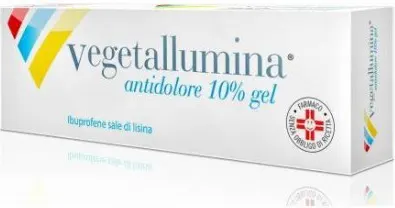
100 g of gel contains: Active ingredient: Ibuprofen lysine salt 10 g Excipients: Sodium methyl parahydroxybenzoate, sodium ethyl parahydroxybenzoate. For a full list of excipients, see section 6.1.
Excipients
Isopropanol, hydroxyethylcellulose, sodium methyl parahydroxybenzoate, sodium ethyl parahydroxybenzoate, glycerol, lavender essence, purified water.
Contraindications
– Hypersensitivity to the active substance or to any of the excipients. Due to the possibility of cross-sensitization, the medicinal product should not be administered to patients in whom acetylsalicylic acid or other nonsteroidal anti-inflammatory drugs have caused asthma, rhinitis, urticaria, or other allergic reactions. – Pregnancy. – Breastfeeding. – Children and adolescents under 14 years of age.
Warnings
It is advisable to avoid applying VEGETALLUMINA Antidolore to open wounds or skin lesions. The use of VEGETALLUMINA Antidolore, as with any drug that inhibits prostaglandin synthesis and cyclooxygenase, is not recommended in women attempting to conceive. Administration of VEGETALLUMINA Antidolore should be discontinued in women who have fertility problems or who are undergoing fertility investigations. Use of VEGETALLUMINA Antidolore, especially if prolonged, may result in local sensitization: at the first appearance of skin rash, mucosal lesions, or any other sign of hypersensitivity, discontinue treatment and take appropriate therapeutic measures. To avoid more serious hypersensitivity or photosensitivity reactions, the patient should avoid direct sunlight, including solariums, during treatment and for two weeks thereafter. In case of allergic reactions or more serious adverse reactions (skin reactions, some of which are fatal, such as exfoliative dermatitis, Stevens-Johnson syndrome, and toxic epidermal necrolysis), therapy must be discontinued immediately (see section 4.8). Patients appear to be at highest risk in the early stages of therapy: the onset of skin reactions occurs in most cases within the first month of treatment. Do not use VEGETALLUMINA Antidolore together with another NSAID or, in any case, do not use more than one NSAID at a time. Important information about some of the excipients of VEGETALLUMINA Antidolore: the medicine contains sodium methyl parahydroxybenzoate and sodium ethyl parahydroxybenzoate, which can cause allergic reactions (possibly delayed).
Pregnancy
The use of VEGETALLUMINA Antidolore is contraindicated during pregnancy and breastfeeding. Inhibition of prostaglandin synthesis may adversely affect pregnancy and/or embryonic/fetal development. Epidemiological studies suggest an increased risk of miscarriage, cardiac malformation, and gastroschisis after use of a prostaglandin synthesis inhibitor in early pregnancy. The absolute risk of cardiac malformations increased from less than 1% to approximately 1.5%. The risk is believed to increase with dose and duration of therapy. In animals, administration of prostaglandin synthesis inhibitors has been shown to result in increased pre- and post-implantation loss and embryonic/fetal mortality. Additionally, an increased incidence of various malformations, including cardiovascular, has been reported in animals administered prostaglandin synthesis inhibitors during the organogenetic period. During the third trimester of pregnancy, all prostaglandin synthesis inhibitors may expose the fetus to: – cardiopulmonary toxicity (with premature closure of the ductus arteriosus and pulmonary hypertension); – renal dysfunction, which may progress to renal failure with oligohydramnios; – the mother and newborn, at the end of pregnancy, to: – possible prolongation of bleeding time and an antiplatelet effect that may occur even at very low doses; – inhibition of uterine contractions resulting in delayed or prolonged labor.
Undesirable Effects
Undesirable effects can be minimized by using the lowest effective dose for the shortest duration necessary to control symptoms. Skin reactions with erythema, itching, irritation, a sensation of heat or burning, and contact dermatitis have been reported with some propionic acid-derived nonsteroidal anti-inflammatory drugs used locally or transdermally. Some cases of bullous eruptions of varying severity, including Stevens-Johnson syndrome and toxic epidermal necrolysis (very rare), have also been reported. Photosensitivity reactions are possible.
Overdose
No cases of overdose have been reported.
Interactions
The limited data and uncertainties regarding their application to the clinical situation do not allow definitive conclusions to be drawn regarding possible interactions with other drugs for the continuous use of ibuprofen; no clinically relevant interactions have been observed with occasional use of ibuprofen. However, it should be noted that ibuprofen may enhance the effects of anticoagulants such as warfarin.
Size
50 g tube
Product Code:FRCM046108





 Richiedi info sul prodotto