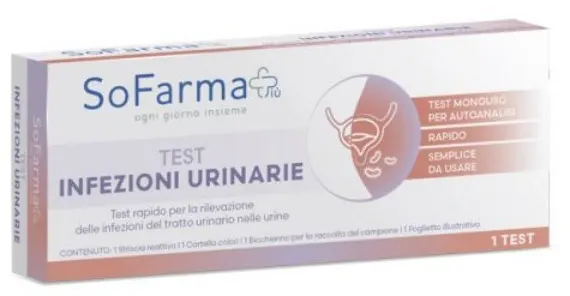
Rapid test for the detection of urinary tract infections in urine.
Indications
The Urinary Infection Test by Sofarmapiù is a self-test for the qualitative detection of the following analytes in urine: blood, proteins, nitrites and leukocytes. The test for urinary tract infections (urine) consists of rigid plastic strips on which several separate reagent areas are applied.
Directions for use
It is recommended to collect a urine sample for testing in the early morning as it is the most concentrated. The urine used for the test should not come into contact with toilet water or any disinfectant or cleaning substance.
For women only: The test should not be performed during or for three days after your menstrual cycle. The urine sample should not be contaminated with vaginal fluids, as this may produce a misleading result. Do not make important medical decisions without first consulting your doctor.
Sample Collection
Collect some of the urine in the plastic cup provided or using a clean cup without residual detergent. Be sure to fill the cup with urine.
Performing the Test
- Open the foil pouch and remove the test strip.
- Do not touch the test fields. Once the pouch is opened, it is recommended to perform the test immediately.
- Immerse the test strip in the urine sample.
- Press the strip and ensure that all four test fields are immersed for approximately 1-2 seconds.
- Then remove the test strip and wipe any excess urine against the edge of the container or with an absorbent material (such as a paper towel) to avoid mixing chemicals from adjacent reagent areas.
- Wait 2 minutes (do not read results after 3 minutes).
- Read the result separately for each parameter; compare the color with the color chart provided.
Reading Results
Read the result separately for each parameter; compare the color with the color chart provided. Color changes at the edges of the test fields or color changes after more than 3 minutes are indicative of a change in color. Tests lasting more than 3 minutes should be ignored.
Negative
The Leukocyte test field remained whitish.
The Blood test field remained mustard yellow.
The Nitrite test field remained white.
The Protein test field remained yellowish.
Positive for Leukocytes: If the color of the test field has changed to purple, leukocytes have been found in the urine. The presence of leukocytes in the urine is an important symptom of inflammation of the kidneys and urinary tract. Taking cephalexin and cephalothin or a high concentration of oxalic acid can also cause test results to be artificially low. Tetracycline can cause reduced reactivity, and high levels of the drug can cause a false negative reaction. High urinary protein content may decrease the intensity of the color reaction.
Positive for blood: If the test field has turned green (or some green spots appear in the background), blood has been found in the urine. A uniform green color change indicates the presence of hemoglobin or hemolyzed red blood cells; scattered or compact green spots indicate intact red blood cells. Urine occult blood is generally attributed to the following three causes: stones, inflammation, and cancer. Inflammation, such as glomerulonephritis, pyelonephritis, cystitis, or hematuria, may also indicate occult blood in the urine. Kidney, ureter, or bladder stones can cause other conditions such as occult blood. Cancer can also cause occult blood, such as benign or malignant tumors of the kidney, ureter, and bladder. Menstrual periods and constipation can also cause occult blood. cause a positive result.
Positive for Nitrites: If the color of the test field has changed to pink, then nitrites have been found in the urine. Gram-negative bacteria in the urine convert nitrates from food into nitrites. Nitrites react with a chemical in the test field and leave a pink tinge. The test result may be distorted if urine does not remain in the bladder for a long time, due to hunger, a plant-free diet, or antibiotic treatment. Comparing the test against a white background can help detect low levels of nitrites, which might otherwise be missed.
Positive for Protein: If the color of the test field has turned green, protein has been found in the urine. An indicator on the test field reacts with protein in the urine, changing its color to green. They can be found where there is inflammation of the bladder or prostate or bleeding in the urinary tract. Infusions containing polyvinylpyrrolidone may produce a false-positive result. The chemicals in the test fields should be considered potentially hazardous substances, although they do not pose a risk if all test components are used according to these instructions.
Warnings
Read the instructions carefully before performing the test. For in vitro diagnostic self-testing only. Use a clean container not contaminated by cleaning fluids to collect urine. Keep out of reach of children. Do not use after the expiration date or if the pouch is damaged. If the foil pouch is damaged or has been opened, do not use. Strictly follow the indicated time. Use the test only once. Do not disassemble or touch the reagent areas of the test strip. For external use only. The used test must be disposed of according to local regulations. If you have difficulty identifying color (such as color blindness), ask for help reading the test. The test may be affected by substances that cause abnormal urine color, such as medications containing azo dyes (e.g., Pyridium, AzoGantrisin, AzoGantanol), nitrofurantoin (Microdantin, Furadantin), and riboflavin. Color development on the test pad may be masked, or a color reaction may be produced that could be interpreted as false results.
Leukocytes: The result should be read at 2 minutes to allow full color development. The intensity of the color that develops is proportional to the number of leukocytes present in the urine specimen. High specific gravity or high glucose concentrations (>2,000 mg/dL) may cause artificially low test results. The presence of cephalexin, cephalothin, or high concentrations of oxalic acid may also cause artificially low test results. Tetracycline may cause reduced reactivity, and high levels of the drug may cause a false-negative reaction. High urinary protein may decrease the intensity of the color reaction. This test will not react with red blood cells or common bacteria in urine.
Blood: A solid green color indicates the presence of myoglobin, hemoglobin, or hemolyzed red blood cells. Scattered or solid green spots indicate intact red blood cells. To improve accuracy, separate color scales are provided for hemoglobin and red blood cells. Positive results with this test are often seen with urine from menstruating females. High urine pH has been reported to reduce sensitivity, while moderate to high concentrations of ascorbic acid may inhibit color formation. Microbial peroxidase, associated with urinary tract infection, may cause a false-positive reaction. The test is slightly more precise. Nitrite: The test is specific for nitrite and will not react with any other substance normally excreted in urine. Any color from pink to solid red should be interpreted as a positive result, suggesting the presence of nitrite. The intensity of the color is not proportional to the number of bacteria present in the urine specimen. Pink spots or pink edges should not be interpreted as a positive result. Comparing the area of the reacted reagent to a white background can aid in the detection of low levels of nitrite, which may otherwise be missed. Ascorbic acid greater than 30 mg/dL may cause false negative results in urine containing less than 0.05 mg/dL of nitrite ions. The sensitivity of this test is reduced for urine specimens with highly buffered alkaline urine or with a high specific gravity. A negative result never excludes the possibility of bacteruria. Negative results may occur with urinary tract infections caused by organisms that do not contain reductase to convert nitrate to nitrite; when urine has not been retained in the bladder long enough (at least 4 hours) for nitrate to be reduced to nitrite; when receiving antibiotic therapy; or when dietary nitrate is absent.
Protein: Any green color indicates the presence of protein in the urine. This test is highly sensitive to albumin and less sensitive to hemoglobin, globulin, and mucoprotein. A negative result does not exclude the presence of these other proteins. False-positive results may occur with highly buffered or alkaline urine. Contamination of urine samples with quaternary ammonium compounds or skin cleansers containing chlorhexidine may produce false-positive results. Urine samples with a high specific gravity may give false negative results.
Storage
Store at room temperature or refrigerated (2-30°C). Do not freeze. Shelf life in unopened packaging: 24 months.
Format
The kit contains: test strip; sample collection cup; color chart; package insert.
Product Code:FRCM209371




 Richiedi info sul prodotto


