




- -15.03%

Recommended price

€13.26
 Richiedi info sul prodotto
Estimated delivery: 1-3 business days

Information on returns and shipments

Payment methods

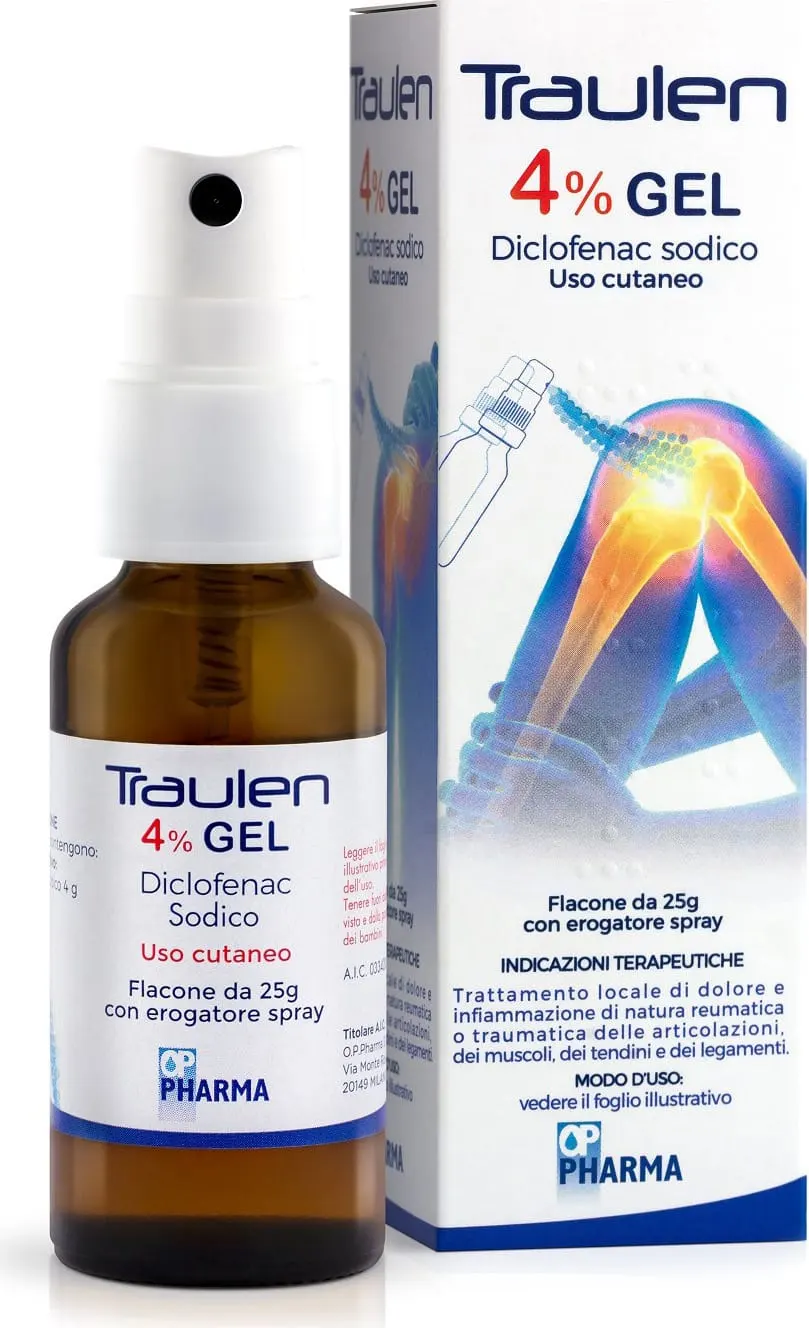
Spray for muscle and joint pain and inflammation.
Traulen 4% Gel is a local treatment for painful and inflammatory conditions of a rheumatic or traumatic nature of the joints, muscles, tendons and ligaments.
Active ingredients:Each 100 g of gel contains 4 g of Diclofenac.
Excipients:Propylene glycol, Isopropyl alcohol, Ethyl alcohol, Soy lecithin, Sodium phosphate dihydrate, Disodium phosphate dodecahydrate, Disodium edetate, Ascorbyl palmitate, Peppermint essence, Purified water.
Adults over 18 years: Three to four applications, depending on the size of the area to be treated, three times a day.
After application, wash your hands, otherwise they will also be treated with the gel.
Caution: Use only for short periods of treatment.
Adolescents aged 14 to 18 years: Three to four applications, depending on the size of the area to be treated, three times a day.
After application, wash your hands, otherwise they will also be treated with the gel.
If this product is needed for more than one day, consult a doctor. Children under 14 years: There are insufficient data on efficacy and safety in children and adolescents under 14 years of age. Therefore, the use of Traulen is contraindicated in children under 14 years of age. Elderly: The usual adult dosage can be used.
The possibility of systemic adverse events with the application of topical diclofenac cannot be excluded if the preparation is used on large areas of skin and for a prolonged period (see the summary of product characteristics of systemic forms of diclofenac).
Therefore, particularly in patients with previous gastrointestinal diseases, the use of Traulen cannot be excluded. To exclude the occurrence of systemic side effects such as nausea, dyspepsia, heartburn, excitement, taste alteration, conjunctivitis for Traulen.Hypersensitivity to diclofenac or to any of the excipients.
Patients in whom attacks of asthma, urticaria or acute rhinitis have occurred after taking acetylsalicylic acid or other non-steroidal anti-inflammatory drugs (NSAIDs).
Third trimester of pregnancy.
Children and adolescents: Use in children and adolescents under 14 years of age is contraindicated.
Since diclofenac is contraindicated in children and adolescents under 14 years of age, it is contraindicated in adults. Systemic absorption of diclofenac following topical application is very low, such interactions are very unlikely.
Traulen is generally well tolerated.
Itching, redness and burning of the skin, skin rashes such as bullous or papular exanthema, skin vesicles, desquamation, tingling, involuntary muscle contractions have occasionally been observed with the use of topical diclofenac.
If applied extensively and for a long period, the appearance of systemic side effects such as nausea, dyspepsia, heartburn, excitement, altered taste, conjunctivitis cannot be ruled out with Traulen.
In this case, consult your doctor.
Adverse reactions (Table below) are listed by frequency, with the most common first. frequent, using the following convention:
| Immune system disorders | |
| Very rare | Hypersensitivity (including urticaria), angioneurotic oedema. |
| Infections and infestations | |
| Very rare | Rash with pustules |
| Respiratory, thoracic and mediastinal disorders | |
| Very rare | Asthma |
| Skin and subcutaneous tissue disorders | |
| Common | Rash, eczema, erythema, dermatitis (including contact dermatitis), pruritus. |
| Rare | Bullous dermatitis. |
| Very rare | Photosensitivity reaction |
The low systemic absorption of topical diclofenac means that it is not recommended to use this product in combination with other medicinal products. that an overdose is very unlikely.
However, adverse effects similar to those observed after an overdose of diclofenac tablets may be expected if topical diclofenac is inadvertently ingested (1 100 g tube contains the equivalent of 1000 mg of diclofenac sodium).
In case of accidental ingestion resulting in significant systemic adverse effects, the general therapeutic measures normally adopted to treat poisoning with non-steroidal anti-inflammatory drugs should be initiated.
Gastric decontamination and the use of activated charcoal should be considered, especially within a short time after ingestion.
Pregnancy
The systemic concentration of diclofenac, compared with oral formulations, is higher than that of other oral formulations. low after topical administration.
Based on experience with treatment with systemically administered NSAIDs, the following is recommended: Inhibition of prostaglandin synthesis may may adversely affect pregnancy and/or embryo/fetal development.
Results of epidemiological studies suggest an increased risk of miscarriage and cardiac malformation and gastroschisis after use of a prostaglandin synthesis inhibitor in early pregnancy.
The absolute risk of cardiac malformations increased from less than 1%, up to approximately 1.5%.
The risk was considered to increase with dose and duration of therapy.
In animals, administration of prostaglandin synthesis inhibitors has been shown to result in increased pre- and post-implantation loss and embryo-fetal mortality.
Furthermore, an increased incidence of various malformations, including cardiovascular, has been reported in animals administered prostaglandin synthesis inhibitors during the organogenetic period.
During the first and second trimesters of pregnancy, diclofenac should not be administered unless clearly indicated. strictly necessary.
If diclofenac is used by a woman attempting to conceive, or during the first and second trimester of pregnancy, the dose should be kept as low as possible and the duration of treatment as short as possible.
During the third trimester of pregnancy, all prostaglandin synthesis inhibitors may expose the fetus to:
the mother and the newborn, at the end of pregnancy, to:
Consequently, diclofenac is contraindicated during the third trimester of pregnancy.
Breastfeeding
Like other NSAIDs, diclofenac passes into breast milk in small amounts.
However, at therapeutic doses of Traulen, no effects on the infant are expected.
Due to the lack of controlled studies in breastfeeding women, the product should be used during breastfeeding only under the advice of a healthcare professional.
In this circumstance, Traulen should not be applied to the breasts of nursing mothers, nor should it be used in the nursing mother's breast. elsewhere on large areas of skin or for a prolonged period of time.
Keep away from heat and open flames.
25 g bottle with spray dispenser
This product has been on sale since 25/09/2017
In the last 30 days, the product's lowest price was 12,28 €
Efficacissimo analgesico topico di emergenza per dolori impedenti il movimento in situazione di crisi muscolare, articolare, tendinea.
Estremamente efficace per lenire dolori articolari e reumatici consigliatissimo
Soffro di epicondilite da qualche mese e grazie all'utilizzo di questo spray, con solo un paio di applicazioni, ho trovato sollievo. Lo consiglio caldamente.
Ottimo rimedio per tutti i dolori delle ossa e per gli strappi. Posso dire di averlo consigliato più volte e con ottimi risultati.
Non lo uso da molto ma sto avendo giovamenti

Estimated delivery: 1-3 business days

Estimated delivery: 1-3 business days


Estimated delivery: 1-3 business days

Estimated delivery: 1-3 business days

