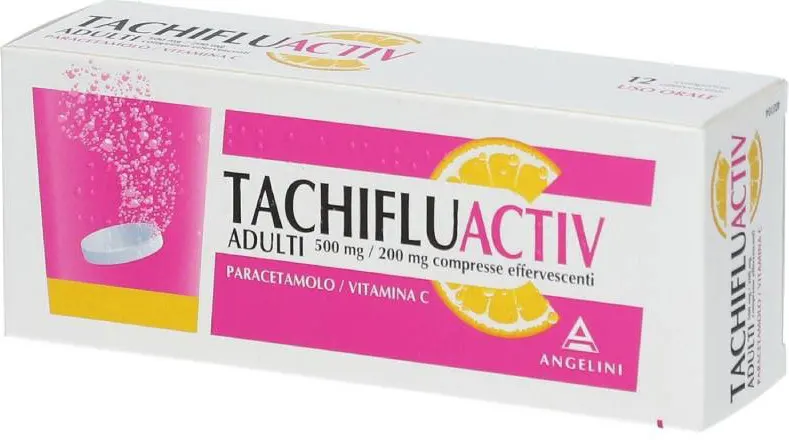
Symptomatic treatment of influenza and feverish conditions and as an analgesic for pain of various kinds.
Indications
Symptomatic treatment of influenza and feverish conditions of all types (fever resulting from colds, exanthematous or infectious diseases). As an analgesic for rheumatic joint and muscle pain, neuralgia, headaches and menstrual pain.
Ingredients
Each effervescent tablet contains:
Active ingredients: paracetamol 500 mg and vitamin C 200 mg.
Excipients: Anhydrous citric acid, Sodium bicarbonate, Anhydrous sodium carbonate, Acesulfame K, Sorbitol, Orange flavouring, Simethicone emulsion, Sodium docusate, Sunset yellow (E110).
Dosage and Directions for Use
1 effervescent tablet at a time, to be repeated if necessary after 4 hours, without exceeding 6 administrations per day. In case of severe pain or high fever, take 2 effervescent tablets, to be repeated if necessary after not less than 4 hours. Do not administer for more than 3 consecutive days without consulting your doctor.
The effervescent tablet must be dissolved in a glass of water.
Warnings
During treatment with TACHIFLUACTIV INFLUENZA E RAFFREDDORE, before taking any other medicine, check that it does not contain paracetamol, since if this active ingredient is taken in high doses, serious adverse reactions can occur. The risk of serious side effects is also increased when paracetamol is taken together with other antipyretic analgesics; therefore, the concomitant use of these types of medicines should be avoided. TACHIFLUACTIV INFLUENZA E RAFFREDDORE should be used with caution in patients with: renal insufficiency; hepatic insufficiency; acute hepatitis; glucose-6-phosphate dehydrogenase deficiency; haemolytic anaemia; chronic malnutrition and dehydration; Cardiovascular disease, tachycardia or palpitations, angina, arrhythmias; diabetes mellitus; prostatic hypertrophy causing urinary disorders; psychosis; hyperthyroidism; asthma; glaucoma; hypertension. Severe skin reactions: Severe skin reactions such as acute generalized exanthematous pustulosis (AGEP) may occur with products containing pseudoephedrine. This acute pustular eruption may occur within the first 2 days of treatment, with fever and numerous, small, mostly non-follicular pustules arising from a widespread edematous erythema and located mainly in the skin folds, trunk, and upper limbs. Patients should be carefully monitored. If signs and symptoms such as pyrexia, erythema, or numerous small pustules are observed, administration of TACHIFLUACTIV INFLUENZA E RAFFREDDORE should be discontinued and appropriate measures taken if necessary. Ischemic colitis: Some cases of ischemic colitis have been reported with pseudoephedrine-containing medicines. Pseudoephedrine should be discontinued and medical advice should be sought if sudden abdominal pain, rectal bleeding, or other symptoms of ischemic colitis occur. Ischemic optic neuropathy: Cases of ischemic optic neuropathy have been reported with pseudoephedrine. Pseudoephedrine should be discontinued if sudden vision loss or reduction in visual acuity, such as scotoma, occurs. Patients should be advised not to take other medicines containing paracetamol concomitantly due to the risk of serious liver damage in the event of overdose (see section 4.9). Alcoholic beverages should be avoided while taking this medicine because alcohol used concomitantly with paracetamol can cause liver damage (see section 4.5). Paracetamol should be administered with caution to patients with alcohol dependence (see section 4.5). This medicine should be given with caution to patients being treated with other medicinal products that affect the liver (see section 4.5). It is recommended to reduce the dose during treatment with oral anticoagulants. The patient should be advised to consult a doctor if he or she is already being treated with other medicinal products. Caution is advised if paracetamol is administered concomitantly with flucloxacillin due to the increased risk of high anion gap metabolic acidosis (HAGMA), particularly in patients with severe renal impairment, sepsis, malnutrition, and other sources of glutathione deficiency (e.g., chronic alcoholism), as well as in those using maximum daily doses of paracetamol. Careful monitoring is recommended, including measurement of urinary 5-oxoproline. In case of surgery, it is advisable to discontinue treatment a few days beforehand, because the risk of hypertensive crisis is increased if halogenated anaesthetics are used (see section 4.5). For athletes: Use of this medicine may result in a positive doping test. Patients should consult their doctor if:
- Nasal pain or congestion worsens or lasts longer than usual. than 5 days (or if symptoms do not improve within 5 days;
- the fever gets worse or lasts more than 3 days;
- there is redness or swelling or if new symptoms occur.
TACHIFLUACTIV INFLUENZA E RAFFREDDORE 500 mg/60 mg effervescent tablets contain: - Aspartame (E 951): a source of phenylalanine, may be harmful for people with phenylketonuria. There are no non-clinical or clinical studies available on the use of aspartame in children under 12 weeks of age. - Sorbitol (E 420): patients with hereditary fructose intolerance should not be given this medicine. - Sodium: this medicine contains 324 mg (14 mmol) per tablet, equivalent to approximately 16% of the maximum daily intake. recommended by the WHO, which corresponds to 2 g of sodium for an adult. Simethicone emulsion also contains: Benzoic acid: This medicine contains 0.06 mg of benzoic acid per tablet equivalent to 0.06 mg/3 g.
Interactions
The drug interactions that can be caused by each individual component are well known and are listed below. There is no indication that these may change with combined use. The administration of paracetamol may interfere with the determination of uric acid (by the phosphotungstic acid method) and blood glucose (by the glucose-oxidase-peroxidase method). Use with extreme caution and under close monitoring during chronic treatment with drugs that can induce hepatic monooxygenases or in case of exposure to substances that can have this effect (for example: rifampicin, cimetidine, ranitidine). Paracetamol The anticoagulant effect of warfarin and other coumarin derivatives may be enhanced by prolonged regular use of paracetamol, increasing the risk of bleeding. Occasional paracetamol use has no significant effect. Hepatotoxic substances may increase the risk of paracetamol accumulation and overdose. The risk of paracetamol hepatotoxicity may be increased by drugs that induce microsomal liver enzymes such as barbiturates, antiepileptics (e.g., phenytoin, phenobarbital, carbamazepine, glutethimide), and drugs for the treatment of tuberculosis such as rifampicin and isoniazid. Metoclopramide may increase the rate of paracetamol absorption, increasing plasma levels. Similarly, domperidone may increase the rate of paracetamol absorption. The half-life of chloramphenicol may be prolonged by Paracetamol. Paracetamol may reduce the bioavailability of lamotrigine, potentially reducing its effects, due to the potential induction of its hepatic metabolism. Cholestyramine may reduce the absorption of paracetamol. Cholestyramine should not be administered within one hour of paracetamol administration. Regular use of paracetamol with zidovudine may cause neutropenia and increase the risk of liver damage. Probenecid, the treatment for gout, reduces the clearance of paracetamol; therefore, the dose of paracetamol may be reduced in case of concomitant treatment. Caution should be exercised when paracetamol is used concomitantly with flucloxacillin, as concomitant use has been associated with high anion gap metabolic acidosis, especially in patients with risk factors (see section 4.4). Hepatotoxicity of Paracetamol may be potentiated by excessive alcohol intake (See section 4.4). Pseudoephedrine Monoamine oxidase inhibitors (MAOIs): Pseudoephedrine may potentiate the action of monoamine oxidase inhibitors and may induce hypertensive crisis (hypertension, hyperpyrexia, headache). The medicine is therefore contraindicated in patients who are taking or have taken MAOIs in the last two weeks. Pseudoephedrine may reduce the effect of other antihypertensive drugs (e.g. debrisoquine, guanethidine, reserpine, methyldopa). The risk of hypertension and other cardiovascular side effects may be increased. Halogenated anaesthetics: Pseudoephedrine may interact with halogenated anaesthetics. Concomitant use of pseudoephedrine with other sympathomimetics or tricyclic antidepressants may increase the risk of adverse effects. Cardiovascular side effects. Concomitant use of pseudoephedrine with digoxin and cardiac glycosides may increase the risk of irregular heartbeat or heart attack. Ergot alkaloids (ergotamine and methysergide): Concomitant use may cause an increased risk of ergotism. Concomitant use of linezolid may increase the risk of hypertension. Concomitant use of midodrine may increase the hypertensive effect of midodrine. Due to the possible effects caused by their interaction, the combination of pseudoephedrine with certain medicines is only possible under strict medical supervision, who will evaluate the risk/benefit ratio in each individual case.
Side effects
Adverse events are tabulated below by class and frequency. Frequencies are defined as:
very common (> 1/10);
common (> 1/10); 1/100, < 1/10);
uncommon (≥ 1/1,000, < 1/100);
rare (≥ 1/10,000, < 1/1,000);
very rare (< 1/10,000), or not known (frequency cannot be estimated from the available data).
Blood and lymphatic system disorders. Very rare: thrombocytopenia, agranulocytosis, leukopenia, pancytopenia. Immune system disorders. Rare: hypersensitivity, angioedema; Not known: anaphylactic reactions, Stevens-Johnson syndrome, toxic epidermal necrolysis. Psychiatric disorders. Rare: nervousness, insomnia, anxiety, agitation, hallucinations have been reported rarely, particularly in children. Nervous system disorders. Rare: Dizziness, headache, tremors. Eye disorders. Not known: ischemic optic neuropathy. Cardiac disorders. Rare: tachycardia, palpitations. Vascular disorders. Rare: hypertension. Gastrointestinal disorders. Rare: vomiting, dry mouth, nausea; Not known: ischemic colitis. Hepatobiliary disorders. Rare: increased liver enzymes. Skin and subcutaneous tissue disorders. Rare: rash, erythema, urticaria, pruritus; Very rare: serious skin reactions have been reported; Not known: serious skin reactions, including acute generalized exanthematous pustulosis (AGEP). Renal and urinary disorders. Rare: urinary retention, especially in patients with prostatic hypertrophy. The following adverse reactions have also been reported: sweating, thirst, precordial pain, difficulty urinating, muscle weakness, mydriasis, gastric problems, ventricular arrhythmias, erythema multiforme, edema of the prostate. larynx, anaphylactic shock, anemia, liver function abnormalities, hepatitis, acute renal failure, interstitial nephritis, hematuria, anuria. Reporting of suspected adverse reactions Reporting suspected adverse reactions that occur after authorization of the medicinal product is important, as it allows continued monitoring of the benefit/risk balance of the medicinal product. Healthcare professionals are asked to report any suspected adverse reactions via the national reporting system at https://www.aifa.gov.it/content/segnalazioni-reazioni-avverse.
Overdose
In case of overdose, the symptoms caused by paracetamol overdose will be the most important. Paracetamol In adults, the maximum daily dose of paracetamol is 4 g; above this limit there is a risk of dose-dependent hepatotoxicity. In case of acute overdose, paracetamol may exert a Hepatotoxicity or even liver necrosis. Paracetamol overdose, including high total dose levels achieved over a prolonged period, can cause nephropathy with irreversible liver failure. Patients should be advised not to take other medications containing paracetamol at the same time. There is a risk of poisoning, particularly in the elderly, children, patients with liver disease, chronic alcoholism, patients with chronic malnutrition, and patients treated with enzyme inducers. Paracetamol overdose can cause liver failure, encephalopathy, coma, and death. Symptoms of paracetamol overdose in the first 24 hours include pallor, nausea, vomiting, and anorexia. Abdominal pain may be the first indication of liver damage, which is usually not evident for 24–48 hours and can sometimes be delayed up to 4–6 days after ingestion. Liver damage generally reaches a maximum 72-96 hours after ingestion. Abnormalities in glucose metabolism and metabolic acidosis may occur. Acute renal failure with acute tubular necrosis may develop even in the absence of severe liver damage. Cardiac arrhythmias and pancreatitis have been reported. Immediate treatment is essential in the management of paracetamol overdose. Early administration of N-acetylcysteine IV or oral as an antidote to paracetamol, possibly gastric lavage and/or oral methionine administration, may have beneficial effects for at least 48 hours after the overdose. Administration of activated charcoal and active monitoring of respiration and circulation may be helpful. In cases of seizures, diazepam may be administered. Pseudoephedrine hydrochloride Due to the nature of this sympathomimetic agent, overdose leads to central nervous system stimulation. Symptoms include irritability, restlessness, excitation, tremor, convulsions, palpitations, hypertension and difficulty urinating. However, overall data indicate that pseudoephedrine is well tolerated and safe when used as a nasal decongestant at the recommended dose, and does not produce irreversible toxicity even with a significant overdose. In the event of a very severe overdose, interventions should be made to control convulsions; diazepam can be used as an anticonvulsant and sedative. Measures should be taken to support respiration. Beta-blockers may be used to limit possible side effects such as tachycardia, arrhythmia, and hypokalemia. If necessary, gastric lavage may be attempted to remove the drug. Dialysis or acid diuresis may be used to accelerate the elimination of pseudoephedrine. Bladder catheterization may be necessary.
Pregnancy and Breastfeeding
TACHIFLUACTIV INFLUENZA E RAFFREDDORE is contraindicated during pregnancy. and during breastfeeding. The safety of TACHIFLUACTIV INFLUENZA E RAFFREDDORE during pregnancy and breastfeeding has not been specifically studied. Available data on the potential effects of each individual component on pregnancy and breastfeeding are summarised below: Pregnancy Epidemiological studies during pregnancy have shown no adverse effects due to paracetamol used at the recommended dosage. Reproduction studies involving oral administration have shown no signs of malformations or foetotoxicity (see section 5.3). Under normal conditions of use, paracetamol can be administered during pregnancy after considering the risk/benefit ratio. There are limited data on the use of pseudoephedrine in pregnant women. Vasoconstriction of the uterine vessels and reduced uterine blood flow associated with the use of pseudoephedrine can cause foetal hypoxia. The use of pseudoephedrine is contraindicated during pregnancy. Breastfeeding Both paracetamol and pseudoephedrine pass into breast milk in small amounts. Since no data are available on the association of the two substances, the medicine should be avoided during breastfeeding. Fertility The effects of TACHIFLUACTIV INFLUENZA E RAFFREDDORE on fertility have not been specifically studied. Preclinical studies with paracetamol do not indicate any particular risks for fertility at therapeutically relevant doses. There are insufficient reproductive toxicology studies with pseudoephedrine.
Format
12 effervescent tablets
Product Code:FRCM046122




 Richiedi info sul prodotto