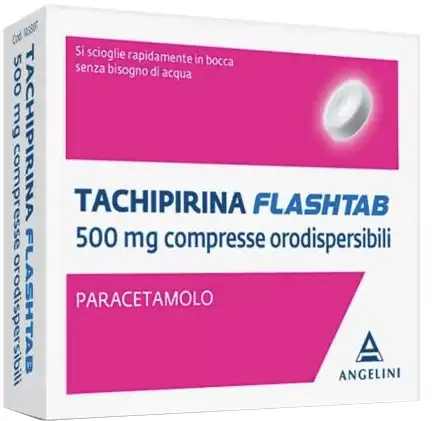
Analgesic and antipyretic drug, based on paracetamol, useful for the treatment of pain of various origins and nature and for the symptomatic treatment of fever in adults.
Indications
Tachipirina Flashtab 500 mg is a drug useful for lowering fever and for intervening on pain in cases of headaches, flu-like syndromes, contractures, toothache and other minor painful conditions.
This medicine is for adults only. Do not administer Tachipirina Flashtab 500 mg to children.
Dosage
The usual dose is one tablet of Tachipirina Flashtab 500 mg, to be repeated, if necessary, after a minimum of 4 hours. In case of severe pain or high fever, take 2 500 mg tablets, to be repeated, if necessary, after a minimum of 4 hours.
The total dose of paracetamol should not exceed 3000 mg per day for adults. Do not exceed 6 500 mg tablets per day. Do not exceed the recommended dose.
For patients with severe renal insufficiency, the interval between the two doses must be at least 8 hours.
It is necessary to consult a doctor if the symptoms worsen or do not improve after 3 days.
Directions for use
The tablet dissolves rapidly on contact with saliva: it should be sucked and not chewed but can be swallowed. It can also be dissolved in half a glass of water.
Components
Active ingredient: paracetamol 500 mg, as coated paracetamol crystals.
Excipients: basic butylated methacrylate copolymer, 30% polyacrylate dispersion, silica (colloidal hydrophobic), mannitol (granules, powder), crospovidone, aspartame (E951), blackcurrant flavouring, magnesium stearate.
Contraindications
Tachipirina Flashtab should not be taken in case of:
- Hypersensitivity to the active ingredient or to any of the excipients listed;
- phenylketonuria, since Contains aspartame;
- Severe liver disease.
Warnings
Do not exceed the recommended dose. Prolonged use of the product without medical supervision may be harmful. This product should be used only if strictly necessary. Doses higher than recommended carry a risk of very serious liver damage. Treatment with an antidote should be administered as soon as possible.
To avoid the risk of overdose, avoid the simultaneous use of other medicines containing paracetamol.
The ingestion of undissolved tablets should be avoided in children under 6 years of age as this could lead to their inhalation.
This medicine contains aspartame, a source of phenylalanine, equivalent to 0.15 mg per tablet and is therefore contraindicated in subjects with phenylketonuria.
Paracetamol should be used with caution in case of:
- adults weighing less than 50 kg;
- mild to moderate hepatocellular insufficiency (note: paracetamol is contraindicated in cases of severe hepatocellular insufficiency);
- chronic alcoholism;
- chronic malnutrition (low hepatic glutathione reserves);
- dehydration;
- severe renal insufficiency (creatinine clearance <10 ml/min).
Combination with another antipyretic is not justified unless the treatment is ineffective. In case of high fever, or signs of secondary infection, or if symptoms persist for more than 3 days, the treatment should be reevaluated with your doctor.
Interactions
Probenecid causes a reduction of at least 2-fold in the clearance of paracetamol by inhibiting its conjugation with glucuronic acid. In case of concomitant treatment with probenecid, a reduction in the dosage of paracetamol should be considered.
Salicylamide can prolong the elimination half-life of paracetamol.
Paracetamol should be used with caution in case of concomitant use of enzyme inducers (such as carbamazepine, phenobarbital, phenytoin, primidone, rifampicin, St. John's Wort or St. John's Wort) or potentially hepatotoxic substances.
Metoclopramide and domperidone: accelerate the absorption of paracetamol.
Cholestyramine: reduces the absorption of paracetamol.
The concomitant use of paracetamol (4 g per day for at least 4 days) with oral anticoagulants may induce slight variations in INR values with a consequent increase in the risk of bleeding. In these cases, more frequent monitoring should be conducted. Frequent changes in INR values during concomitant use and after its discontinuation.
Interactions with clinical tests: The administration of paracetamol may alter the measurement of uric acid in the blood, obtained with the phosphotungstic acid method, and the measurement of blood glucose obtained with the glucose oxidase-peroxidase method.
Undesirable effects
System organ class: rare (from >=1/10,000 to <1/1,000); very rare (<1/10,000), not known.
Hepatobiliary disorders: increased levels of hepatic transaminases.
Immune system disorders: hypersensitivity reaction (from simple skin rash or urticaria to anaphylactic shock requiring discontinuation of treatment).
Blood and lymphatic system disorders: thrombocytopenia, leukopenia, neutropenia (sporadic reports).
Skin and subcutaneous tissue disorders: very rare cases of serious skin reactions have been reported.
Pregnancy and breastfeeding
Epidemiological data on the use of therapeutic oral doses of paracetamol show no adverse effects on pregnancy or on the health of the fetus/newborn. Prospective data on pregnancies exposed to overdoses have not shown an increased risk of malformations. Reproduction studies performed with oral administration have not shown any malformations or fetotoxic effects. Consequently, under normal conditions of use, paracetamol can be used during pregnancy after an assessment of the risk-benefit ratio. During pregnancy, paracetamol should not be taken for long periods, at high doses, or in combination with other medications, as its safety has not been established. After oral administration, paracetamol is excreted in breast milk in small amounts. No adverse effects on breastfed infants have been reported. Therapeutic doses of this medicine can be taken during breastfeeding.
Format
Blister pack containing 16 dispersible tablets.
Product Code:FRCM046959




 Richiedi info sul prodotto