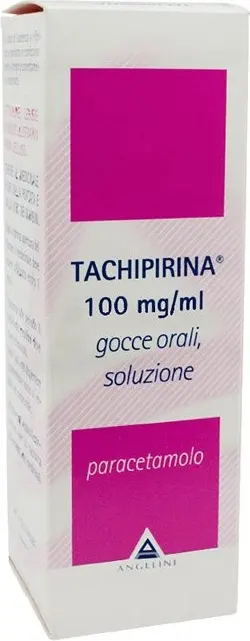
A drug based on paracetamol useful as an antipyretic and analgesic.
Indications
Tachipirina drops is a drug that, thanks to its active ingredient (paracetamol), acts as an antipyretic (i.e., to reduce fever) and as an analgesic (i.e., to relieve pain).
As an antipyretic it can be used for the symptomatic treatment of febrile conditions in cases of influenza, exanthematous diseases, acute respiratory tract conditions, etc.
As an analgesic it can be used in case of headaches, neuralgia, myalgia and other painful conditions of various origins and of medium intensity.
Composition
Tachipirina drops for children and adults 100 mg/ml contains:
Active ingredient
1 ml of solution contains 100 mg of paracetamol.
Excipients
Propylene glycol, Macrogol 6000, sorbitol, sodium saccharin, flavoring: citrus and vanilla, propyl gallate, caramel (E150a), sodium edetate, purified water.
Tachipirina drops: Dosage and method of use
The administration of Tachipirina drops for children must respect the dosage defined based on their body weight. For children up to 10 years of age, it is essential to follow the dosage established based on body weight and not age, which is approximate and provided for information purposes only. If the child's age does not correspond to the weight shown in the table, always refer to body weight when choosing the dosage.
The dosage schedule for Tachipirina oral drops, solution is as follows.
| Weight | Age (approximate) | Single dose | Daily dose |
| from 3.2 kg | 30 days | 8 drops | Up to 4 times (every 6 hours) |
| from 4.3 kg | 1 month | 10 drops | Up to 4 times (every 6 hours) |
| from 5.3 kg | 2 months | 13 drops | Up to 4 times (every 6 hours) |
| from 6.1 kg | 3 months | 22 drops | Up to 4 times (every 6 hours) |
| from 6.7 kg | 4 months | 25 drops | Up to 4 times (every 6 hours) |
| from 7.2 kg | 5-6 months | 27 drops | Up to 4 times (every 6 hours) |
| from 8 kg | 7-10 months | 30 drops | Up to 4 times (every 6 hours) |
| from 9 kg | 11-14 months | 33 drops | Up to 4 times (every 6 hours) |
| from 10 kg | 15-19 months | 36 drops | Up to 4 times (every 6 hours) |
| from 11 kg | 20-23 months | 39 drops | Up to 4 times (every 6 hours) |
In adults, the maximum oral dosage is 3000 mg of paracetamol per day. Each drop contains 4 mg of paracetamol. The doctor should evaluate the need for treatment for more than 3 consecutive days. In case of severe renal insufficiency (creatinine clearance less than 10 ml/min), the interval between administrations must be at least 8 hours, both in children and adults.
To administer Tachipirina drops to children and adults, invert the bottle and pour the number of drops corresponding to the dosage to be used into 25–50 ml of water.
Pregnancy and breastfeeding
The use of Tachipirina drops during pregnancy or while breastfeeding, although clinical studies have not highlighted particular contraindications or caused adverse effects on the mother or child, is recommended only in cases of actual need and under the direct supervision of a doctor.
Warnings and precautions
In rare cases of allergic reactions, administration must be suspended and appropriate treatment must be initiated.
Use with caution in cases of chronic alcoholism, excessive alcohol intake (3 or more alcoholic drinks per day), anorexia, bulimia or cachexia, chronic malnutrition (low hepatic glutathione reserves), dehydration, hypovolemia.
Paracetamol should be administered with caution to patients with mild to moderate hepatocellular insufficiency (including Gilbert's syndrome), severe hepatic insufficiency (Child-Pugh>9), acute hepatitis, concomitant treatment with drugs that alter liver function, glucose-6-phosphate dehydrogenase deficiency, hemolytic anemia.
High or prolonged doses of the product can cause alterations to the kidneys and blood, even serious ones, therefore, administration to patients with renal insufficiency should be carried out only if really necessary and under direct medical supervision. In case of prolonged use, it is advisable to monitor liver and kidney function and blood counts.
During treatment with paracetamol, before taking any other medication, check that it does not contain the same active ingredient, since if paracetamol is taken in high doses, serious adverse reactions can occur. Contact your doctor before combining any other medication.
Important information about some excipients:
Sorbitol should be used with caution in patients with rare hereditary problems of fructose intolerance.
Propylene glycol can cause symptoms similar to those caused by alcohol.
The container of Tachipirina drops, solution is made of latex rubber: it can cause serious allergic reactions.
Interactions
The oral absorption of paracetamol depends on the speed of gastric emptying. Therefore, concomitant administration of drugs that slow (e.g., anticholinergics, opioids) or increase (e.g., prokinetics) the rate of gastric emptying may result in a decrease or increase in the bioavailability of the product, respectively. Concomitant administration of cholestyramine reduces the absorption of paracetamol. Concomitant use of paracetamol and chloramphenicol may increase the half-life of chloramphenicol, with the risk of increasing its toxicity. Concomitant use of paracetamol (4 g daily for at least 4 days) with oral anticoagulants may cause slight changes in INR values. In these cases, more frequent monitoring of INR values should be conducted during concomitant use and after its discontinuation. Use with extreme caution and under close monitoring during chronic treatment with drugs that can induce hepatic monooxygenases or in case of exposure to substances that can have this effect (for example, rifampicin, cimetidine, antiepileptics such as glutethimide, phenobarbital, carbamazepine). The same applies in cases of alcoholism and in patients treated with zidovudine. The administration of paracetamol may interfere with the determination of uric acid (using the phosphotungstic acid method) and blood glucose (using the glucose-oxidase-peroxidase method).
Contraindications
• Hypersensitivity to the active substance or to any of the excipients.
• Patients suffering from severe hemolytic anemia (this contraindication does not apply to the 500 mg oral formulations).
• Severe hepatocellular insufficiency (this contraindication does not apply to the 500 mg oral formulations).
Undesirable effects
The following are the undesirable effects of paracetamol organised according to the MedDRA system organ class. There are insufficient data to establish the frequency of the individual effects listed.
Blood and lymphatic system disorders: Thrombocytopenia, leukopenia, anemia, agranulocytosis.
Immune system disorders: Hypersensitivity reactions (urticaria, laryngeal edema, angioedema, anaphylactic shock).
Nervous system disorders: Dizziness.
Gastrointestinal disorders: Gastrointestinal reaction.
Hepatobiliary disorders: Abnormal liver function, hepatitis.
Skin and subcutaneous tissue disorders: Erythema multiforme, Stevens-Johnson syndrome, epidermal necrolysis, rash.
Renal and urinary disorders: Acute renal failure, interstitial nephritis, haematuria, anuria.
Furthermore, very rare cases of serious skin reactions have been reported.
Format
30 ml bottle of 100 mg/ml solution.
Product Code:FRCM046966




 Richiedi info sul prodotto