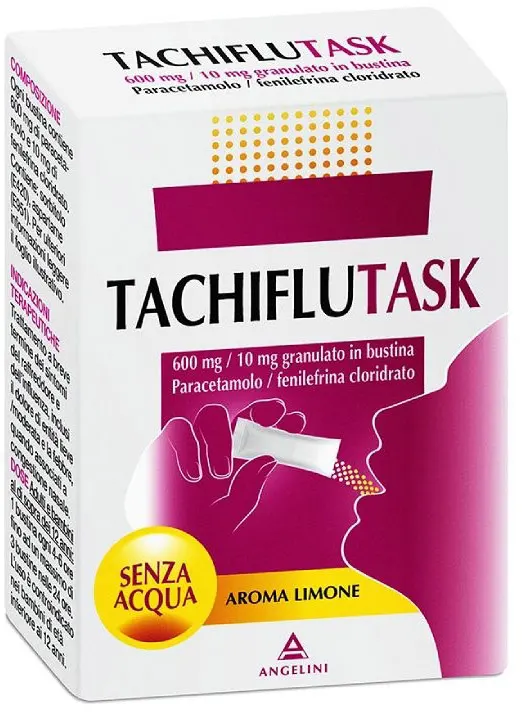
Sachets to combat the symptoms of colds and flu.
Indications
Tachiflutask 600 mg / 10 mg is a medicine in sachets for the short-term treatment of the symptoms of colds and flu, including mild/moderate pain and fever, when associated with nasal congestion.
Lemon flavour.
Ingredients
Active ingredients: Each sachet contains paracetamol 600 mg and phenylephrine hydrochloride 10 mg (equivalent to phenylephrine 8.2 mg).
Excipients: Mannitol (E 421), Xylitab 200 (xylitol, carboxymethylcellulose), lemon flavouring, sorbitol (E 420), ascorbic acid, citric acid, hydrated colloidal silica, aspartame (E 951), sodium saccharin.
How to use and Dosage
Adults and children over 12 years: 1 sachet every 46 hours and up to a maximum of 3 sachets in 24 hours.
The medicine should not be used for more than 1 day. for 3 consecutive days without consulting your doctor.
Paediatric population.
Children under 12 years: Tachiflutask is contraindicated in children under 12 years of age.
Method of administration: Place the granules directly on the tongue and swallow.
Tachiflutask dissolves in saliva: this allows it to be used without water.
The contents of the sachet can be swallowed. It can also be dissolved in a glass of hot (not boiling) water, stirring with a teaspoon.
If desired, dilute with cold water to cool and sweeten.
Once prepared, the solution should be drunk within a few minutes.
Warnings
Patients should be advised not to take other medicines containing paracetamol while taking Tachiflutask as high doses of paracetamol can cause serious adverse reactions.
Avoid alcohol consumption during treatment with Tachiflutask.
The risk of overdose is greater in patients with liver problems.
Instruct the patient to contact their doctor before combining warfarin or any other drug.
The use of the product is not recommended if the patient is being treated with anti-inflammatory drugs.
Caution is advised if paracetamol is administered concomitantly with flucloxacillin due to the risk of overdose. of the increased risk of high anion gap metabolic acidosis (HAGMA), particularly in patients with severe renal impairment, sepsis, malnutrition and other sources of glutathione deficiency (e.g. chronic alcoholism), as well as in those using maximum daily doses of paracetamol.
Careful monitoring is recommended, including measurement of urinary 5-oxoproline.
Consult your doctor before using the product in patients with enlarged prostate gland or occlusive vascular diseases (e.g. Raynaud's syndrome).
Do not exceed the recommended dose and do not administer for more than 3 consecutive days.
Tachiflutask contains aspartame: this substance can be harmful to people with phenylketonuria.
Tachiflutask contains less than 1 mmol (23 mg) sodium per tablet, i.e. it is essentially sodium-free.
Contraindications
Children under 12 years of age.
Hypersensitivity to the active substances or to any of the excipients.
Patients taking beta-blockers.
Patients taking tricyclic antidepressants and those taking or who have taken in the last 2 weeks monoamine oxidase inhibitors.
Patients with bronchial asthma, pheochromocytoma, narrow-angle glaucoma, or who are simultaneously taking other sympathomimetic medicinal products (such as decongestants, appetite suppressants and amphetamine-like psychostimulants).
Patients with hepatic or renal insufficiency, diabetes, hyperthyroidism, hypertension and cardiovascular diseases. cardiovascular.
Paracetamol-based products are contraindicated in patients with manifest glucose-6-phosphate dehydrogenase deficiency and in those affected by severe haemolytic anaemia.
Severe hepatocellular insufficiency.
Interactions
Paracetamol: the hepatotoxic effect of paracetamol may be potentiated by the intake of other drugs acting on the liver such as zidovudine and isoniazid which can produce an inhibition of the metabolism of paracetamol.
The administration of probenecid before paracetamol decreases the clearance of paracetamol and the urinary elimination of paracetamol sulfate and paracetamol glucuronide, and increases the half-life of paracetamol itself.
Use with extreme caution and under close monitoring during chronic treatment with drugs that can determine the induction of hepatic monooxygenases or in case of exposure to substances that can have this effect (for example rifampicin, cimetidine, antiepileptics such as glutethimide, phenobarbital, carbamazepine).
Paracetamol increases the half-life of chloramphenicol.
The product taken in high doses can potentiate the effect of coumarin anticoagulants (warfarin).
Metoclopramide and domperidone may increase the absorption of paracetamol, while it is reduced or delayed by cholestyramine and anticholinergics, respectively.
Caution should be exercised when paracetamol is used concomitantly with flucloxacillin since concomitant use has been associated with high anion gap metabolic acidosis, especially in patients with risk factors.
Phenylephrine: Phenylephrine may antagonize the effect of beta-blockers and antihypertensive drugs (including debrisoquine, guanethidine, reserpine, and methyldopa) and may potentiate the action of monoamine oxidase inhibitors.
Concomitant use of phenylephrine with tricyclic antidepressants or sympathomimetic amines may increase the risk of angioedema. increase the risk of cardiovascular effects.
Phenylephrine may interact with digoxin and cardiac glycosides, increasing the risk of arrhythmia or heart attack, and with alkaloids (ergotamine and methylsergide), increasing the risk of ergotism.
Interference with some laboratory tests: the administration of paracetamol may interfere with the determination of uric acid (using the phosphotungstic acid method) and blood glucose (using the glucose-oxidase-peroxidase method).
Undesirable effects
The following undesirable effects are listed below, organised according to the MedDRA System Organ Class.
Frequency is defined as follows: very common (>=1/10), common (from >=1/100 to <1/10), uncommon (from >=1/1,000 to <1/100), rare (from >=1/10,000 to <1/1,000), very rare (<1/10,000), not known (frequency cannot be estimated from the available data).
Blood and lymphatic system disorders:
Rare: agranulocytosis*, leukopenia*, thrombocytopenia*; not known: anaemia*.
Immune system disorders:
Rare: allergic reactions*,**, hypersensitivity reactions*,**, anaphylaxis*,**; Not known: anaphylactic shock*,**.
Metabolism and nutrition disorders:
Common: anorexia**.
Psychiatric disorders:
Very rare: insomnia**, nervousness**, anxiety**, restlessness**, confusion**, irritability**.
Nervous system disorders:
Very rare: tremor**, dizziness**, headache**.
Eye disorders:
Not known: mydriasis**, acute angle-closure glaucoma**.
Cardiac disorders:
Rare: tachycardia**, palpitations**.
Vascular disorders:
Not known: hypertension**.
Respiratory, thoracic and Mediastinal disorders:
Rare: bronchospasm*,**; not known: laryngeal edema*.
Gastrointestinal disorders:
Common: nausea**, vomiting**; not known: diarrhoea*, gastrointestinal disorder*.
Hepatobiliary disorders:
Rare: abnormal liver function*; not known: liver disorder*, hepatitis*.
Skin and subcutaneous tissue disorders:
Rare: rash*,**, angioedema**; not known: toxic epidermal necrolysis*, Stevens Johnson syndrome*, erythema multiforme or polymorphous*.
Renal and urinary disorders:
Very rare: tubulointerstitial nephritis (after prolonged use of paracetamol at high doses)*; Not known: aggravated renal failure*, haematuria*, anuria*, urinary retention.
* Side effects associated with paracetamol.
** Side effects associated with phenylephrine Very rare cases of serious skin reactions have been reported.
Pregnancy and Breastfeeding
- Pregnancy
Paracetamol: A large amount of data on pregnant women indicate neither malformative nor fetal/neonatal toxicity.
Epidemiological studies on neurodevelopment in children exposed to paracetamol in utero show inconclusive results.
If clinically needed, paracetamol can be used during pregnancy, however it should be used at the lowest effective dose for the shortest possible time and with the most appropriate dose. low frequency possible.
The administration of the preparation during pregnancy and breastfeeding must take place under the direct supervision of a doctor.
Phenylephrine: data on the use of phenylephrine during pregnancy are limited.
Vasoconstriction of the uterine vessels and reduction of blood flow to the uterus associated with the use of phenylephrine can result in fetal hypoxia.
The use of phenylephrine during pregnancy should be avoided as further information is needed. - Breastfeeding
Paracetamol: paracetamol is excreted in breast milk but in clinically insignificant quantities.
Available published data do not contraindicate its use during breastfeeding.
Phenylephrine: there are no data available regarding the excretion of phenylephrine in breast milk nor in clinically significant quantities. Information on the effects of phenylephrine on breast-fed children is reported.
In the absence of available data, the use of phenylephrine should be avoided during breast-feeding. - Fertility
There is no evidence in non-clinical studies to indicate effects of paracetamol on male and female fertility at doses commonly used in clinical practice.
The effect of phenylephrine on male and female fertility has not been studied.
Storage
This medicine does not require any special temperature storage conditions.
Store in the original container in order to protect from moisture and light.
Format
Pack of 10 sachets of granules
Product Code:FRCM174600




 Richiedi info sul prodotto