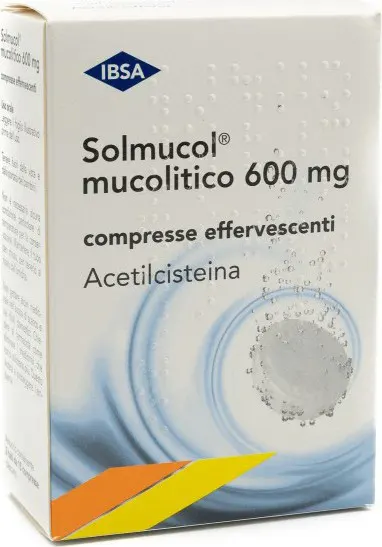
Effervescent tablets to thin mucus in the respiratory tract.
Indications
Solmucol Mucolitico 600 mg are effervescent tablets containing Acetylcysteine, an active ingredient belonging to the class of "mucolytics", drugs that act by thinning mucus in the respiratory tract (phlegm).
Solmucol Mucolitico is used to make phlegm more fluid and therefore easier to eliminate in patients with acute or long-lasting (chronic) respiratory tract diseases.
Composition
Active ingredients: Each tablet contains 600 mg of Acetylcysteine.
Excipients: Citric acid, maltodextrin, sodium bicarbonate, orange flavoring, leucine, and sodium saccharin.
Directions for use and Dosage
Adults: 1 tablet per day (preferably in the evening).
Dissolve one tablet in half a glass of water, stirring as needed with a teaspoon.
Warnings
Particular caution is required when using this medicine in patients with peptic ulcers or a history of peptic ulcers, especially if they are taking other drugs known to cause gastro-intestinal damage at the same time.
If a generalized rash or other allergic symptoms appear during oral therapy with acetylcysteine, administration of the drug must be suspended.
In particular, patients with bronchial asthma must be closely monitored during therapy; If bronchospasm occurs, treatment must be stopped immediately.
The administration of acetylcysteine, especially at the beginning of treatment, can fluidify bronchial secretions and simultaneously increase their volume.
If the patient is unable to expectorate effectively, postural drainage or, if necessary, bronchoaspiration should be used to avoid retention of secretions.
The possible presence of a sulphurous odor does not indicate an alteration of the preparation but is characteristic of the active ingredient contained therein.
Paediatric population
Keep the medicine out of the reach and sight of children.
Mucolytics can induce bronchial obstruction in children under 2 years of age.
In fact, the capacity for bronchial mucus drainage is limited in this age group, due to the physiological characteristics of the airways.
Mucolytics do not They should therefore be used in children under 2 years of age.
Information on some excipients with known effects
Contains approximately 194 mg of sodium per dose; this information should be taken into account in patients with reduced kidney function or on a low-sodium diet.
Contraindications
Hypersensitivity to the active substance or to any of the excipients listed.
Generally contraindicated during pregnancy and breastfeeding.
The drug is contraindicated in children under 2 years of age.
Interactions
Drug-drug interaction
Concurrent administration of a bronchial mucolytic and a substance that inhibits secretions (for example, an anticholinergic) should be avoided.
Antitussive drugs and acetylcysteine should not be taken at the same time since the reduction of the cough reflex could lead to an accumulation of bronchial secretions.
Activated charcoal may reduce the effect of acetylcysteine.
It is advisable not to mix other drugs with the Solmucol Mucolitico solution.
Due to its -SH radical, acetylcysteine can chemically interfere with various penicillins, tetracyclines, cephalosporins, aminoglycosides, macrolides and amphotericin B, if these substances are mixed in the same solution.
The available information regarding antibiotic-acetylcysteine interaction refers to in vitro tests, in which the two substances were mixed, which showed a decreased activity of the antibiotic.
In the case of simultaneous use of Solmucol Mucolitico with the oral forms of the antibiotics mentioned, it is recommended to take the two drugs separately with at least a two-hour interval between them.
It has been shown that the simultaneous intake of nitroglycerin and acetylcysteine causes significant hypotension and determines dilation of the temporal artery with possible onset of headache.
If the simultaneous administration of nitroglycerin and acetylcysteine is necessary, patients must be monitored for the onset of hypotension, which may also be severe, and alert them to the possible onset of headache.
Drug-laboratory test interactions
Acetylcysteine may cause interference with the colorimetric assay method for the determination of salicylates.
Acetylcysteine may interfere with the test for the determination of ketones in urine.
Paediatric population
Interaction studies have only been performed in adult patients.
Undesirable effects
The following are the undesirable effects identified during post-marketing experience;
The frequency of adverse reactions presented in the table is defined using the following convention:
- very common (? 1/10);
- common (? 1/100, <1/10);
- uncommon (? 1/1000, <1/100);
- rare (? 1/10000, <1/1000);
- very rare (<1/10000);
- not known (frequency cannot be estimated from the available data).
| Table of side effects |
| Immune system disorders | Uncommon | Hypersensitivity |
| Very rare | Anaphylactic shock, anaphylactic/anaphylactoid reaction. |
| Nervous system disorders | Uncommon | Headache. |
| Ear and labyrinth disorders | Uncommon | Tinnitus. |
| Cardiac disorders | Uncommon | Tachycardia. |
| Vascular system disorders | Very rare | Haemorrhage. |
| Respiratory, thoracic and mediastinal disorders | Rare | Bronchospasm, dyspnoea. |
| Not known | Bronchial obstruction. |
| Gastrointestinal disorders | Uncommon | Vomiting, diarrhoea, stomatitis, abdominal pain, nausea. |
| Rare | Dyspepsia. |
| Skin and subcutaneous tissue disorders | Uncommon | Urticaria, rash, angioedema, pruritus. |
| General disorders and administration site conditions | Uncommon | Pyrexia. |
| Not known | Facial oedema. |
| Investigations | Uncommon | Blood pressure decreased. |
In very rare cases, the appearance of serious skin reactions has occurred in temporal connection with the intake of acetylcysteine, such as Stevens-Johnson syndrome and Lyell's syndrome.
Although in most cases at least one other suspect drug has been identified as more likely to be involved in the genesis of the aforementioned mucocutaneous syndromes, in case of mucocutaneous alterations, it is advisable to contact your doctor and the intake of acetylcysteine must be stopped immediately.
Some studies have confirmed a reduction in platelet aggregation during the intake of acetylcysteine.
The clinical significance of these findings has not yet been defined.
Reporting of suspected adverse reactions
Reporting suspected adverse reactions that occur after authorization of the medicinal product is important, as it allows continued monitoring of the benefit/risk balance of the medicinal product. Healthcare professionals are asked to report any suspected adverse reactions via the national reporting system.
Overdose
No particular signs and symptoms occurred in subjects treated with high doses of oral acetylcysteine.
Healthy volunteers, who took a daily dose of acetylcysteine equal to 11.6 g for three months, did not experience serious adverse reactions.
Doses up to 500 mg NAC/kg of body weight, administered orally, were tolerated without any symptoms of intoxication.
Symptoms
Overdose may cause gastrointestinal symptoms such as nausea, vomiting and diarrhea.
Treatment
There are no specific antidote treatments; Overdose treatment is based on symptomatic treatment.
Pregnancy and breastfeeding
Teratological studies conducted with Acetylcysteine on animals have not shown any teratogenic effect; however, controlled studies in humans are not available.
Therefore, its administration during pregnancy and breastfeeding should be carried out only if strictly necessary and under the direct supervision of a doctor.
Storage
No particular temperature conditions for storage.
Keep the tube tightly closed to protect it from humidity.
Format
30 effervescent tablets
Product Code:FRCM138811




 Richiedi info sul prodotto