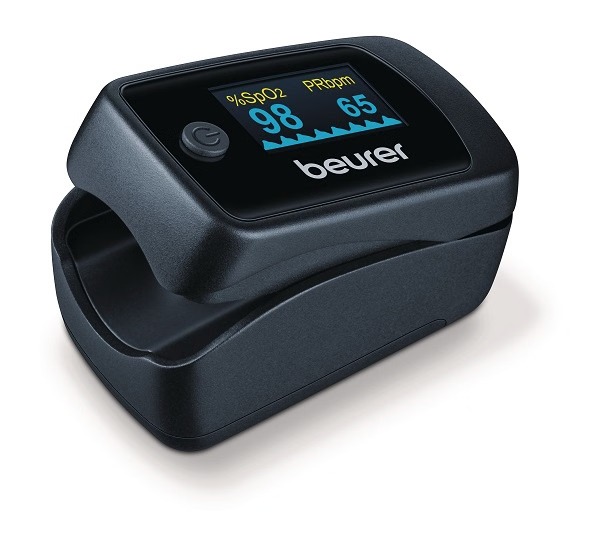
The Beurer Po45 Pulse Oximeter is A portable, non-invasive device for randomly checking arterial hemoglobin oxygen saturation (Spo2) and heart rate.
Indications
A portable, non-invasive device for randomly checking arterial hemoglobin oxygen saturation (Spo2) and heart rate in adult, adolescent, and pediatric patients in hospitals, hospital-type facilities, and home care settings.
The Beurer Po 45 pulse oximeter allows for the non-invasive measurement of arterial oxygen saturation (Spo2), heart rate (Pr bpm), and the perfusion index (Pi). Oxygen saturation indicates the percentage of hemoglobin bound to oxygen in arterial blood. It is therefore a fundamental parameter for evaluating respiratory function.
Passing through the lungs, oxygen is bound to the hemoglobin in red blood cells. The pulse oximeter uses two light frequencies (red and infrared) to detect the percentage (%) of hemoglobin saturated with oxygen in the blood. This percentage is called oxygen saturation (Spo2). In addition to the Spo2 level, the pulse oximeter measures and displays the heart rate.
- Red or infrared light source.
- Red and infrared detector.
A low oxygen saturation level is a sign of low blood pressure. It is mainly a symptom of pathologies (respiratory diseases, asthma, heart failure, etc.).
People with low oxygen saturation levels are more likely to develop the following symptoms: respiratory failure, increased heart rate, sluggishness, nervousness, and sweating. Chronically low oxygen saturation levels require monitoring with a pulse oximeter and medical supervision. In the event of an acute drop in oxygen saturation, with or without secondary symptoms, immediate medical attention is necessary, as this could be life-threatening. Therefore, the pulse oximeter is essential. Particularly suitable for at-risk patients, such as those with heart conditions and asthma, but also for athletes and healthy individuals who travel at high altitudes (for example, mountaineers, skiers, or sports aviators).
Features of the pulse oximeter
- Easy to use and lightweight to carry (also ideal for traveling).
- Compact and space-saving.
- Two-color OLED display, displays oxygen saturation (Spo2), pulse rate (Pr bpm), and perfusion index (Pi).
- Brightness Adjustable display (1 to 10).
- 7 display formats/low battery warning/automatic shutdown after 8 seconds if no signal is received.
How to use
- Insert your finger into the finger clip of the pulse oximeter. Hold your finger still.
- Press the function button. The pulse oximeter begins measuring. Do not move during the measurement process.
- After a few seconds, the measurement values appear on the screen.
Interactions
Keep portable RF communications equipment (including peripherals such as antenna cables or external antennas) at least 30 cm away from any part of the Po 45. Otherwise, the performance of the device may be impaired.
If electrosurgical devices or defibrillators are used, the functionality of the pulse oximeter may be impaired.
Using the device on subjects with low blood pressure, jaundice, or taking vasoconstrictor drugs may lead to incorrect or false measurements.
Measurements may be false in patients who have previously taken clinical dyes and in patients with abnormal hemoglobin levels. This This applies in particular to carbon monoxide poisoning and methemoglobin poisoning, caused, for example, by the administration of local anesthesia or a deficiency of the methemoglobin reductase enzyme.
Warnings
Failure to follow these instructions can cause personal injury and property damage. Keep these instructions in a safe place and make them accessible to other users. Please pass these instructions on if you pass on the device.
Check that all supplied parts are present.
Regularly check the pulse oximeter for visible damage before use and to ensure that the batteries are still sufficiently charged. If in doubt, do not use the pulse oximeter and contact Beurer Customer Service or an authorized dealer.
Do not use additional modules not recommended by the manufacturer or offered as accessories.
Do not open or repair the device, as this may impair its proper functioning. Otherwise, the warranty will be void. For repairs, contact Beurer Customer Service or an authorized dealer.
The pulse oximeter displays a temporary measurement value each time, but cannot be used for continuous monitoring.
The pulse oximeter does not have alarm functions and is therefore not suitable for use with medical devices. Suitable for evaluating medical results.
Do not proceed with any type of self-diagnosis or self-treatment based on the measurement results without first consulting your doctor. In particular, do not take any new medications on your own initiative and do not change the type and/or dosage of a medication prescribed for an ongoing treatment.
During the measurement process, do not look directly into the device. The red light and the invisible infrared light of the pulse oximeter are harmful to your eyesight.
The pulse oximeter is calibrated to display functional oxygen saturation.
The device should not be used by persons (including children) with reduced physical, sensory or mental capabilities. physical, perceptive, or intellectual disabilities, or lack of experience and/or knowledge, unless they are supervised by a person responsible for their safety or have been instructed in how to use the device. Children should be supervised to ensure that they do not play with the device.The plethysmographic waveform and pulse column indications do not allow an assessment of the intensity of the heartbeat or circulation in the measurement area, but rather represent exclusively the current variation of the optical signal in the measurement area; Furthermore, they do not allow for reliable heart rate diagnosis.
Failure to follow these instructions may result in incorrect measurements or malfunctions:
- The finger used for measurement must not have nail polish, false nails, or other cosmetic products;
- Make sure that the nail of the finger used for measurement is short enough to allow the fingertip to cover the internal sensors;
- If the subject moves during the measurement process, keep hand, finger, and body still;
- In subjects suffering from heart rhythm disorders, it is recommended to use a heart rate monitor. It is possible that the oxygen saturation (Spo2) and heart rate (Pr bpm) values are distorted or that a valid measurement cannot be made;
- in case of carbon monoxide poisoning, the pulse oximeter detects values that are too high;
- to avoid distorting the measurement result, avoid using the pulse oximeter near strong light sources (for example, fluorescent lamps or direct sunlight);
- in subjects with arterial catheter, hypotonia, severe vasoconstriction, anemia, or hypothermia, the measurements may be incorrect;
Contraindications
The pulse oximeter should not be used:
- in case of allergies to rubber products;
- if the device itself is wet or if the finger to be used for measurement is moist;
- on small children or infants;
- during MRI or CT scans;
- when transporting a patient outside of a medical facility;
- when measuring blood pressure on the upper arm with a cuff;
- in the presence of nail polish, plasters, or dirt;
- on thick fingers that can only be inserted into the device by force (fingertip dimensions: width approx. > 20 mm, thickness > 15 mm);
- on fingers with anatomical changes, edema, scars, or burns;
- on fingers that are too thin or too narrow, such as those of small children (width approximately < 10 mm, thickness < 5 mm);
- on patients who show symptoms of agitation at the application site (for example, in the presence of tremors);
- in the vicinity of flammable or explosive gas mixtures.
Side effects
In people with circulatory disorders, prolonged use of the pulse oximeter may be painful. Therefore, do not use the pulse oximeter for more than 30 minutes per finger. This is the only way to ensure proper sensor adjustment and skin integrity.
Storage
Protect the pulse oximeter from dust, shocks, humidity, temperature changes, and explosive substances.
Packaging
Package contains 1 Po 45 pulse oximeter, 2 1.5 V AAA batteries, 1 strap, 1 pouch, and these instructions for use.
Product Code:FRCM247568




 Richiedi info sul prodotto


