Free shipping from 69,00 € and always free returns

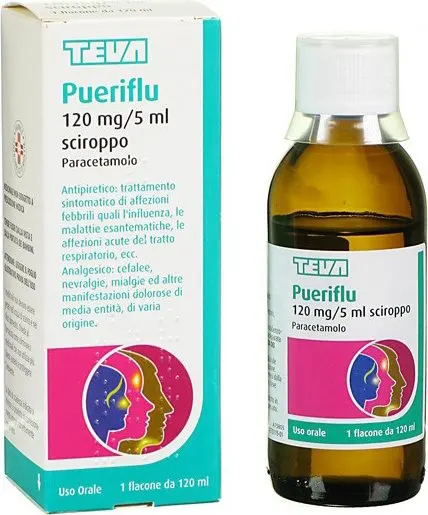
Pueriflu 120 mg/5 ml - sciroppo analgesico ed antipiretico 120 ml

(0)
Productor: Teva italia
info prodotto Richiedi info sul prodotto
Product not active click on Notify me to know when it will be available again
info resi e spedizione

Information on returns and shipments

info pagamenti

Payment methods

Authorized company for online trading of
Medicines authorized by the Ministry of Health
99& satisfied customers
Product Description

Syrup

Excipients

120 mg/5 ml syrup - 120 ml, 200 ml and 240 ml bottles Sucrose, macrogol 6000, sodium citrate, anhydrous citric acid, sodium saccharin, methyl p-hydroxybenzoate (E218), propyl p-hydroxybenzoate (E216), strawberry/mandarin flavouring, purified water.

120 mg/5 ml syrup - 10 single-dose containers of 5 and 10 ml Sucrose, macrogol 6000, sodium citrate, anhydrous citric acid, sodium saccharin, methyl p-hydroxybenzoate (E218), propyl p-hydroxybenzoate (E216), flavouring strawberry/mandarin, purified water.

COMPOSITION

120 mg/5 ml syrup

100 ml of syrup contain: paracetamol 2.4 g.

For the full list of excipients, see section 6.1.

PHARMACEUTICAL FORM

Syrup. Clear, colorless or slightly yellowish solution

Therapeutic indications

As an antipyretic: symptomatic treatment of febrile conditions such as influenza, exanthematous diseases, acute respiratory tract conditions, etc.
As an analgesic: headaches, neuralgia, myalgia and other moderately severe pain of various origins.

Dosage and method of administration

In children under three months of age, in case of jaundice, it is advisable to reduce the single oral dose.
For children, it is essential to respect the dosage defined based on their body weight, and therefore choose the appropriate formulation. Approximate ages based on body weight are given for information purposes only.
In adults, the maximum oral dosage is 3000 mg of paracetamol per day (see section 4.9).
In children under three months of age, in case of jaundice, it is advisable to reduce the single oral dose. In adults, the maximum rectal dosage is 4000 mg of paracetamol per day (see section 4.9).
The 120 ml, 200 ml and 240 ml packs include a measuring cup with level markings corresponding to the capacities of 5 ml, 7.5 ml and 10 ml. and 20 ml
120 mg/5 ml syrup - 120 ml bottle 120 mg/5 ml syrup - 200 ml bottle 120 mg/5 ml syrup - 240 ml bottle
Children weighing between 7 and 10 kg (approximately between 6 and 18 months): 5 ml at a time (corresponding to 120 mg of paracetamol), to be repeated if necessary after 6 hours, without exceeding 4 administrations per day.
Children weighing between 11 and 12 kg (approximately between 18 and 24 months): 5 ml at a time (corresponding to 120 mg of paracetamol),
to be repeated if necessary after 4 hours, without exceeding 6 administrations per day.
Children weighing between 13 and 20 kg (approximately between 2 and 7 years): 7.5 - 10 ml at a time (corresponding to 180 and 240 mg of paracetamol respectively), to be repeated if necessary after 6 hours, without exceeding 4 administrations per day.
Children weighing between 21 and 25 kg (approximately between 6 and 10 years): 10 ml at a time (corresponding to 240 mg of paracetamol), to be repeated if necessary after 4 hours, without exceeding 6 administrations per day.
Children weighing between 26 and 40 kg (approximately between 8 and 13 years): 15-20 ml at a time (corresponding to 360 and 480 mg of paracetamol respectively), to be repeated if necessary after 6 hours, without exceeding 4 administrations per day.
Children weighing between 41 and 50 kg (approximately between 12 and 15 years): 20 ml at a time (corresponding to 480 mg of paracetamol), to be repeated if necessary after 4 hours, without exceeding 6 administrations per day.
Children weighing more than 50 kg (approximately over 15 years):
20 ml at a time (corresponding to 480 mg of paracetamol), to be repeated if necessary after 4 hours, without exceeding 6 administrations per day.
Adults: 20 ml at a time (corresponding to 480 mg of paracetamol) to 480 mg), to be repeated if necessary after 4 hours, without exceeding 6 administrations per day.
120 mg/5 ml syrup - 10 single-dose containers of 5 ml
Children weighing between 7 and 10 kg (approximately between 6 and 18 months): 1 container of 5 ml (corresponding to 120 mg of paracetamol), to be repeated if necessary after 6 hours, without exceeding 4 administrations per day.
Children weighing between 11 and 12 kg (approximately between 18 and 24 months): 1 container of 5 ml (corresponding to 120 mg of paracetamol), to be repeated if necessary after 4 hours, without exceeding 6 administrations per day.
Children weighing between 11 and 12 kg (approximately between 18 and 24 months): 1 container of 5 ml (corresponding to 120 mg of paracetamol), to be repeated if necessary after 4 hours, without exceeding 6 administrations per day. day.
120 mg/5 ml syrup - 10 single-dose containers of 10 ml
Children weighing between 21 and 25 kg (approximately between 6 and 10 years): 1 container of 10 ml (corresponding to 240 mg of paracetamol), to be repeated if necessary after 4 hours, without exceeding 6 administrations per day.
Children weighing between 41 and 50 kg (approximately between 12 and 15 years): 2 containers of 10 ml (equal to 20 ml - corresponding to 480 mg of paracetamol), to be repeated if necessary after 4 hours, without exceeding 6 administrations per day.
Children weighing more than 50 kg (approximately over ...1 container of 10 ml (corresponding to 240 mg of paracetamol), to be repeated if necessary after 4 hours, without exceeding 6 administrations per day.
Children weighing more than 150 kg (approximately over 15 years): 1 container of 10 ml (corresponding to 240 mg of paracetamol), to be repeated if necessary after 4 hours, without exceeding 6 administrations per day.
Children weighing more than 1 years):
2 containers of 10 ml (equal to 20 ml - corresponding to 480 mg of paracetamol), to be repeated if necessary after 4 hours, without exceeding 6 administrations per day.

Contraindications

the excipients listed in paragraph 6.1

Warnings and precautions for use

In rare cases of allergic reactions, administration must be suspended and appropriate treatment must be initiated.

High or prolonged doses of the product can cause high-risk liver disease and alterations to the kidneys and blood, which may be serious.

Paracetamol should be administered with caution to patients with mild to moderate hepatocellular insufficiency (including Gilbert's syndrome), severe hepatic insufficiency (Child-Pugh >9), hepatitis B. acute, in concomitant treatment with drugs that alter liver function, glucose-6-phosphate dehydrogenase deficiency, haemolytic anaemia, renal failure. Therefore, administration should be carried out only if really necessary and under direct medical supervision. During treatment with paracetamol, before taking any other drug, check that it does not contain the same active ingredient, since if paracetamol is taken in high doses, serious adverse reactions can occur.

Instruct the patient to contact the doctor before combining any other drug. See also section 4.5.

PUERIFLU contains sucrose, which should be taken into account in diabetic patients and in patients on low-calorie diets, and methyl parahydroxybenzoate and propyl parahydroxybenzoate which can cause allergic reactions (even delayed). Patients with rare hereditary problems of fructose intolerance, glucose-galactose malabsorption, or sucrase-isomaltase insufficiency should not take this medicine.

Do not administer for more than 3 consecutive days without consulting your doctor.

Interactions

The oral absorption of paracetamol depends on the rate of gastric emptying. Therefore, concomitant administration of drugs that slow (e.g. anticholinergics, opioids) or increase (e.g. prokinetics) the rate of gastric emptying may result in a decrease or increase in the bioavailability of the product, respectively.

Concomitant administration of cholestyramine reduces the absorption of paracetamol. Concomitant use of paracetamol and chloramphenicol may increase the half-life of chloramphenicol, with the risk of increasing its toxicity.

Regular and prolonged use of paracetamol increases the effect of anticoagulants, in particular the concomitant use of paracetamol (4 g per day for at least 4 days) with oral anticoagulants may induce slight variations in INR values. In these cases, more frequent monitoring of INR values ​​must be conducted during concomitant use and after its discontinuation.

Use Pueriflu with extreme caution and only under strict medical supervision during chronic treatment with drugs that can cause the induction of hepatic monooxygenases or in case of exposure to substances that can have this effect (for example, rifampicin,

cimetidine, antiepileptics such as glutethimide, phenobarbital, carbamazepine). The same applies in cases of alcoholism and in patients treated with zidovudine.

The administration of paracetamol may interfere with the determination of uric acid (using the phosphotungstic acid method) and blood glucose (using the glucose-oxidase-peroxidase method).

Pregnancy and breastfeeding

Although clinical studies in pregnant or breastfeeding patients have not highlighted any particular contraindications to the use of paracetamol or caused any adverse effects on the mother or child, it is recommended to administer the product only in cases of actual need and under the direct supervision of a doctor.

Side effects

With the use of paracetamol, skin reactions of various types and severity have been reported, including cases of erythema multiforme, Stevens-Johnson syndrome, and epidermal necrolysis.

Hypersensitivity reactions such as skin rashes with erythema or urticaria, angioedema, laryngeal edema, anaphylactic shock have been reported. In addition, the following adverse reactions have been reported: leukopenia, anaemia, liver function disorders and hepatitis, renal disorders (acute renal failure, interstitial nephritis, haematuria, anuria), gastrointestinal reactions and dizziness.

The frequencies of adverse reactions are classified as follows: Very common (≥ 1/10), Common (≥ 1/100, <1/10), Uncommon (≥ 1/1,000,
<1/100), Rare (≥ 1/10,000, <1/1,000), Very rare (<1/10,000), not known (frequency cannot be estimated from the available data).
Within each frequency grouping, adverse reactions are presented in decreasing order of seriousness.
Blood and lymphatic system disorders Not known: Thrombocytopenia, agranulocytosis Immune system disorders
Not known: Hypersensitivity reactions
Hepatobiliary disorders
Not known: Liver injury
Skin and subcutaneous tissue disorders
Not known: Exanthema
Very rare: Severe skin rashes (Stevens-Johnson syndrome, toxic epidermal necrolysis, acute generalized exanthematous pustulosis)
Reporting of suspected adverse reactions
Reporting suspected adverse reactions after authorisation of the medicinal product is important. It allows continued monitoring of the benefit/risk balance of the medicinal product. Healthcare professionals are asked to report any suspected adverse reactions via the national reporting system at www.agenziafarmaco.gov.it/it/responsabili.

Overdose

In case of accidental ingestion of very high doses of paracetamol, acute intoxication manifests itself with anorexia, nausea, and vomiting followed by a profound deterioration in general conditions; these symptoms generally appear within the first 24 hours. In case of overdose, paracetamol can cause necrosis of the renal tubules and hepatic cytolysis, which can progress to massive and irreversible necrosis, resulting in hepatocellular failure, metabolic acidosis, and encephalopathy, which can lead to coma and death. Simultaneously, an increase in liver transaminase, lactate dehydrogenase, and bilirubin levels, and a reduction in prothrombin levels are observed, which may occur within 12-48 hours of ingestion.

The measures to be taken consist of hospitalization for appropriate treatment, with the administration, as soon as possible, of N-acetylcysteine ​​​​as an antidote: the dosage is 150 mg/kg IV in glucose solution over 15 minutes, then 50 mg/kg over the next 4 hours and 100 mg/kg over the next 16 hours, for a total of 300 mg/kg over 20 hours.

Product Code:FRCM046962

Price Trend

This product has been on sale since 25/09/2017

In the last 30 days, the product's lowest price was 2,74 €

5% EXTRA DISCOUNT on FIRST ORDER! Register and discover the WELCOME Coupon!
To enhance your website experience, Farmacosmo.com uses different types of cookies. You can click OK, to allow them, or manage them individually. By clicking on the ''x'' you don't accept any cookies and other tracking methods other than technical ones. To read more see our Cookie Policy. Cookie Policy