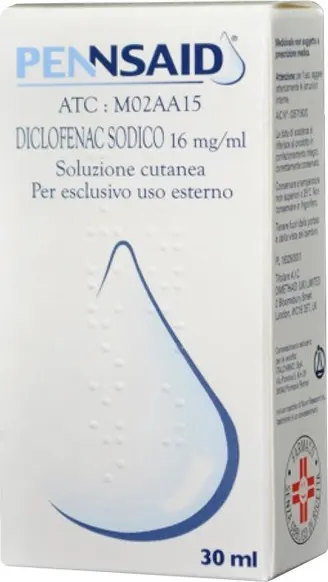
Skin Solution
Composition:
1 ml of skin solution contains 16.05 mg of diclofenac sodium. For excipients, see section 6.1.
Excipients
Dimethyl sulfoxide, ethanol, glycerin, propylene glycol, distilled water.
Therapeutic indications
PENNSAID® (16 mg/ml diclofenac sodium) is a skin solution indicated for the symptomatic relief of pain associated with osteoarthritis of the superficial joints, including the knee. No data are available on the use of PENNSAID® in large, deep joints covered by muscle or other soft tissue, such as the hip or spine.
Contraindications
PENNSAID® (16 mg/ml diclofenac sodium) is contraindicated in pregnant or breastfeeding women and in patients with hypersensitivity to diclofenac or other components of the solution. Since cross-sensitivity may exist with other nonsteroidal anti-inflammatory drugs, even those belonging to different groups, diclofenac should not be used in those who have experienced asthma attacks, urticaria, acute rhinitis, or other allergic reactions after taking oral acetylsalicylic acid (ASA) or other nonsteroidal anti-inflammatory drugs (NSAIDs). Skin Allergy or Sensitivity: PENNSAID® also contains dimethyl sulfoxide (DMSO) as a carrier agent and therefore should not be used in patients with a known history of allergy or skin sensitivity to DMSO.
Dosage
PENNSAID® is applied topically to the painful joint. After washing the area to be treated with soap and water and waiting for it to dry, apply approximately 20 or 40 drops (approximately 0.5 or 1 ml) of PENNSAID® (16 mg/ml diclofenac sodium) for a medium-sized joint (e.g., wrist) or large joint (e.g., knee), respectively. Patients should use up to a maximum of 40 drops four times a day per joint as recommended by their doctor. To prevent the product from running off the treatment area, apply the solution in portions of 5 or 10 drops for a medium-sized or large joint. Distribute PENNSAID® evenly over the area to be treated with your hand or fingers. Repeat the process until the entire recommended dose of PENNSAID® has been applied. Apply 4 times a day. Patients with renal and hepatic impairment: For the use of PENNSAID in patients with hepatic or renal impairment, see section 4.4. Paediatric use: Since there are no clinical data on the use of PENNSAID® in paediatrics, its use in this group of patients is not recommended.
Warnings and precautions
The occurrence of adverse effects can be minimised by using the lowest effective dose for the shortest duration necessary to control symptoms. Elderly: In the elderly, there is an increased frequency of adverse reactions to oral NSAIDs, especially gastrointestinal bleeding and perforation, which may be fatal. Patients with a history of gastrointestinal toxicity, particularly if elderly, should report any unusual abdominal symptoms (especially gastrointestinal bleeding), especially in the initial stages of therapy. Serious skin reactions, some of them fatal, including exfoliative dermatitis, Stevens-Johnson syndrome, and toxic epidermal necrolysis, have been reported very rarely in association with the use of NSAIDs (see section 4.8). Patients are at greatest risk for these reactions early in therapy, with the onset of reactions occurring in most cases within the first month of therapy. Therapy with PENNSAID® should be discontinued at the first appearance of skin rash, mucosal lesions, or any other sign of hypersensitivity. Patients should be advised to wash their hands after application to avoid contact with eyes, mucous membranes, and untreated skin. No other medications should be applied to the affected area at the same time as PENNSAID®. The likelihood of adverse reactions following topical application of PENNSAID® is very low when compared to the frequency of adverse reactions following oral administration of diclofenac, due to the low systemic absorption of PENNSAID®. This medicine should be used with caution in patients with impaired renal function as isolated cases of systemic reactions with deterioration of renal function have been observed following oral or topical administration of NSAIDs. The lowest dosage of PENNSAID® per joint should be considered. Hepatic system: A slight increase in liver function tests may occur following treatment with PENNSAID®. If these abnormal values persist or worsen, or if clinical signs or symptoms suggestive of liver disease, or other manifestations (e.g., eosinophilia, rash) develop, administration of Pennsaid should be discontinued. If it becomes necessary to administer this medicine in the presence of severe hepatic impairment, this should be done under careful medical supervision. Use caution when using diclofenac sodium in patients with hepatic porphyria, as diclofenac sodium may trigger an attack. Gastrointestinal system: Peptic ulcerations, perforations, and gastrointestinal hemorrhages, sometimes severe and rarely fatal, with or without preliminary symptoms, have been reported during oral or rectal therapy with nonsteroidal anti-inflammatory drugs (NSAIDs). However, the maximum serum diclofenac level after topical application of PENNSAID® is low (50 times lower than that achieved after oral administration of 25 mg of diclofenac). Therefore, PENNSAID® (diclofenac sodium) may reasonably be administered under close medical supervision to patients prone to gastrointestinal irritation, including those with a history of peptic ulcer induced by other nonsteroidal anti-inflammatory drugs or suffering from other inflammatory diseases of the gastrointestinal tract (such as ulcerative colitis or Crohn's disease). In such cases, the physician must weigh the benefits of treatment against the possible risks (See CONTRAINDICATIONS and ADVERSE EFFECTS). The patient should be instructed to contact their physician immediately at the first signs or symptoms of gastric ulcer or gastrointestinal bleeding. These reactions may occur at any time during treatment, without preliminary symptoms or signs. Dermatology: The area treated with PENNSAID® should not be covered with occlusive dressings. PENNSAID® should be applied to skin that is free of lesions or infections. Do not use PENNSAID® on joint surfaces with previous skin diseases (e.g., psoriasis) unless advised by your doctor. Application of PENNSAID® to mucous membranes is not recommended. Hypersensitivity: The dimethyl sulfoxide (DMSO) contained in PENNSAID® can induce the release of histamine, and hypersensitivity reactions have occasionally been reported after topical administration. If anaphylactoid reactions occur, appropriate therapy must be instituted and PENNSAID® should be discontinued. Ophthalmology: In animal studies, high doses of DMSO, particularly when administered orally, have caused abnormal changes in the lens of the eye. In studies on primates and humans, no such changes have been observed after ocular and oral administration of dimethyl sulfoxide. Infections: The anti-inflammatory and analgesic effects of diclofenac sodium may mask the usual signs of infection. Therefore, the physician should pay particular attention to the possible development of localized skin infections in the area to which the patient has applied the drug. It has been observed that the maximum concentration of diclofenac in the blood, after the application of the maximum dose of PENNSAID® (1 ml), is less than 10 ng/ml. This value is 50 times lower than the maximum concentration of diclofenac in the blood after oral administration of 25 mg of diclofenac. PENNSAID® contains dimethyl sulfoxide (DMSO), which can cause drowsiness and headache and may be irritating to the skin.
Interactions
The interactions reported in this paragraph have been observed after systemic administration of diclofenac sodium. The risk associated with the topical use of PENNSAID® is unknown, but is probably low. Acetylsalicylic acid (ASA): Serum levels of diclofenac may decrease when taken concomitantly with acetylsalicylic acid. The bioavailability of acetylsalicylic acid is reduced by the presence of diclofenac. Although these pharmacokinetic interactions do not appear to be clinically relevant, there is no proven advantage to the concomitant use of these two drugs. Digoxin: Diclofenac may increase the concentration of digoxin in plasma. Dosage adjustments may therefore be necessary. Lithium: Plasma lithium concentrations may increase when administered concomitantly with diclofenac (which alters the renal clearance of lithium). The lithium dosage may need to be adjusted. Oral hypoglycemic agents: Pharmacodynamic studies have not demonstrated any potentiation of the effects due to concomitant administration with diclofenac; however, isolated cases of both hypoglycemic and hyperglycemic effects on the dosage of hypoglycemic agents have been reported. Anticoagulants: NSAIDs may increase the effects of anticoagulants, such as warfarin (see section 4.4). Diuretics: Nonsteroidal anti-inflammatory drugs are known to inhibit the activity of diuretics. Concomitant administration of anti-inflammatory drugs and potassium-sparing diuretics may cause an increase in serum potassium, making periodic monitoring of blood/plasma levels necessary. Glucocorticoids: Concomitant administration may aggravate gastrointestinal side effects. Nonsteroidal anti-inflammatory drugs (NSAIDs): The simultaneous oral administration of two or more nonsteroidal anti-inflammatory drugs may promote the onset of side effects (see Special warnings and precautions for use). Methotrexate: The administration of nonsteroidal anti-inflammatory drugs less than 24 hours before or after treatment with methotrexate must be done with caution, as these drugs may elevate the blood concentration and increase its toxicity. Cyclosporine: The nephrotoxicity of cyclosporine may be increased due to the effects of nonsteroidal anti-inflammatory drugs on renal prostaglandins. Quinolone antibacterials: Isolated cases of convulsions have been reported, which may have been due to the concomitant use of quinolones and nonsteroidal anti-inflammatory drugs. Antihypertensive drugs: Like other nonsteroidal anti-inflammatory drugs, diclofenac may reduce the antihypertensive effects of propranolol, other beta-blockers, and other antihypertensive drugs. Other medications: Diclofenac sodium should not be used concomitantly with diclofenac potassium, as both are present in plasma as the same active organic ion. Corticosteroids: increased risk of gastrointestinal ulceration or bleeding (see section 4.4) Antiplatelet agents and selective serotonin reuptake inhibitors (SSRIs): increased risk of gastrointestinal bleeding (see section 4.4)
Undesirable effects
Topical application: Undesirable effects are divided into local, therefore related to the area of application, and systemic. Six double-blind controlled clinical studies highlighted the following undesirable effects with a significant increase in incidence in the group treated with PENNSAID® compared to the placebo group. At the application site, cases of dry skin (35.8% versus 6.86% of the placebo-treated group) and rash (10.44% versus 2.86% of the placebo-treated group) were statistically significant. Other adverse reactions of PENNSAID®, which were statistically significant compared to placebo, included constipation (3.83% versus 0.57%), dyspepsia (8.98% versus 4%), and flatulence (4.49% versus 0.57%). Photoallergic reactions and contact dermatitis have been reported after topical application of diclofenac. The systemic absorption of diclofenac sodium after topical application of PENNSAID® is very low compared to that of diclofenac sodium tablets. However, when PENNSAID® is applied to a relatively large area of skin for a prolonged period of time, the possibility of systemic adverse reactions similar to the systemic effects caused by oral diclofenac cannot be completely ruled out. Possible systemic adverse reactions are described below. Oral administration: Oral administration of diclofenac causes adverse events due to both systemic and local gastrointestinal reactions. The most serious gastrointestinal adverse events are ulceration and haemorrhage, while the most serious dermatological reactions, although rare, are erythema multiforme (Stevens-Johnson and Lyell syndromes). Occasional deaths have been reported, especially in the elderly. Bullous reactions, including Stevens-Johnson syndrome and toxic epidermal necrolysis (very rare). Oedema, hypertension, and cardiac failure have been reported in association with NSAID treatment. Gastrointestinal: Occasionally: epigastric, gastric, or abdominal pain, abdominal cramps, nausea, dyspepsia, anorexia, diarrhea, vomiting, and flatulence. Rarely: gastrointestinal bleeding (bloody diarrhea, melaena, haematemesis), gastric and intestinal ulcerations with or without bleeding or perforation. Isolated cases: large intestine disorders (e.g., nonspecific haemorrhagic colitis and worsening of ulcerative colitis or Crohn's disease), intestinal diaphragmatic strangulation, hyperacidity, stomatitis, glossitis, coated tongue, esophageal lesions, constipation, and pancreatitis. Central nervous system: Occasionally: dizziness, headache, and vertigo. Rarely: drowsiness, malaise, impaired concentration, and tiredness. Isolated cases: sensory disturbances including paraesthesia, memory impairment, disorientation, insomnia, irritability, convulsions, depression, anxiety, nightmares, tremors, psychotic reactions, and aseptic meningitis. Special senses: Isolated cases: visual disturbances (blurred vision, double vision), hearing impairment, tinnitus, and taste disturbances. Cardiovascular: Rarely: palpitations, angina, and arrhythmia. Isolated cases: worsening of heart failure and hypertension. Dermatology: Occasionally: rash and pruritus. Rarely: urticaria. Isolated cases: bullous dermatosis, erythema, eczema, erythema multiforme, Stevens-Johnson syndrome, Lyell syndrome (toxic epidermal necrolysis), erythroderma (exfoliative dermatitis), hair loss, photosensitivity reactions, and purpura, including allergic purpura. Renal system: Rarely: edema (facial, generalized, peripheral). Isolated cases: acute renal failure, nephrotic syndrome, urinary abnormalities (e.g., hematuria and proteinuria), interstitial nephritis, and papillary necrosis. Hematology: Isolated cases: thrombocytopenia, leukopenia, agranulocytosis, hemolytic anemia, aplastic anemia, and anemia due to gastrointestinal bleeding. Hepatic: Occasionally: increases (
Product Code:FRCM046642




 Richiedi info sul prodotto