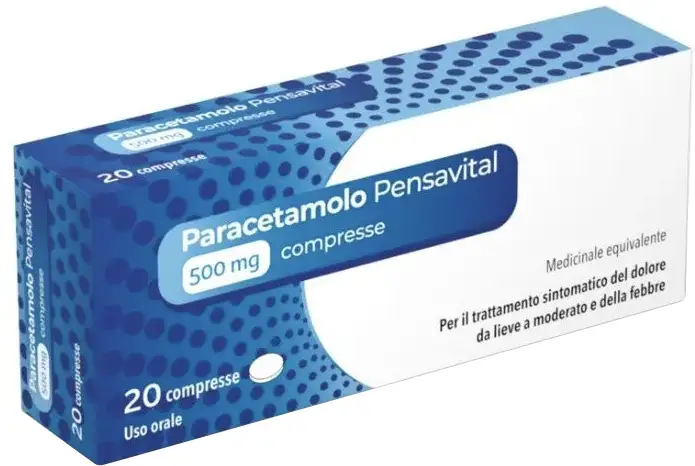
Equivalent medicinal product for the symptomatic treatment of mild to moderate pain and fever.
Indications
Paracetamol Pensavital is recommended for the treatment of mild to moderate pain and fever. It is indicated in adults and children aged 10 years and over (or weighing more than 33 kg).
Composition
Active ingredients
Each tablet contains 500 mg of paracetamol.
Excipients
Sodium starch glycolate (Type A), purified water, pregelatinized starch, povidone K30 (E1201), stearic acid (E570), crospovidone (E1202).
Directions for use and Dosage
Oral use.
The tablets should be taken with a glass of liquid, preferably water.
Adults and adolescents over 15 years of age: 1 or 2 tablets 3-4 times a day.
The dose should be spaced at least 1 hour apart. 4 hours.
Do not take more than 6 tablets (3 g) in 24 hours.
Children: it is necessary to respect the dosage defined in terms of weight.
The age of the child based on weight is given for information purposes.
The recommended daily dose of paracetamol is approximately 60 mg/kg/day, divided into 4 or 6 daily doses, which is means 15 mg/kg every 6 hours or 10 mg/kg every 4 hours.
Children between 33 and 40 kg in weight (from 10 to 12 years): 1 tablet per dose, every 6 hours, up to a maximum of 4 tablets per day.
Between 41 and 50 kg in weight (from 12 to 15 years): 1 tablet per dose, every 4 hours, up to a maximum of 6 tablets per day.
Patients with renal impairment: in case of renal insufficiency, reduce the dose, depending on the degree of glomerular filtration according to the following list.
Glomerular filtration rate: 10 50 ml/min; dose: 500 mg every 6 hours.
Glomerular filtration rate: < 10 ml/min; Dose: 500 mg every 8 hours.
Patients with hepatic impairment: In case of hepatic impairment, the dose should not exceed 2 g/24 hours and the minimum interval between doses should be 8 hours.
Use in the elderly population: An increased elimination half-life of paracetamol has been observed in elderly patients and therefore it is recommended to reduce the adult dose by 25%.
Warnings
Paracetamol should be administered with caution, avoiding prolonged treatment in patients with anemia, cardiac or pulmonary disease or renal dysfunction (in the latter case, occasional use is acceptable, but prolonged administration of high doses may increase the risk of adverse renal effects).
The use of paracetamol in patients who regularly consume alcohol (three or more alcoholic drinks per day) may increase the risk of renal impairment. cause liver damage.
Chronic alcoholics should not be given more than 2 g/day of paracetamol.
Caution is advised in asthmatic patients sensitive to acetylsalicylic acid, as mild bronchospastic reactions with paracetamol (cross-reaction) have been described in these patients, although in a minority of such patients it may cause serious reactions in some cases, especially when administered at high doses.
Caution is advised if paracetamol is administered concomitantly with flucloxacillin due to the increased risk of high anion gap metabolic acidosis (HAGMA), particularly in patients with severe renal impairment, sepsis, malnutrition and other sources of glutathione deficiency (e.g. chronic alcoholism), as well as ... those using the maximum daily doses of paracetamol.
Careful monitoring is recommended, including measurement of urinary 5-oxoproline.
Concomitant use of more than one paracetamol-containing medicine may lead to intoxication.
Paracetamol-associated toxicities can occur from either a single overdose or multiple ingestions of excessive doses of paracetamol.
Hepatotoxicity has been reported with daily doses of less than 4 g.
If pain persists for more than 5 days or fever for more than 5 days, consult a doctor immediately. If symptoms persist for more than 3 days, or worsen, or other symptoms appear, the clinical situation should be re-evaluated.
When doses less than 500 mg of paracetamol per dose are required, other presentations of paracetamol should be used depending on the dosage required.
Contraindications
Hypersensitivity to the active substance or to any of the excipients.
Undesirable effects
Safety profile report: The most common adverse reactions are listed in Table 1. Commonly reported during the period of use of paracetamol are: hepatotoxicity, renal toxicity, alterations in the blood count, hypoglycaemia and allergic dermatitis.
List of adverse reactions.
Vascular disorders.
Rare (>=1/10 000, <1/1 000): hypotension.
Hepatobiliary disorders.
Rare (>=1/10 000, <1/1 000): increased levels of hepatic transaminases.
General disorders and administration site conditions.
Rare (>=1/10 000, <1/1 000): malaise.
Blood and lymphatic system disorders.
Very rare (<1/10 000): thrombocytopenia, agranulocytosis, leukopenia, neutropenia, haemolytic anaemia.
Metabolism and nutrition disorders.
Very rare (<1/10 000): hypoglycaemia.
Hepatobiliary disorders.
Very rare (<1/10 000): hepatotoxicity (jaundice).
Renal and urinary disorders.
Very rare (<1/10 000): sterile pyuria (cloudy urine), adverse renal effects.
Special warnings and precautions for use.
General disorders and administration site conditions.
Very rare (<1/10 000): hypersensitivity reactions ranging from simple skin rash to urticaria and anaphylactic shock.
/>Skin and subcutaneous tissue disorders.
Very rare (<1/10,000): serious skin reactions have been reported.
Reporting of suspected adverse reactions.
Reporting suspected adverse reactions that occur after authorisation of the medicinal product is important, as it allows continued monitoring of the benefit/risk balance of the medicinal product.
Pregnancy and breastfeeding
Pregnancy: A large amount of data on pregnant women indicates neither malformations nor feto/neonatal toxicity.
Epidemiological studies on neurodevelopment in children exposed to paracetamol in utero show inconclusive results.
If clinically needed, paracetamol can be used during pregnancy, however it should be used at the lowest effective dose for as long as possible. As soon as possible and at the lowest possible frequency.
Breastfeeding: Although peak concentrations of 10 to 15 mcg/ml (66.2 to 99.3 mcmol/L) have been measured in breast milk within 1 to 2 hours of maternal ingestion of a single 650 mg dose, neither paracetamol nor its metabolites have been detected in the urine of infants.
The half-life in breast milk is between 1.35 and 3.5 hours.
No adverse effects have been reported in children.
Paracetamol can be used in breastfeeding women if the recommended dose is not exceeded.
Caution should be exercised in case of prolonged use.
Format
20 tablets
Product Code:FRCM199123




 Richiedi info sul prodotto