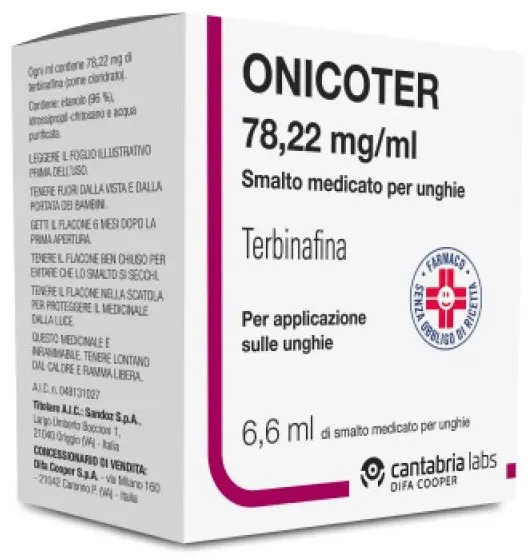
Medicated nail polish useful for the treatment of fungal nail infections.
Indications
Mild to moderate fungal nail infections caused by dermatophytes and/or other fungi sensitive to terbinafine. Onicoter is indicated in adults. Official guidelines on the appropriate use of antifungal agents should be taken into account.
Composition
Active ingredients
Each ml of medicated nail polish contains terbinafine hydrochloride equivalent to 78.22 mg of terbinafine. Excipient with known effect: Each ml of medicated nail polish contains 616 mg of ethanol (96%). For the full list of excipients, see section 6.1.
Excipients
Ethanol (96%) Hydroxypropyl chitosan Purified water
Directions for use and Dosage
The medicated nail lacquer is intended for use on fingernails or toenails. Dosage After an initial daily treatment for a period of 4 weeks, Onicoter should be applied to the affected nails once a week. In general, the duration of treatment is 6 months of therapy for fingernails and 9 to 12 months for toenails. Additional oral therapy should be considered in case of inadequate response to topical treatment at the end of the treatment period and in case of severe nail infection, involving one or more fingers and/or toes and/or the nail matrix. In such situations, medical advice should be sought. Dosage in special populations: Paediatric populationThe safety and efficacy of Onicoter have not yet been established in children and adolescents aged 2 to 17 years. Available data in children and adolescents are described in sections 4.8 and 5.1. Method of administration For topical use only (for application to nails). Before each application of Onicoter, remove any cosmetic nail polish or other cosmetic product from the nails and surrounding skin. Clean and dry the affected areas thoroughly. Apply a thin layer of Onicoter using the applicator over the entire surface of the affected nails, 5 mm of surrounding skin and, if possible, under the free edge of the nail and on the skin under the nail. Wait approximately 30 seconds until the polish has completely dried. Treated nails should not be washed or wet for at least 6 hours. It is therefore recommended to apply in the evening before going to bed and after showering or bathing. After this time, normal hygiene practices can be continued. Onicoter should not be removed with solvents or abrasives (e.g., nail filing). Thoroughly washing the nails with water is sufficient.
Warnings
As with all topical treatments for onychomycosis, adding systemic therapy should be considered if more than 3 nails are involved, more than half of the nail plate is affected, or the nail matrix is involved, and if predisposing factors, such as diabetes and immune disorders, are present. The duration of the disease, the extent of nail plate involvement, and the thickness of the nail may influence the results of the treatment. Onicoter is for external use only. Patients with a history of diabetes, immune disorders, peripheral vascular disease, injured, painful, or severely damaged nails, skin conditions such as psoriasis or any other chronic skin condition, and yellow nail syndrome (edema of the lower limbs, respiratory problems, and yellowish discoloration of the nails) should consult a doctor before starting treatment. Contact with any part of the body other than the affected area should be avoided until the nail polish has completely dried. Irritation may occur if accidental contact with eyes or mucous membranes occurs. In case of accidental contact with these areas, rinse thoroughly with running water. The impact of cosmetic nail polish or other cosmetic nail products on the efficacy of Onicoter has not been evaluated. Paediatric population Onicoter should not be used in children and adolescents under 18 years of age due to the lack of clinical experience in this age group. Onicoter contains 616 mg of alcohol (ethanol) in each ml of solution. May cause irritation. cause a burning sensation on damaged skin.
Contraindications
Hypersensitivity to the active substance or to any of the excipients listed in section 6.1.
Undesirable effects
Summary of the safety profile Adults The safety profile of Onicoter in adults is based on pooled data from 2 randomized, double-blind, placebo-controlled studies (PM1331 and PM0731) in patients with mild to moderate onychomycosis. A total of 556 patients were treated with Onicoter at the recommended dose and 454 patients were treated with placebo. The most commonly reported adverse drug reaction was erythema (0.9% in the Onicoter group; no events of erythema were reported in the placebo group) at the application site. All events of erythema were mild and transient. Tabulated list of adverse reactions Table 1 summarises the adverse reactions reported in patients with onychomycosis receiving Onicoter. Frequencies are defined as: very common (> 1/10); common (> 1/100 to <1/10); uncommon (> 1/1,000 to <1/100); rare (> 1/10,000 to <1/1,000); very rare (<1/10,000); not known (cannot be estimated from the available data). Table 1: Adverse reactions in patients with onychomycosis treated with Onicoter
| System Organ Class | Frequency | Adverse reactions |
| Skin and subcutaneous tissue disorders | Uncommon | Erythema, Skin irritation |
Paediatric populationThe safety of Onicoter was evaluated in 20 paediatric patients with mild to moderate onychomycosis aged 2 to 17 years who participated in an open-label Phase III study (PM Ped 004). The most commonly reported adverse drug reaction in pediatric patients was skin irritation in 3 of 16 children (18.8%) aged 2 to 11 years, localized at the application site. No adverse events were reported in 4 adolescents aged 12 to 17 years. Skin irritation events in children were mild and transient. Reporting of suspected adverse reactions Reporting suspected adverse reactions that occur after authorization of the medicinal product is important, as it allows continued monitoring of the benefit/risk balance of the medicinal product.
Overdose
Due to the route of administration, overdose is very unlikely. Systemic signs of overdose are not expected following topical application of Onicoter. In case of accidental oral ingestion, appropriate symptomatic measures should be taken.
Pregnancy and breastfeeding
Pregnancy There are no data available on the use of terbinafine in pregnant women. Animal studies do not indicate any harmful effects on pregnancy or on the health of the fetus (see section 5.3). Onicoter should not be used during pregnancy unless clearly necessary. Breastfeeding Terbinafine is excreted in breast milk. Only low systemic exposure is expected after topical use. Terbinafine should be used in a breastfeeding mother only if the expected benefit justifies the risk to the child. Furthermore, children should not be allowed to come into contact with any treated areas. Fertility No effects of terbinafine on fertility were observed in animal studies (see section 5.3).
Format
6.6 ml
Product Code:FRCM177950





 Richiedi info sul prodotto