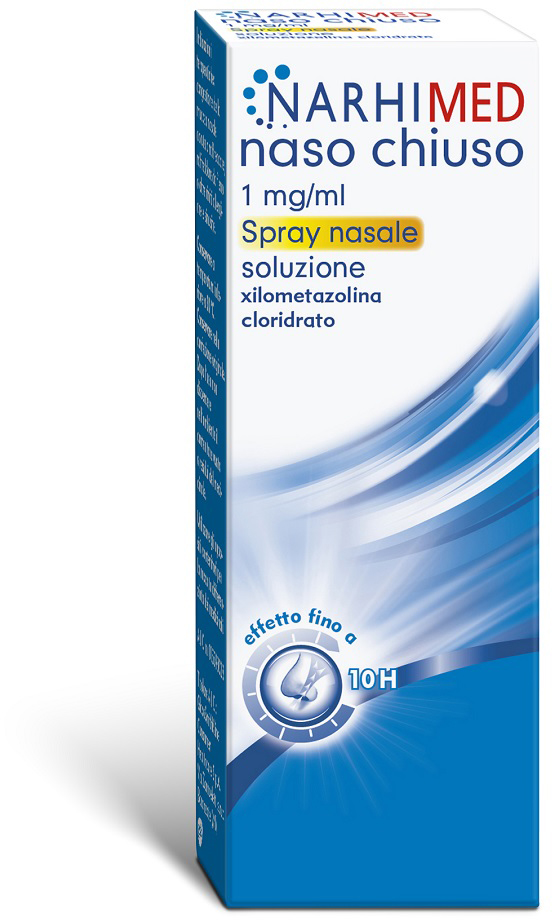
Narhimed Blocked Nose is used in case of congestion of the nasal mucosa due to colds, hay fever or other allergic rhinitis and sinusitis.
Indications
Narhimed Blocked Nose contains the active ingredient xylometazoline hydrochloride, which belongs to the class of nasal mucosal decongestant drugs that work by narrowing the vessels in the nasal mucosa, reducing the swelling (edema) that makes breathing difficult.
Composition
Active ingredients
The active ingredient is xylometazoline hydrochloride.
Each spray mist delivers 0.14 mg of xylometazoline hydrochloride.
Excipients
Sodium phosphate monobasic dihydrate, sodium phosphate dibasic dodecahydrate, sodium edetate, benzalkonium chloride,
sorbitol 70%, hypromellose, sodium chloride, purified water.
How to use and Dosage
Always use this medicine exactly as described in this leaflet or as instructed by your doctor or pharmacist.
If you are not sure, check with your doctor or pharmacist.
Nasal spray, solution:
Dispense 1 spray into each nostril 1-3 times a day, depending on your needs.
Do not exceed 3 sprays per day in each nostril.
Follow these instructions, taking care not to spray the spray into your eyes.
Before To use the spray for the first time, press the pump a few times until a uniform mist is emitted.
For subsequent applications, the dosing pump will be ready for immediate use.
- Blow your nose carefully.
- Hold the bottle upright with your thumb under the base and the nozzle between your two fingers.
- Lean forward slightly and insert the nozzle into one nostril.
- Spray while simultaneously breathing gently through your nose.
- Immediately after use, clean and dry the nozzle before replacing the cap.
To avoid the possible spread of infections, the medicine pack should be used by only one person.
The local effect of the medicine will take place within a few minutes, which lasts up to 10 hours and wears off slowly.
If you forget to use Narhimed Blocked Nose: Do not use a double dose to make up for a forgotten dose.
If you stop taking Narhimed Blocked Nose: If you have any further questions on the use of this medicine, ask your doctor or pharmacist.
Warnings
Talk to your doctor or pharmacist before using Narhimed Blocked Nose.
Before using Narhimed Blocked Nose, consult your doctor if:
- You have had a strong reaction to other medicines containing adrenergic substances, such as substances contained in other nasal decongestants, which manifests itself with signs of insomnia, dizziness, tremor, abnormal heartbeat or high blood pressure;
- have recently had nose surgery;
- have or have had a benign tumor of the adrenal gland (pheochromocytoma);
- have or have had high blood pressure.
- have heart and blood vessel problems;
- have thyroid disease (hyperthyroidism);
- have diabetes;
- have an enlarged prostate (prostatic hypertrophy);
- are taking medicines for depression (monoamine oxidase inhibitors, tricyclic tetracyclic antidepressants) or have taken them in the last two weeks.
Do not exceed the indicated doses and do not useNarhimed Naso Closed for more than 7 consecutive days: prolonged or excessive use may cause the recurrence of nasal congestion and may alter the normal function of the nasal mucosa, causing a reduction in the effectiveness of the medicine, thinning of the nasal mucosa and a reduction in the number and size of the glands that produce mucus.
Children and adolescents:The medicine should not be used in children under 12 years of age.
Elderly:Elderly patients are more susceptible to the risk of developing nasal congestion. subject to side effects associated with NarhimedBlocked Nose: tell your doctor if you experience any unusual symptoms.
Other medicines and Narhimed Blocked Nose:Tell your doctor or pharmacist if you are using, have recently used or might use any other medicines.
If you are taking or have taken in the last two weeks medicines for the treatment of depression (monoamine oxidase inhibitors, tricyclic or tetracyclic antidepressants), concomitant use of Narhimed Blocked Nose is not recommended.
Driving and using machines:
Narhimed Blocked Nose has no or negligible influence on the ability to drive and use machines. machinery.
However, Narhimed Blocked Nose may cause vision problems, dizziness, vertigo, or other central nervous system disorders.
If you experience these problems, do not drive or operate machinery.
Narhimed Blocked Nose contains benzalkonium chloride:
Narhimed Blocked Nose contains benzalkonium chloride (BAC) as a preservative, which, especially when used for long periods, may cause allergic reactions. cause swelling of the nasal mucosa.
If such a reaction (persistent nasal congestion) is suspected, a nasal medicine without benzalkonium chloride should be used, if possible.
If such nasal medicines without benzalkonium chloride are not available, another pharmaceutical form should be considered.
It may cause bronchospasm.
Caution for those who participate in sports activities:
The product contains substances prohibited for doping.
Any use other than those reported in terms of dosage schedule and administration route is prohibited.
Contraindications
Hypersensitivity to xylometazoline or to any of the excipients.
Closed-angle glucoma.
Chronic rhinitis.
Patients with dry or atrophic rhinitis.
Pregnancy. Children under 12 years of age.
As with other vasoconstrictors, do not use the drug in patients undergoing transsphenoidal hypophysectomy or surgery with exposure of the dura mater.
Interactions
Monoamine oxidase inhibitors (MAOIs): xylometazoline may potentiate the action of monoamine oxidase inhibitors and may cause hypertensive crisis.
Xylometazoline is not recommended in patients who are taking or have taken MAOIs in the last two weeks.
Tricyclic and tetracyclic antidepressants: Concomitant use of tricyclic and tetracyclic antidepressants and sympathomimetics may reinforce the sympathomimetic effect of xylometazoline and is therefore not recommended.
Side effects
Like all medicines, this medicine can cause serious side effects. cause side effects, although not everybody gets them.
Side effects can be minimised by using the lowest effective dose for the shortest duration necessary.
Tell your doctor immediately and stop taking the medicine if you experience the following symptoms:
severe allergic reactions, including: swelling of the face, throat or tongue, difficulty breathing, wheezing, rhinitis and skin rashes; severe skin rashes, itching, hives, bruising, pain in red areas, rashes with blisters or peeling skin, giant wheals (swollen skin accompanied by itching and burning). These conditions may also affect the lips, eyes, nose and genitals.
Common side effects (may affect up to 1 in 10 people)
- headache;
- dry or sore nose;
- nausea;
- burning in the nose.
Very rare side effects (may affect up to 1 in 10,000 people)
- transient visual disturbances;
- irregular heartbeat and increased heart rate.
Other side effects
- increased blood pressure;
- slow heartbeat;
- difficulty urinating;
- insomnia;
- restlessness.
Reporting of side effects
If you get any side effects, talk to your doctor or pharmacist.
Overdose
If you take more Narhimed Blocked Nose than you should
In case of accidental ingestion or use of an excessive dose of Narhimed Blocked Nose, tell your doctor immediately or contact the nearest hospital. near the hospital.
If you accidentally swallow the medicine or if you use it for a long time at excessive doses, the following symptoms may occur:
- increased blood pressure
- rapid heartbeat
- excessive sensitivity to light
- severe headache
- chest tightness.
In children, it may be check:
- low temperature
- severe depression of the central nervous system with severe sedation
- acceleration and irregularity of the pulse
- high blood pressure
- sometimes confusional state (clouding of consciousness).
If you forget to use Narhimed Blocked Nose
Do not use a double dose to make up for a forgotten dose.
If you stop taking Narhimed Blocked Nose
If you have any further questions on the use of this medicine, ask your doctor or pharmacist.
Pregnancy and breast-feeding
If you are pregnant or breast-feeding, think you may be pregnant or are planning to have a baby, ask your doctor or pharmacist for advice before taking this medicine.
Pregnancy: Narhimed Blocked Nose must not be used during pregnancy and even if you suspect or are planning a pregnancy.
Breastfeeding: Narhimed Blocked Nose can This medicine should be used during breastfeeding only under medical advice.
Storage
Keep this medicine out of the sight and reach of children.
Do not use this medicine after the expiry date which is stated on the carton after EXPIRY.
The expiry date refers to the last day of that month.
Store below 30°C.
Store in the original packaging.
Do not throw away any medicines via wastewater or household waste.
Ask your pharmacist how to throw away medicines you no longer use.
These measures will help protect the environment.
Format
Narhimed Blocked Nose comes in the form of a nasal spray, solution 0.1%.
The bottle contains 10 ml of a white, opalescent solution with a menthol and eucalyptol (cineole) aroma.
Product Code:FRCM046849





 Richiedi info sul prodotto