




- -41.7%

Recommended price

€8.75
 Richiedi info sul prodotto
Estimated delivery: 1-3 business days

Information on returns and shipments

Payment methods

Composition:
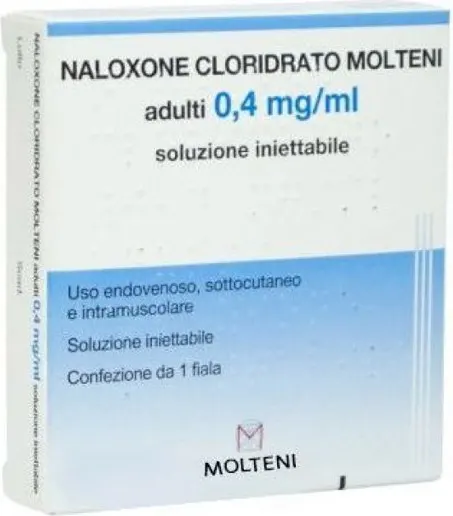
Naloxone hydrochloride MOLTENI adults 0.4 mg/ml solution for injectionOne vial contains: Active ingredient: naloxone hydrochloride 0.4 mg.
MOLTENI children's 0.04 mg/2 ml solution for injection One vial contains: Active ingredient: naloxone hydrochloride 0.04 mg. For the full list of excipients, see section 6.1.
Excipients
Water for injections
Therapeutic indications
Naloxone hydrochloride MOLTENI adults 0.4 mg/ml Antidote in the treatment of acute intoxication from narcotic analgesics. Naloxone hydrochloride MOLTENI children 0.04 mg/2 ml Respiratory depression in the newborn caused by maternal exposure to opioids before birth.
Contraindications
Hypersensitivity to the active substance or to any of the excipients.
Posology
Naloxone can be administered intravenously, subcutaneously or intramuscularly. Intravenous administration, recommended in emergency situations, results in a more rapid onset of pharmacological activity. Since the duration of the pharmacological effects of some narcotics may exceed that of naloxone, the patient should be constantly monitored and, if necessary, the drug administration should be repeated. However, it is always recommended to send the patient to a fully equipped emergency room as soon as possible. If it is necessary to dilute the solution contained in the vial, 0.9% sodium chloride (saline solution) or 5% glucose can be used. Adults: Narcotic overdose (known or suspected) The initial dose of naloxone, administered intravenously, intramuscularly, or subcutaneously, is 0.4 mg/ml. If there is no sufficient improvement in respiratory function after intravenous administration, it is advisable to repeat the dose at intervals of 2–3 minutes. Poor improvement after administration of 2–3 doses of NALOXONE may be caused by concomitant disease processes or the presence of non-opioid drugs. Post-operative depression induced by narcotics To obtain partial or complete antagonism of the depressant effects of opioids following surgery, a lower dose of naloxone is required. This must, however, be established in relation to the patient's response. Naloxone must be administered intravenously, in increasing doses between 0.1 and 0.2 mg, at 2–3 minute intervals, until adequate antagonism of the depressant effects induced by narcotics is obtained. Within 1–2 hours of the first administration, it may be necessary to repeat the administration of naloxone, depending on the type, quantity and time interval since the last administration of the narcotic. Additional intramuscular doses, however, result in a more prolonged effect. Excessive doses of naloxone can significantly reduce the analgesic effect induced by the narcotic and increase blood pressure. Similarly, too rapid antagonism may induce nausea, vomiting, sweating, or tachycardia. Children: Narcotic overdose (known or suspected) The initial dose is 0.01 mg/kg administered intravenously, intramuscularly, or subcutaneously. The dose can be increased. The dose should be repeated according to the indications for administration in adults.
Warnings and precautions
The symptoms of acute opioid intoxication are respiratory depression, coma (precoma or conscious coma and in the most severe cases, deep coma), pupillary miosis (absent in the case of concomitant intake of substances with a mydriatic effect, in cases of acute pethidine intoxication and in terminal coma). The administration of vasopressor drugs and resuscitation techniques, such as maintaining a patent airway, artificial respiration and cardiac massage, can be combined to counteract acute narcotic poisoning. Naloxone is not effective against respiratory depression due to non-opioid drugs. The patient must be carefully observed after awakening for up to 3–6 hours in cases of acute heroin intoxication and up to 24–48 hours in cases of acute methadone intoxication. Respiratory depression may recur and the patient may fall into a coma after the first effective dose of naloxone is administered, because the duration of the antagonistic action (20–30 minutes after intravenous administration, 2.5–3 hours after intramuscular or subcutaneous administration) may be shorter than that of the injected opiate, which varies from time to time (heroin, morphine, methadone, pentazocine, etc.). Therefore, it may be necessary to administer additional doses of naloxone after the first effective administration. After the initial intervention, it is therefore necessary to transfer the patient to a hospital for prompt treatment. Naloxone should be administered with caution to patients with cardiac disease or those receiving cardiotoxic drugs. Naloxone should be administered with caution to patients who have experienced significant laryngospasm in the preceding hours. Naloxone should be used in newborns of mothers who have received an opioid within 4 hours of birth and only as adjunctive therapy in newborns who have not established independent breathing following ventilation. Naloxone is not effective against respiratory depression due to non-opioid drugs. The use of naloxone in newborns of mothers addicted to opioids is not recommended, as naloxone may precipitate the withdrawal syndrome and seizures typical of this condition in these patients.
Interactions
Naloxone should not be administered concomitantly with clonidine: the hypotensive and bradycardic effects of chronic clonidine administration may be exacerbated. be temporarily attenuated by intravenous administration of naloxone. Therefore, blood pressure should be carefully monitored.
Undesirable effects
The following are the undesirable effects of naloxone organized according to the MedDRA system organ classification. There are insufficient data to determine the frequency of the individual effects listed. Cardiac disorders Cases of cardiac arrest, hypertension, hypotension, fibrillation, and ventricular tachycardia have occurred. Skin and subcutaneous tissue disorders Sweating, hot flushes, and flushing. Endocrine disorders Increased growth hormone levels when administered at doses of 0.3 to 4 mg/kg. Gastrointestinal disorders Nausea, vomiting, dysphagia. Nervous system disorders Paraesthesia, convulsions, tremors. Memory deficit with doses of 0.3 to 4 mg/kg. Psychiatric disorders Agitation, hallucinations. Renal and urinary disorders: Urgency to urinate. Respiratory, thoracic, and mediastinal disorders: Dyspnea, hypoxia, pulmonary edema, and respiratory depression. Hyperventilation at doses of 0.3 to 4 mg/kg.
Pregnancy and breastfeeding
Not applicable.
This product has been on sale since 25/09/2017
In the last 30 days, the product's lowest price was 4,32 €

Estimated delivery: 1-3 business days

Estimated delivery: 1-3 business days


Estimated delivery: 1-3 business days

Estimated delivery: 1-3 business days

Estimated delivery: 1-3 business days

Estimated delivery: 1-3 business days