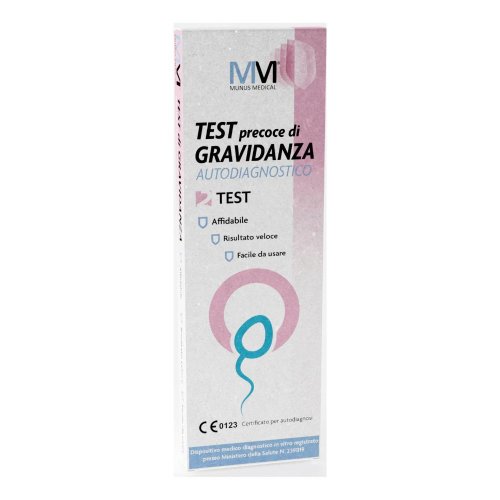
The Munus Pregnancy Test is a rapid chromatographic immunoassay for the qualitative detection of human chorionic gonadotropin (hCG) in urine, facilitating the early diagnosis of pregnancy.
Indications
A rapid chromatographic immunoassay for the qualitative detection of human chorionic gonadotropin in urine to facilitate the early diagnosis of pregnancy.
It is a rapid, one-step lateral flow immunoassay in a midstream format for the qualitative detection of human chorionic gonadotropin (hCG) in urine to facilitate the early detection of pregnancy. The test uses a combination of antibodies, including a hCG monoclonal antibody, to selectively detect elevated levels of hCG. The test is performed by adding urine to the hydrophilic stick and obtaining the result from the colored lines.
Directions for Use
Sample Collection and Preparation
The urine sample should be collected in a clean, dry container. A first-morning urine sample is preferred, as it generally contains the highest concentration of hCG; however, urine samples collected at any time of day can be used.
Urine samples with visible particles should be centrifuged, filtered, or allowed to settle to obtain a clear sample for analysis.
If this is not possible, the urine sample should be collected in a clean, dry container. If testing is possible immediately, urine samples can be stored at 2-8°C for up to 48 hours before testing.
For extended storage, samples can be frozen and stored below -20°C. Frozen samples must be thawed and mixed before testing.
Testing
Before testing, allow the test and sample to reach room temperature (15-30°C).
Remove the midstream from the foil pouch and test immediately or within one hour. Remove the midstream cap, place the absorbent tip in the urine stream, or immerse the absorbent tip (>2/3) in the urine in a clean container for at least 15 seconds. Do not urinate in the result window.
Replace the cap on the test midstream, then place the midstream on a clean, stable desk and start the timer immediately.
Read the result after 3 minutes; do not interpret the result after 10 minutes.
Reading the Results
Positive: Two colored lines appear. One line should be in the control line area (C) and another line in the test line area (T). One line may be lighter than the other; they do not need to be the same intensity. This result indicates the probability of pregnancy.
Negative: One colored line appears in the control region (C). No line appears in the test line area (T). This result indicates the probability of pregnancy. that you are not pregnant.
Invalid: The result is invalid if no colored line appears in the control line area (C), even if a line appears in the test line area (T). You should repeat the test with a new test.
Interactions
Medications containing hCG (such as Pregnyl, Profasi, Pergonal, Apl) may give a false positive result. Alcohol, oral contraceptives, painkillers, antibiotics, or hormone therapies that do not contain hCG do not affect the test result.
Warnings
Read all information in this leaflet before performing the test.
For in vitro diagnostic use only. Not for internal use.
Do not use after the expiration date printed on the foil pouch.
Do not use if the pouch is torn or damaged.
Keep out of reach of children.
Do not open the foil pouch until you have finished testing. You are ready to begin testing.
The test used must be disposed of according to local regulations.
There is a possibility that this midstream test may produce false results. Consult your doctor before making any medical decisions.
Very dilute urine samples, as indicated by a low specific gravity, may not contain representative levels of hcg. If pregnancy is still suspected, collect a first-morning urine sample 48 hours later and submit it for testing.
Very low levels of hcg (less than 50 miu/ml) are present in urine samples shortly after implantation. However, since hcg is a common cause of pregnancy, it is important to consult your doctor before making any medical decisions. Since a significant number of pregnancies end naturally in the first trimester, a weakly positive test result should be confirmed by retesting with a first-morning urine sample collected 48 hours later.
This test may produce false-positive results. A number of conditions other than pregnancy, including trophoblastic disease and some non-trophoblastic malignancies, including testicular tumors, prostate cancer, breast cancer, and lung cancer, cause elevated hCG levels. Therefore, the presence of hCG in urine should not be used to diagnose pregnancy unless these conditions have been ruled out.
This test may produce false-negative results. False-negative results may occur when hCG levels are below the sensitivity of the test. If pregnancy is still suspected, collect a first-morning urine sample 48 hours later and submit it for testing. If pregnancy is suspected and the test continues to produce negative results, consult a physician for further diagnosis.
This test provides a presumptive diagnosis of pregnancy. A confirmed diagnosis of pregnancy should be made by a physician only after all clinical and laboratory results have been evaluated.
Pregnancy and Breastfeeding
Very dilute urine samples, as indicated by a low specific gravity, may not contain representative levels of hCG. If you still suspect pregnancy, collect a first-morning urine sample 48 hours later and test it.
Very low levels of hCG (less than 50 miu/ml) are present in urine samples shortly after implantation. However, because a significant number of pregnancies end naturally in the first trimester, a weakly positive test result should be confirmed by retesting with a first-morning urine sample collected 48 hours later.
This test may produce false-positive results. A number of conditions other than pregnancy, including trophoblastic disease and some non-trophoblastic malignancies, including testicular tumors, prostate cancer, breast cancer, and lung cancer, cause elevated hCG levels. Therefore, the presence of hCG in urine should not be used to diagnose pregnancy unless these conditions have been ruled out.This test may produce false-negative results. False-negative results can occur when hCG levels are below the sensitivity of the test. If you still suspect pregnancy, collect a first-morning urine sample 48 hours later and test it. If you suspect pregnancy and the test continues to produce negative results, consult a doctor for further diagnosis.
This test provides a presumptive diagnosis of pregnancy. A confirmed diagnosis of pregnancy should be made by a doctor only after all clinical and laboratory results have been evaluated.
Storage
Store in its original packaging at room temperature or in the refrigerator (2-30°C). Do not freeze.
The test is stable until the expiration date printed on the sealed pouch. The test must remain in the sealed pouch until use. Do not use beyond the expiration date.
Shelf life with intact packaging: 36 months.
Format
The kit contains: midstream test; package insert.
Product Code:FRCM230852




 Richiedi info sul prodotto


