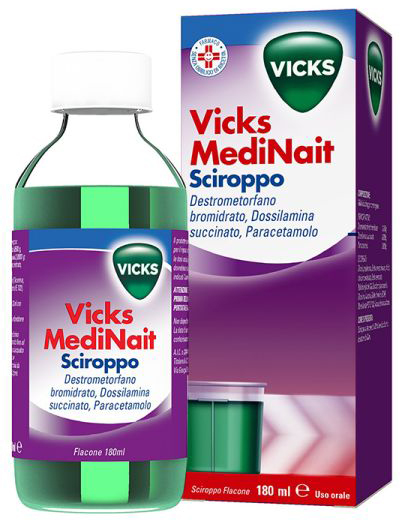
Vicks MediNait: syrup for the treatment of cold and flu symptoms
Active ingredients
100 ml of syrup contains: Active ingredients Dextromethorphan hydrobromide 0.0500 g. Doxylamine succinate 0.0250 g. Paracetamol 2.0000 g. For the full list of excipients, see section 6.1.
Excipients
Propylene glycol, sodium citrate dihydrate, citric acid monohydrate, sodium benzoate, polyethylene glycol 300, sugar (sucrose), glycerin, anethole, quinoline yellow (E 104), brilliant blue FCF (E133), demineralised water.
Therapeutic indications
Treatment of cold and flu symptoms.
Contraindications
Known individual hypersensitivity to the components. Children under 12 years of age. Asthma, diabetes, glaucoma, prostatic hypertrophy, stenosis of the gastrointestinal and urogenital tracts, epilepsy, severe liver disease or severe renal impairment. Paracetamol-based products are contraindicated in patients with manifest glucose-6-phosphate dehydrogenase deficiency and in those with severe haemolytic anaemia. History of gastrointestinal bleeding or perforation related to previous active treatments or history of recurrent peptic haemorrhage/ulcer (two or more distinct episodes of proven ulceration or bleeding). Severe heart failure. In case of concomitant administration with MAOIs (monoamine oxidase inhibitors) or within two weeks of taking MAOIs.
Dosage
Adults and children over 12 years: one level measuring cup (30 ml = 2 tablespoons), once a day, for no more than 1 hour. 3 days.
Warnings and Precautions
Ask your doctor before use if you have a cough that occurs with excessive phlegm (mucus) or a persistent cough, such as that which occurs with smoking, asthma, or emphysema. High or prolonged doses of paracetamol, present in the product, can cause high-risk liver disease and even serious kidney and blood changes. Paracetamol should be used with caution in patients with renal and liver failure, including those with alcoholic cirrhotic liver disease. The risk of overdose is greater in those with alcoholic liver disease. Do not use with any other product containing paracetamol. Use of the product is not recommended if the patient is being treated with anti-inflammatory drugs. Doses should be reduced during therapy with oral anticoagulants. In the rare cases of allergic reactions, administration should be suspended. Particular caution is required when determining the dose in elderly patients, given their greater sensitivity to antihistamines. The use of antihistamines concomitantly with certain ototoxic antibiotics may mask the first signs of ototoxicity, which may only become apparent when the damage is irreversible. The product should be administered with caution in patients with cardiovascular disease, hypertension, and hyperthyroidism. Caution is required in patients with a history of hypertension and/or heart failure, as fluid retention and edema have been reported in association with NSAID therapy. Additive effects may occur with alcohol, hypnotics, sedatives, or tranquilizers, which should therefore not be taken concomitantly. The use of Vicks Medinait should be avoided in conjunction with NSAIDs, including selective COX-2 inhibitors. Undesirable effects can be minimized by using the lowest effective dose for the shortest duration necessary to control symptoms. Elderly: Elderly patients have an increased frequency of adverse reactions to NSAIDs, especially gastrointestinal bleeding and perforation, which may be fatal (see section 4.2). Gastrointestinal bleeding, ulceration and perforation: Gastrointestinal bleeding, ulceration and perforation, which can be fatal, have been reported with all NSAIDs at anytime during treatment, with or without warning symptoms or a previous history of serious gastrointestinal events. The risk of gastrointestinal bleeding, ulceration or perforation is higher with increasing NSAID doses, in the elderly and in patients with a history of ulcers, particularly if complicated with haemorrhage or perforation (see section 4.3). These patients should start treatment on the lowest available dose. Concomitant use of protective agents (misoprostol or proton pump inhibitors) should be considered for these patients, as well as for patients taking low-dose aspirin or other drugs that may increase the risk of gastrointestinal events (see below and section 4.5). Patients with a history of gastrointestinal toxicity, particularly when elderly, should report any unusual gastrointestinal symptoms (especially gastrointestinal bleeding), particularly in the initial stages of treatment. Caution should be exercised in patients taking concomitant medications which could increase the risk of ulceration or bleeding, such as oral corticosteroids, anticoagulants such as warfarin, selective serotonin reuptake inhibitors, or antiplatelet agents such as aspirin (see section 4.5). If gastrointestinal bleeding or ulceration occurs in patients taking Vicks Medinait, the treatment should be discontinued. NSAIDs should be administered with caution to patients with a history of gastrointestinal disease (ulcerative colitis, Crohn's disease), as these conditions may be exacerbated (see section 4.8 – Undesirable effects). Serious skin reactions, some of them fatal, including exfoliative dermatitis, Stevens-Johnson syndrome, and toxic epidermal necrolysis, have been reported very rarely in association with the use of NSAIDs (see section 4.8). Patients appear to be at highest risk early in the course of therapy: the onset of the reaction occurs in most cases within the first month of treatment. Vicks Medinait should be discontinued at the first appearance of skin rash, mucosal lesions, or any other sign of hypersensitivity. The product contains sucrose; this should be taken into account when following a low-calorie diet. After 3 days of continuous use without noticeable results, consult your doctor. Instruct the patient to contact their doctor before combining any other medication.
Interactions
Do not use during or within two weeks of treatment with antidepressant drugs (anti-MAOIs). Use with extreme caution and under close supervision during chronic treatment with drugs that can induce hepatic monooxygenase or in case of exposure to substances that can have this effect (for example, rifampicin, cimetidine, antiepileptics such as glutethimide, phenobarbital, carbamazepine and also alcohol). These substances can increase the hepatotoxicity of paracetamol. The administration of paracetamol can interfere with the determination of uric acid (by the phosphotungstic acid method) and that of glycemia (by the glucose-oxidase-peroxidase method). The absorption rate of paracetamol can be affected. may be increased by metoclopramide or domperidone, and absorption may be reduced by cholestyramine. There is a potential for interaction between dextromethorphan and drugs that inhibit the CYP2D6 isoenzyme, such as SSRIs (e.g., fluoxetine, paroxetine). Diuretics, ACE inhibitors, and Angiotensin II antagonists: NSAIDs may reduce the effect of diuretics and other antihypertensive drugs. In some patients with compromised renal function (e.g., dehydrated patients or elderly patients with compromised renal function), co-administration of an ACE inhibitor or an angiotensin II antagonist and agents that inhibit the cyclooxygenase system may lead to further deterioration of renal function, including possible acute renal failure, which is usually reversible. These interactions should be considered in patients taking Vicks Medinait concomitantly with ACE inhibitors or angiotensin II antagonists. Therefore, the combination should be administered with caution, especially in elderly patients. Patients should be adequately hydrated, and renal function monitoring should be considered after initiating concomitant therapy. Corticosteroids: Increased risk of gastrointestinal ulceration or bleeding (see section 4.4). Anticoagulants: NSAIDs may enhance the effects of anticoagulants, such as warfarin (see section 4.4). Antiplatelet agents and selective serotonin reuptake inhibitors (SSRIs): increased risk of gastrointestinal bleeding (see section 4.4).
Undesirable effects
In general, no serious adverse effects are expected. Blood and lymphatic system disorders: Blood dyscrasias, such as thrombocytopenia, agranulocytosis, haemolytic anaemia, neutropenia, leukopenia, pancytopenia, have been reported very rarely with the use of paracetamol or doxylamine, but these were not necessarily causally related. Immune system disorders: There have been rare cases of allergy or hypersensitivity reactions with paracetamol and doxylamine, including skin rashes, urticaria, anaphylaxis and bronchospasm. Hypersensitivity reactions such as angioedema, laryngeal edema, anaphylactic shock have also been reported. Nervous system disorders: Drowsiness is common with doxylamine and may rarely occur with dextromethorphan. Other side effects that are more common with antihistamines such as doxylamine include headache, blurred vision, and psychomotor impairment. Dextromethorphan is also rarely associated with dizziness. Gastrointestinal disorders: The most commonly observed adverse events are gastrointestinal in nature. Dry mouth, constipation, and increased gastric reflux may occur with antihistamines such as doxylamine. Gastrointestinal disorders that may rarely occur with doxylamine or dextromethorphan include nausea, vomiting, abdominal pain, and diarrhea. Flatulence, dyspepsia, melaena, haematemesis, ulcerative stomatitis, exacerbation of colitis and Crohn's disease have been reported (see section 4.4 – Special warnings and precautions for use). Gastritis has been observed less frequently. Peptic ulcers, perforation or gastrointestinal bleeding, sometimes fatal, particularly in the elderly, may occur (see section 4.4). Hepatobiliary disorders: Altered liver function and hepatitis. In case of overdose, paracetamol can cause hepatic cytolysis, which can progress to massive and irreversible necrosis (see section 4.9). Skin and subcutaneous tissue disorders: Hypersensitivity, including skin rashes and urticaria, may rarely occur with the use of paracetamol. Skin reactions of various types and severity have been reported with the use of paracetamol, including cases of erythema multiforme and bullous reactions including Stevens-Johnson syndrome and toxic epidermal necrolysis (very rarely). Skin rashes, with or without irritation, have been reported rarely with the use of pseudoephedrine and dextromethorphan. Renal and urinary disorders: Antihistamines, such as doxylamine, can cause urinary retention or difficulty urinating, and renal disorders (acute renal failure, interstitial nephritis, hematuria, anuria). Other adverse effects: Antihistamines can also cause asthenia, photosensitivity, and, at high doses, convulsions, difficulty breathing due to thickened bronchial secretions, and, especially in the elderly, extrasystoles, tachycardia, and hypotension. Edema, hypertension, and cardiac failure have been reported in association with NSAID treatment. Reporting of suspected adverse reactions Reporting suspected adverse reactions that occur after authorization of the medicinal product is important. It allows continued monitoring of the benefit/risk balance of the medicinal product. Healthcare professionals are asked to report any suspected adverse reactions via the national reporting system available on the website: www.agenziafarmaco.gov.it/it/responsabili of the Italian Medicines Agency.
Pregnancy and breastfeeding
Do not use during pregnancy or breastfeeding. Pregnancy Inhibition of prostaglandin synthesis may adversely affect pregnancy and/or embryo/fetal development. Results of epidemiological studies suggest an increased risk of miscarriage, cardiac malformation, and gastroschisis after use of a prostaglandin synthesis inhibitor in early pregnancy. The absolute risk of cardiac malformations increased from less than 1% to approximately 1.5%. The risk is believed to increase with dose and duration of therapy. In animals, administration of prostaglandin synthesis inhibitors has been shown to result in increased pre- and post-implantation loss and embryo-fetal mortality. Furthermore, an increased incidence of various malformations, including cardiovascular, has been reported in animals administered prostaglandin synthesis inhibitors during the organogenetic period. During the third trimester of pregnancy, all prostaglandin synthesis inhibitors may expose the fetus to: – cardiopulmonary toxicity (with premature closure of the ductus arteriosus and pulmonary hypertension), – renal dysfunction, which may progress to renal failure with oligo-hydroamniosis, the mother and the newborn, at the end of pregnancy, to: – possible prolongation of bleeding time, and antiplatelet effect which may occur even at very low doses, – inhibition of uterine contractions resulting in delayed or prolonged labor. Cetirizine should be avoided during breastfeeding.
Product Code:FRCM046909








 Richiedi info sul prodotto