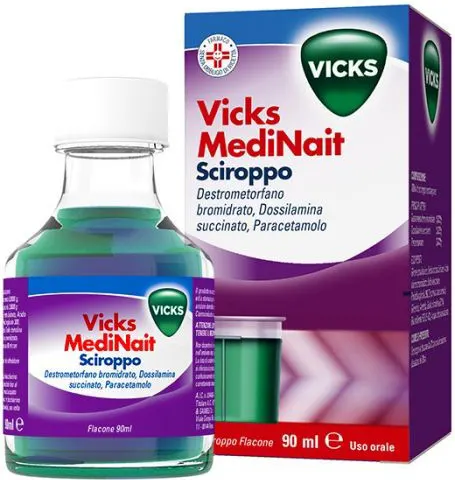
Syrup useful for the treatment of cold and flu symptoms.
Indications
Vicks MediNait Syrup combines the action of three active ingredients (Dextromethorphan hydrobromide, Doxylamine succinate, Paracetamol) to relieve all flu symptoms, especially at night.
In particular, Vicks MediNait Syrup acts on:
- Fever;
- Pains;
- Runny nose;
- Sneezing;
- Headache;
- Sore throat;
- Cough.
Furthermore, the paracetamol contained in Vicks MediNait syrup is absorbed more quickly than in the blood. quickly from the body compared to the same active ingredient taken in tablets. In this way, if taken before going to sleep, this flu medicine promotes a good night's sleep and helps you face the next day better.
You can buy Vicks MediNait Syrupat a discounted price on Farmacosmo!
Composition
100 ml of Vicks MediNait contains the following active ingredients:
• 0.05 g of dextromethorphan hydrobromide, useful for calming cough symptoms;
• 0.0250 g of doxylamine succinate, an antihistamine that acts on some cold symptoms, such as a runny nose and sneezing;
• 2 g of paracetamol, which has a pain-relieving action and helps lower fever.
The other ingredients are: propylene glycol, sodium citrate, citric acid monohydrate, sodium benzoate, macrogol, sucrose, glycerol, anethole, quinoline yellow (E 104), brilliant blue FCF (E 133) and purified water.
Vicks MediNait contains 8.25 g of sucrose per dose. To be taken into consideration by people with diabetes mellitus and if they are on a low-calorie diet. If you have an intolerance to some sugars, contact your doctor before taking this medicine.
This medicine contains 3.3 mmol (or 76 mg) of sodium per dose (30 ml). To be taken into consideration by people with reduced kidney function or who are on a low-sodium diet.
Vicks MediNait in Pregnancy and breastfeeding
Vicks MediNait should not be used during pregnancy and breastfeeding.
If you are pregnant, if you suspect you are pregnant or are planning to become pregnant, or if you are breastfeeding, ask your doctor or pharmacist for advice before taking this medicine to evaluate the risk/benefit ratio.
Dosage and method of use
For adults and children over 12 years of age, the recommended dose of Vicks MediNait is 30 ml (one measuring cup, equal to 2 tablespoons), to be taken once a day on a full stomach, before going to bed, for no more than 1 hour. 3 days.
Warnings
Vicks MediNait Syrup should not be used:
• if you are allergic to the active substances or to any of the other ingredients of this medicine;
• to treat a child under 12 years of age;
• if you suffer or have suffered from asthma;
• if you have diabetes;
• if you suffer from too high eye pressure (glaucoma);
• if you have an enlarged prostate (prostatic hypertrophy);
• if you suffer from a condition characterised by narrowing of the digestive tract (for example, in the intestine) or urinary tract (gastrointestinal and urogenital stenosis);
• if you suffer or have suffered from epilepsy;
• if your liver function is severely impaired;
• if your kidney function is severely impaired;
• if you lack an enzyme called glucose-6-phosphate dehydrogenase;
• if you have suffered from bleeding or perforation of the stomach or intestine (two or more episodes of ulcer or bleeding);
• if you have heart problems (severe heart failure);
• if you are already taking medicines belonging to the class of monoamine oxidase inhibitors (MAOIs), used as antidepressants, or if you have stopped them less than two weeks ago;
• if you are already taking medicines containing paracetamol;
• if you are already taking hypnotics, sedatives or tranquilizers;
• if you are already taking other nonsteroidal anti-inflammatory drugs (NSAIDs), including selective COX-2 inhibitors (such as celecoxib, parecoxib or rofecoxib);
• together with alcohol.
• if you are pregnant, especially in the first trimester, or if you are breastfeeding.
It is particularly important to know that even if you are perfectly healthy, the use of paracetamol and medicines containing it (such as Vicks MediNait), in high doses and for prolonged periods, can cause alterations, even serious ones, to the liver, kidneys (especially in elderly patients), or blood. Paracetamol-based products should therefore be taken with caution if you already suffer from liver or kidney problems.
Furthermore, taking drugs belonging to the NSAID category (such as paracetamol) carries the risk of developing bleeding, ulcers, or perforations in the stomach and intestines, which can be fatal, especially for elderly people. Be careful if you are elderly or if you are a patient with a history of ulcers, as you may be more likely to develop bleeding and lesions in the stomach or intestines. Start treatment with the lowest available dose, as the risk of experiencing these types of side effects increases with increasing doses.
Ask your doctor or pharmacist about the possible concomitant use of a drug that can protect the stomach (protective agents such as misoprostol or proton pump inhibitors), even if you take low doses of aspirin or other medicines that can increase the risk of stomach and intestinal events.
If you are an elderly person, you may also be more sensitive to the effects of antihistamines (such as doxylamine contained in Vicks MediNait). The use of antihistamines, together with some antibiotics, can mask the first signs of damage to the hearing system.
Interactions
The use of Vicks MediNait is not recommended together with anti-inflammatory drugs.
It is important to tell your doctor if you are using any of the following medicines:
• antibiotics because the doxylamine contained in the medicine can mask the signs of ear toxicity caused by some antibiotics;
• drugs that induce the production of liver enzymes known as "monooxygenases" (for example, antibiotics such as rifampicin and cimetidine and antiepileptics such as glutethimide, phenobarbital, and carbamazepine) because they can increase the liver toxicity of paracetamol;
• drugs used to treat vomiting (for example, metoclopramide and domperidone) because they increase the rate of absorption of paracetamol;
• a cholesterol medicine called cholestyramine because it can reduce the rate of absorption of paracetamol;
• diuretics, ACE inhibitors, and angiotensin II antagonists (used in hypertension, kidney disease, and some heart conditions) because paracetamol may reduce the effect of these categories of drugs. Furthermore, in patients with kidney disease (especially elderly patients), further worsening of kidney function may occur;
• corticosteroids (powerful anti-inflammatories) because they increase the risk of gastrointestinal lesions (ulcers) and bleeding;
• anticoagulants (such as warfarin) because paracetamol may enhance the effect of this category of medicines;
• antiplatelet agents (such as aspirin) and selective serotonin reuptake inhibitors (used as antidepressants) because they may increase the effect of these drugs. increase the risk of gastrointestinal bleeding.
In particular, tell your doctor if you are taking or have recently taken:
• medicines to treat depression such as fluoxetine, paroxetine, sertraline, and bupropion;
• medicine to treat severe pain or to reduce withdrawal symptoms in cases of dependence (methadone);
• medicines to treat psychiatric illnesses (haloperidol, thioridazine, perphenazine);
• medicines to treat heart rhythm disorders (amiodarone, quinidine, propafenone);
• medicines to treat abnormal heart rhythms (flecainide);
• medicines to reduce the level of calcium in the blood and treat a disorder of the body due to a reduced secretion of the hormone that regulates these levels in the blood (hyperparathyroidism) such as cinacalcet;
• Medicines used to prevent the growth of fungi (terbinafine).
Laboratory tests
Paracetamol, contained in Vicks MediNait, may interfere with the measurement of uric acid or glucose levels in the blood (uricemia and glycemia).
Vicks MediNait with alcohol
Do not drink alcoholic beverages while you are being treated with this medicine because they can increase the toxicity of paracetamol on the liver. Furthermore, drinking alcohol can increase drowsiness and reduce your reaction time.
Side effects
Like all medicines, this medicine can cause side effects, although not everybody gets them. Stop treatment and tell your doctor immediately if you experience the following symptoms:
• skin rash and itching, difficulty breathing (bronchospasm) or swallowing, swelling of the face, hands and feet, eyes, lips and/or tongue (angioedema). These may be signs of serious allergic reactions (anaphylactic shock);
• skin changes, such as hives, widespread red bumps or blisters and peeling, especially on the legs, arms, hands and feet, which may extend to the face and lips, occasionally accompanied by fever. These may be signs of serious skin diseases such as erythema multiforme, toxic epidermal necrolysis or Stevens-Johnson syndrome.
Other side effects may include:
Common (may affect up to 1 in 10 people):
drowsiness; headache; blurred vision; psychomotor impairment; dry mouth; constipation; increased heartburn, acidity, and regurgitation (gastric reflux).
Rare (may affect up to 1 in 1,000 people):
nausea; vomiting; abdominal pain; diarrhoea; skin rash; hives; dizziness.
Very rare (may affect up to 1 in 10,000 people):
reduction in the number of blood cells called platelets (thrombocytopenia); reduction in the number of all blood cells (pantocytopenia); reduction, which may be severe, in the number of white blood cells in the blood (agranulocytosis, neutropenia, leukopenia); low concentration of haemoglobin in the blood due to excessive destruction of red blood cells in the blood (haemolytic anaemia).
Not known (frequency cannot be estimated from the available data):
flatulence; difficulty indigestion (dyspepsia); passing bloody stools (melena); vomiting blood (haematemesis); inflammation of the oral mucosa (ulcerative stomatitis); worsening of any severe intestinal inflammation characterised by episodes of severe diarrhoea (colitis); worsening of any chronic intestinal disease (Crohn's disease); changes in liver function; inflammation of the liver (hepatitis) leading to cytolysis (cell death) and blockage of the organ (liver necrosis); inflammation and damage to the gastric mucosa (gastritis, peptic ulcers); perforation or bleeding of the stomach (gastric haemorrhage); inability to empty the bladder (urinary retention) and difficulty urinating; Failure to produce or pass urine (anuria); blood in the urine (hematuria); changes in kidney function (acute renal failure, interstitial nephritis); tiredness (asthenia); immune system reaction to sunlight manifested as an itchy skin rash (photosensitivity); convulsions; difficulty breathing due to increased secretions from the respiratory tract; changes in heartbeat (extrasystoles and tachycardia); low blood pressure (hypotension); accumulation of fluid in the body (edema); high blood pressure (hypertension); changes in heart function (cardiac failure).
Format
90 ml bottle.
Product Code:FRCM046911







 Richiedi info sul prodotto