



- -27.92%

Recommended price

€20.11

 Richiedi info sul prodotto
Estimated delivery: 2-5 working days

Information on returns and shipments

Payment methods

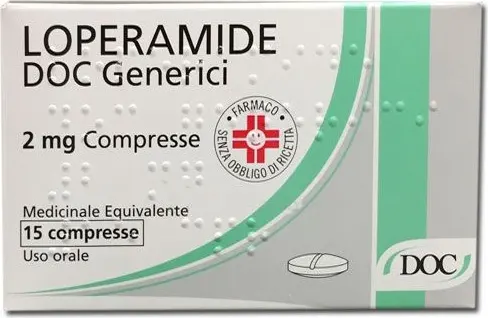
Equivalent medicinal product.
Loperamide Doc is indicated for the treatment of acute diarrhea.
Each tablet contains 2 mg of loperamide (as loperamide hydrochloride). Excipient with known effect: lactose monohydrate.
Magnesium stearate, maize starch, lactose monohydrate, microcrystalline cellulose.
Adults and children aged 6 to 17 years: The tablets should be taken with a little liquid. Acute diarrhoea: The initial dose is 2 tablets (4 mg) for adults and 1 tablet (2 mg) for children; then 1 tablet (2 mg) after each subsequent loose (loose) stool. Chronic diarrhoea: The initial dose is 2 tablets (4 mg) for adults and 1 tablet (2 mg) for children per day; this initial dose should be adjusted until 1-2 solid stools per day are achieved, which is generally achieved with a maintenance dose of 1-6 tablets (2 mg -12 mg) per day.
The maximum daily dose for chronic and acute diarrhoea is 8 tablets (16 mg) per day for adults; in children the dose should be related to body weight (3 tablets/20 kg) but should not exceed a maximum of 8 tablets per day. Children under 2 years of age Loperamide Doc should not be used in children under 2 years of age.
Elderly No dose adjustment is necessary in the elderly.
Renal impairment No dose adjustment is necessary in patients with renal impairment.
Hepatic impairment Although no pharmacokinetic data are available in patients with hepatic impairment, Loperamide Doc should be used with caution in these patients due to reduced first-pass metabolism.
Treatment of diarrhea with Loperamide Doc is only symptomatic.
Whenever an underlying etiology can be determined, specific treatment should be administered when appropriate.
Fluid and electrolyte depletion may occur in patients with diarrhea, especially in children.
In these cases, the most important countermeasure is the administration of adequate fluid and electrolyte replacement therapy.
Loperamide Doc should not be administered to children between 2 and 6 years of age without a prescription and medical supervision.
In acute diarrhea, if no improvement in clinical symptoms is observed within 48 hours, administration of Loperamide Doc should be discontinued and patients should be advised to consult their doctor.
AIDS patients treated with Loperamide Doc for diarrhea should discontinue therapy at the first signs of abdominal distension.
In these patients with infectious colitis caused by viral and bacterial pathogens, treated with loperamide hydrochloride, isolated cases of constipation with an increased risk of toxic megacolon have been observed. Although no pharmacokinetic data are available in patients with hepatic impairment, Loperamide Doc should be used with caution in these patients due to reduced first-pass metabolism.
Patients with hepatic dysfunction should be carefully monitored for signs of central nervous system (CNS) toxicity.
Cardiac events, including QT prolongation and torsade de pointes, have been reported in association with overdose.
Some cases have been fatal. Patients are advised not to exceed the recommended dose and/or prolong the duration of therapy.
This medicinal product contains 0.34 g of lactose per tablet.
When taken according to the recommended dosage, each daily dose provides up to 2.720 g of lactose, therefore patients with rare hereditary problems of galactose intolerance, the Lapp lactase deficiency, or glucose-galactose malabsorption should not take this medicine.
Treatment with loperamide should be discontinued if there is no improvement in clinical symptoms within 48 hours of starting therapy and patients should consult their doctor.
Possible interactions may occur with drugs with pharmacological properties similar to those of loperamide or drugs that can slow intestinal peristalsis (e.g. anticholinergics), as the effects of loperamide may be potentiated.
Substances that accelerate gastrointestinal transit may reduce its effect.
The concomitant use of CYP450 inhibitors and P-glycoprotein inhibitors is not recommended.
Non-clinical data have shown that loperamide is a substrate of P-glycoprotein.
Coadministration of loperamide (a single dose of 16 mg) with quinidine or ritonavir, both inhibitors of P-glycoprotein, has been shown to increase plasma levels of loperamide by 2 to 3-fold.
The clinical relevance of this pharmacokinetic interaction with P-glycoprotein inhibitors, when loperamide is administered at the recommended doses (2 to a maximum of 16 mg daily), is unknown. Coadministration of loperamide (a single dose of 4 mg) with itraconazole, an inhibitor of CYP3A4 and P-glycoprotein, has been shown to increase plasma levels of loperamide by 3 to 4-fold.
In the same study, gemfibrozil, a CYP2C8 inhibitor, has been shown to increase plasma levels of loperamide by approximately 2-fold.
The combination of itraconazole and gemfibrozil showed a 4-fold increase in peak plasma levels of loperamide and a 13-fold increase in total plasma exposure. These increases were not associated with central nervous system (CNS) effects as detected by psychomotor tests (e.g., subjective dizziness and the Digit Symbol Substitution Test).
Concomitant administration of loperamide (a single dose of 16 mg) and ketoconazole, an inhibitor of CYP3A4 and P-glycoprotein, showed a 5-fold increase in plasma levels of loperamide.
This increase was not associated with an increase in pharmacodynamic effects as detected by pupillometry.
Concomitant treatment with oral desmopressin resulted in a 3-fold increase in plasma desmopressin concentrations, presumably due to slowed gastrointestinal motility.
Drugs with similar pharmacological properties are expected to potentiate the effect of loperamide, and drugs that accelerate gastrointestinal transit may diminish this effect.
Although there are no indications that loperamide hydrochloride has teratogenic or embryotoxic properties, the expected therapeutic benefits should be weighed against the potential risks before administering Loperamide Doc during pregnancy, especially during the first trimester. Breastfeeding Small amounts of loperamide may appear in human breast milk.
Therefore, Loperamide Doc is not recommended during breastfeeding.
This medicinal product does not require any special storage conditions.
15 tablets of 2 mg.
This product has been on sale since 08/01/2020
In the last 30 days, the product's lowest price was 3,96 €
Un aiuto concreto per chi soffre di queste cose. Farmacia impeccabile
Farmaco equivalente, economico e con le stesse proprietà dell'originale. Funziona!

Estimated delivery: 2-5 working days


Estimated delivery: 2-5 working days

Estimated delivery: 2-5 working days


Estimated delivery: 2-5 working days

Estimated delivery: 2-5 working days