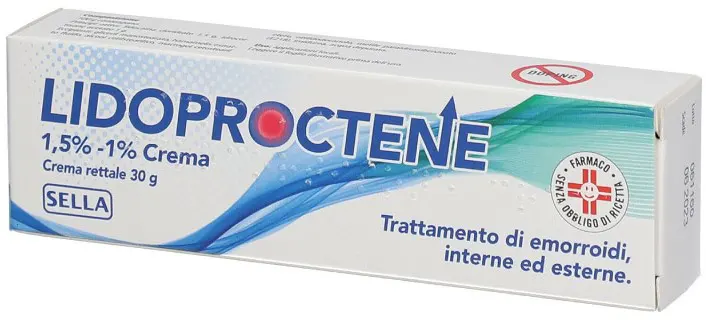
Cream for the treatment of internal and external hemorrhoids.
Indications
Lidoproctene is a combination of two active ingredients: lidocaine hydrochloride and hydrocortisone acetate.
Lidocaine hydrochloride belongs to a group of medicines called local anaesthetics that relieve pain, while hydrocortisone acetate, which belongs to a group of medicines called corticosteroids, reduces inflammation and swelling.
This medicine is indicated:
- For the treatment of internal and external hemorrhoids;
- In case of inflammation (eczema), irritation (erythema), lesions (fissures), itching and burning in the anal area due to the presence of hemorrhoids;
- Before and after surgery on the anus or lower part of the intestine (anorectal surgery).
Ingredients
Active ingredients: Lidocaine hydrochloride/hydrocortisone acetate.
Excipients: Glyceryl monostearate, witch hazel fluid extract, cetylstearyl alcohol, macrogol cetostearyl ether, octyldodecanol, methyl parahydroxybenzoate (E218), imidurea, purified water.
Directions for use and Dosage
Two or more times a day. applications per day, with gentle massage, in the quantity sufficient to cover the affected area.
For internal application, use the special cannula provided inside the box.
Warnings
The safety of using products containing lidocaine depends on the dosage, a correct application technique and the adoption of precautionary measures.
The medicine should be used at the lowest effective dose, appropriately reducing the dosage in relation to age and physical condition, in the elderly and in acutely ill patients.
Excessive dosage of lidocaine or a short interval between the application of doses can cause serious side effects. cause high plasma levels and the onset of adverse effects.
The absorption of lidocaine after application to damaged skin and mucous membranes is high.
Therefore, lidocaine ointment should be used with caution in patients with severe trauma, sepsis, or extensive skin lesions.
It is good practice to avoid prolonged use of hydrocortisone acetate, particularly on large surfaces.
Local application of corticosteroids for prolonged periods can lead to systemic absorption.
Systemic absorption of corticosteroids for local use can lead to systemic absorption. may produce reversible suppression of the hypothalamic-pituitary-adrenal (HPA) axis, with the possibility of glucocorticosteroid failure after discontinuation of treatment.
Manifestations of Cushing's syndrome may also occur in some patients following systemic absorption of corticosteroids during treatment.
Patients receiving large amounts of highly active steroids applied topically to large areas of skin should be evaluated periodically for HPA axis suppression.
If HPA axis suppression occurs, attempts should be made to discontinue the drug, reduce the frequency of application, or substitute a less potent corticosteroid.
Recovery of HPA axis function is usually rapid and complete after cessation of the drug.
Sometimes, a relapse may occur. manifest withdrawal symptoms, which require supplemental systemic corticosteroids.
As with all highly active local corticosteroid preparations, treatment should be discontinued as soon as the disease is controlled.
Hydrocortisone, like other local corticosteroids, may accentuate an incipient infection.
In this case, appropriate cover therapy must be instituted.
Use of local products, especially if prolonged, may give rise to sensitization or hemorrhagic phenomena; If skin irritation (rashes, irritation, and burning) occurs during use of the medicine, discontinue treatment and, if necessary, initiate appropriate therapy.
The possibility of specific sensitization to lidocaine should not be underestimated.
Avoid contact with eyes.
For those who participate in sports: Use of the medicine without therapeutic need constitutes doping and may result in a positive result in anti-doping tests.
Methyl parahydroxybenzoate (E218): may cause allergic reactions (even delayed).
Cetylstearyl alcohol: may cause allergic reactions. cause local skin reactions (e.g. contact dermatitis).
Contraindications
Hypersensitivity to the active ingredients, to amide-type local anesthetics and to corticosteroids in general, or to any of the excipients; concomitant manifest or suspected fungal infection; concomitant viral infections (e.g. cutaneous tuberculosis, herpes simplex, chickenpox), bacterial and fungal infections; children under 12 years of age; generally contraindicated in pregnancy and breastfeeding.
Interactions
Cimetidine and beta-blockers (such as propranolol) slow the hepatic catabolism of local anesthetics; digitalis increases the risk of bradycardia and auriculovestibular conduction disorders.
When using high doses of lidocaine, the risk of increased systemic toxicity must be considered in patients treated with other local anesthetics or with agents structurally related to them, e.g., tocainide.
Local administration of hydrocortisone acetate, especially when applied over large areas or for long periods, can cause systemic effects such as glycosuria and postprandial hyperglycemia. Furthermore, under occlusion, it can cause systemic toxicity. induce a decrease in urinary excretion of 17-KS and 17-OHCS.
Interactions with other drugs may also occur, which are mainly expressed through mechanisms of enzyme induction, displacement, or opposing activity.
Barbiturates, antihistamines, and diphenylhydantoin, by inducing an increase in the metabolism of the steroid, reduce its pharmacological activity.
Anti-inflammatories, such as salicylates and phenylbutazone, by displacing the steroid from its binding to plasma proteins, increase its activity.
Oral hypoglycemic agents and insulin are counteracted in their action by the increase in blood glucose induced by the steroid due to its intense glycemic and glycogenolytic activity.
Undesirable effects
The following are the undesirable effects of the product, organized according to the MedDRA system organ classification.
There are insufficient data to establish the frequency of the individual effects listed.
Skin and subcutaneous tissue disorders: irritation, dryness, atrophy of the skin and mucous membranes, burning sensation, itching.
Immune system disorders: Allergic reactions (and in the most severe cases, anaphylactic shock) have been reported following the local administration of amide-type local anesthetics.
When administered as directed, the medicine is absorbed only in small quantities with minimal systemic effects.
However, the adverse reactions due to a systemic effect of the medicine are listed below.
Nervous system disorders: manifestations of excitation or depression associated with dizziness, drowsiness, visual disturbances, anxiety, tremors followed by changes in the state of consciousness, convulsions and respiratory arrest.
Cardiac disorders: bradycardia, hypotension, myocardial depression up to cardiac arrest.
Pregnancy and Breastfeeding
There are no clinical data available on the safety of lidocaine use during pregnancy.
Glucocorticoids, of which hydrocortisone is a part, have harmful pharmacological effects on pregnancy and/or the fetus/newborn.
As with all locally applied glucocorticoids, the possibility that fetal growth may be influenced by the passage of hydrocortisone across the placental barrier must be taken into account.
Therefore, the drug should not be used during pregnancy unless clearly necessary.
There are no clinical data available on the safety of lidocaine use during breastfeeding.
Glucocorticoids are excreted in breast milk; Therefore, a decision must be made whether to discontinue breastfeeding or treatment with the medicine, taking into account the importance of the medicine for the mother.
Storage
Store in the original package to protect the medicine from light and away from direct sources of heat.
Store at a temperature not exceeding 30°C.
Format
30 g
Product Code:FRCM174610





 Richiedi info sul prodotto