Free shipping from 69,00 € and always free returns

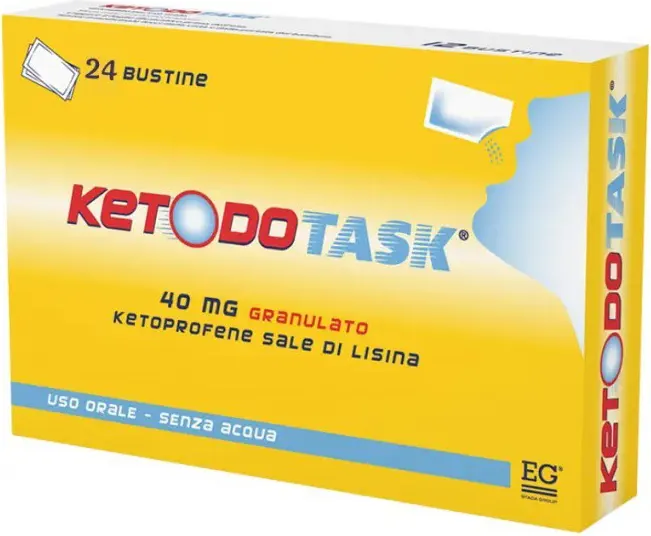
Ketodotask buccal granulate - pain relief medicament 24 sachets of 40 mg

5.0
(1)
Productor: Eg
info prodotto Richiedi info sul prodotto
Product not active click on Notify me to know when it will be available again
Available in the following sizes
  • 24 sachets
    Not available
  • 12 sachets
    Not available
  • 30 sachets
    Not available
info resi e spedizione

Information on returns and shipments

info pagamenti

Payment methods

Authorized company for online trading of
Medicines authorized by the Ministry of Health
99& satisfied customers
Product Description

Painkiller ideal for the treatment of mild to moderate pain.

Indications

Ketodotask is a useful medicine in case of mild to moderate pain and inflammation.

Composition

Active ingredients

Ketoprofen lysine salt 40 mg (corresponding to 25 mg of ketoprofen)

Excipient with known effect: aspartame.

Excipients

Mannitol, xylitol, lime flavoring, lemon flavoring, frescofort flavoring, aspartame, talc, basic butylated methacrylate copolymer, magnesium stearate, hydrated colloidal silica, hypromellose, stearic acid, povidone, sodium lauryl sulfate.

Directions for use and Dosage

  • Adults and adolescents over 15 years of age: 1 sachet, as a single dose, or repeated 2-3 times a day, in the most intense forms of pain. The duration of therapy should be limited to overcoming the painful episode.
  • Special populations: Elderly: Elderly patients should adhere to the minimum dosages indicated above.
  • Patients with mild or moderate renal impairment: It is advisable to monitor the volume of diuresis and renal function.
  • Patients with mild or moderate hepatic insufficiency: They should be monitored carefully and treated with the minimum effective daily dose.
  • Ketodotask should not be used in patients with severe hepatic and renal dysfunction.
  • Paediatric population: Contraindicated in children and adolescents under 15 years of age.

Method of administration: The contents The sachet can be placed directly on the tongue. It dissolves in saliva, allowing it to be used without water. It is best to take the medicine on a full stomach.

Warnings

Ketodotask contains 10.56 mg of aspartame per dose (1 sachet), equivalent to 31.78 mg per maximum recommended daily dose (3 sachets). Aspartame is a source of phenylalanine. It can be taken with food. be harmful in patients with phenylketonuria.

Contraindications

Ketodotask must not be administered in the following cases:

  • Hypersensitivity to the active substance, to other nonsteroidal anti-inflammatory drugs (NSAIDs) or to any of the excipients listed.
  • Patients with a history of hypersensitivity reactions, such as bronchospasm, asthma attacks, acute rhinitis, nasal polyps, urticaria, angioneurotic edema or other allergic-type reactions to ketoprofen or to substances with a similar mechanism of action [for example, acetylsalicylic acid (ASA) or other nonsteroidal anti-inflammatory drugs (NSAIDs)]. Severe, rarely fatal, anaphylactic reactions have been reported in these patients.
  • Active peptic ulcer/haemorrhage, or a previous history of gastrointestinal bleeding, ulceration or perforation (two or more distinct, proven episodes of bleeding or ulceration), or chronic dyspepsia.
  • Gastrointestinal bleeding or gastrointestinal perforation resulting from previous NSAID therapy or other active bleeding or bleeding disorders.
  • Severe cardiac failure.
  • Severe hepatic failure.
  • Severe renal failure.
  • Haemorrhagic diathesis and other coagulation disorders, or patients undergoing anticoagulant therapy.
  • Patients undergoing major surgery.
  • Third trimester of pregnancy and breastfeeding.
  • Children and adolescents under 15 years of age.

Undesirable effects

Patients should be informed of the potential occurrence of drowsiness, dizziness, or convulsions and should avoid driving or performing activities requiring particular alertness if these symptoms are present.

The most commonly observed adverse events are gastrointestinal in nature. Peptic ulcers, perforation, or gastrointestinal bleeding, sometimes fatal, particularly in the elderly, may occur.

The frequency and severity of these effects are reduced when the medicine is taken with food. Manifestations of hypersensitivity may take the form of severe systemic reactions (laryngeal edema, glottis edema, dyspnea, palpitations) up to anaphylactic shock. In these cases, immediate medical assistance is required. The following adverse reactions have been observed following the administration of ketoprofen lysine salt in adults. The frequency of adverse events is classified as follows: very common (≥1/10); common (≥1/100, <1/10); uncommon (≥1/1000, <1/100); rare (≥1/10,000, <1/1000); very rare (<1/10,000); Not known (frequency cannot be estimated from the available data).

Infections and infestations  

Not known: aseptic meningitis, lymphangitis. 

Blood and lymphatic system disorders

  • Rare: haemorrhagic anaemia.
  • Not known: agranulocytosis, thrombocytopenia, bone marrow aplasia, haemolytic anaemia, leukopenia, neutropenia, aplastic anaemia, leukocytosis, thrombocytopenic purpura. 

Immune system disorders

Not known: anaphylactic reactions (including shock), hypersensitivity. 

Psychiatric disorders

Not known: depression, hallucinations, mood alterations, excitability, insomnia.

Nervous system disorders

  • Uncommon: headache, dizziness, somnolence.
  • Rare: paraesthesia.
  • Not known: syncope, convulsions, dysgeusia, tremor, hyperkinesia, dyskinesia, vertigo.

Eye disorders

  • Rare: blurred vision.
  • Not known: periorbital oedema.

Ear and labyrinth disorders

Rare: tinnitus.

Cardiac disorders

Not known: cardiac failure, palpitations, tachycardia

Vascular disorders

Not known: hypotension, hypertension, vasodilation, vasculitis.

Respiratory, thoracic and mediastinal disorders

  • Rare: asthma.
  • Not known: laryngeal edema, bronchospasm (especially in patients with known hypersensitivity to acetylsalicylic acid and other NSAIDs), rhinitis, dyspnoea, laryngospasm, acute respiratory failure.

Gastrointestinal disorders

Common: nausea, vomiting, dyspepsia, abdominal pain.

  • Uncommon: constipation, diarrhoea, flatulence, gastritis.
  • Rare: ulcerative stomatitis, peptic ulcer.
  • Not known: exacerbation of colitis and Crohn's disease, gastrointestinal haemorrhage and perforation, gastric ulcer, duodenal ulcer, pancreatitis, melaena, haematemesis, gastric pain, erosive gastritis, tongue oedema.

Hepatobiliary disorders

Rare: hepatitis, increased serum transaminase levels, elevated serum bilirubin levels due to liver disorders, jaundice.

Skin and subcutaneous tissue disorders

  • Uncommon: rash, pruritus.
  • Not known: photosensitivity, alopecia, urticaria, angioedema, bullous eruptions, including Stevens-Johnson syndrome, Lyell's syndrome and toxic epidermal necrolysis. erythema, exanthema, maculo-papular rash, purpura, dermatitis. 

Renal and urinary disorders

Not known: fluid retention, haematuria, acute renal failure, tubulointerstitial nephritis, nephritic syndrome, glomerular nephritis, acute tubular necrosis, renal papillary necrosis, nephrotic syndrome, oliguria, renal function test abnormalities, dysuria. 

General disorders and administration site conditions

  • Uncommon: oedema, fatigue.
  • Not known: chills, asthenia, facial oedema, peripheral oedema.

Investigations

Rare: increased weight.

Overdose

Cases of overdose with doses greater than 2.5 g of ketoprofen lysine salt have been reported. In most cases, symptoms observed include lethargy, drowsiness, nausea, vomiting, and epigastric pain. Symptoms of overdose may also include central nervous system disorders, such as headache, dizziness, confusion, and loss of consciousness. Hypotension, respiratory depression, and cyanosis may occur. Renal failure, convulsions, and coma have also been described. A single case of anxiety, visual hallucinations, hyperexcitability, and behavioral changes has been reported in a pediatric patient who had taken twice the recommended dose. The symptoms disappeared spontaneously within 1-2 days. There are no specific antidotes for an overdose of ketoprofen lysine salt. If a serious overdose is suspected, gastric lavage and the institution of supportive and symptomatic therapy are recommended to compensate for dehydration, monitor renal function, and correct any acidosis present. In cases of renal insufficiency, hemodialysis may be useful to remove the drug from the circulation.

Pregnancy and breastfeeding

  • Pregnancy: Inhibition of prostaglandin synthesis may adversely affect pregnancy and/or embryo/fetal development. Results of epidemiological studies suggest an increased risk of miscarriage and cardiac malformation and gastroschisis after use of a prostaglandin synthesis inhibitor in early pregnancy. The absolute risk of cardiac malformations increased from less than 1% to approximately 1.5%. The risk is believed to increase with dose and duration of therapy. In animals, the administration of prostaglandin synthesis inhibitors has been shown to cause increased pre- and post-implantation loss, embryo-fetal mortality, and an increased incidence of various malformations, including cardiovascular. Therefore, ketoprofen should not be administered during the first and second trimester of pregnancy, unless strictly necessary.
    If ketoprofen is used in women attempting to conceive or during the first and second trimester of pregnancy, the dose and duration of treatment should be kept as low as possible.
    The product is contraindicated during the third trimester of pregnancy.
  • Breastfeeding: Since ketoprofen is contraindicated during the third trimester of pregnancy, it is contraindicated in women wishing to conceive. There are no data available on the secretion of ketoprofen lysine salt in breast milk. Ketoprofen should not be administered during breastfeeding.
  • Fertility: The use of ketoprofen lysine salt, as with any drug inhibiting the synthesis of prostaglandins and cyclooxygenase, is not recommended in women intending to become pregnant. The administration of ketoprofen lysine salt should be suspended in women who have fertility problems or who are undergoing fertility investigations.

Format

24 sachets of 40 mg

Product Code:FRCM140872

Price Trend

This product has been on sale since 12/01/2021

In the last 30 days, the product's lowest price was 8,72 €

To enhance your website experience, Farmacosmo.com uses different types of cookies. You can click OK, to allow them, or manage them individually. By clicking on the ''x'' you don't accept any cookies and other tracking methods other than technical ones. To read more see our Cookie Policy. Cookie Policy