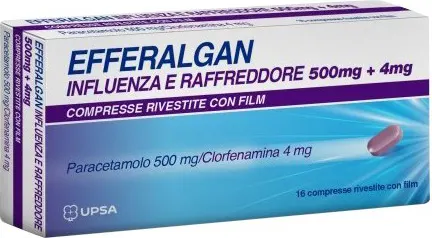
A medicine useful in cases of flu and colds.
Indications
Efferalgan influenza e freddi is indicated for the treatment of colds, rhinitis, nasopharyngitis, and flu-like conditions in adults and adolescents over 15 years of age, for the treatment of clear nasal discharge and watery eyes, sneezing, headaches, and/or fever.
Composition
Active ingredients
Paracetamol: 500.00 mg; Chlorphenamine maleate: 4.00 mg per film-coated tablet. Excipient(s) with known effect: Carmoisine (E122)
Excipients
Croscarmellose sodium, hypromellose, microcrystalline cellulose, povidone K90, glyceryl behenate, magnesium stearate, Glazing agent*, Polishing agent**. *Glazing agent: Hypromellose (E464), propylene glycol (E1520), titanium dioxide (E171), carmoisine (E122), indigo carmine (E132). **Polishing agent: Purified water, beeswax (E901), carnauba wax (E903), polysorbate 20 (E432), sorbic acid (E200).
Directions for use and Dosage
Reserved for adults and adolescents over 15 years of age. Oral use. The tablets should be swallowed whole with a drink (e.g. water, milk, fruit juice). Evening administration is preferable due to the sedative effect of chlorphenamine maleate. Frequency of administration: 1 tablet, to be repeated, as needed, after an interval of at least 4 hours, without exceeding 4 tablets per day.
| Weight (age) | Dose per administration | Dosage interval | Maximum daily dose |
| Adults and adolescents >50 kg (>15 years) | 1 tablet i.e. 500 mg of paracetamol 4 mg of chlorphenamine | 4 hours | 4 tablets i.e. 2,000 mg of paracetamol 16 mg of chlorphenamine |
Do not exceed the maximum dosage of 4 tablets in 24 hours.
Patients with renal insufficiency: In case of renal insufficiency and unless otherwise advised by your doctor, it is recommended to reduce the dose and increase the minimum interval between 2 doses, according to the following table:
| Creatinine clearance | Dosage interval |
| ≥50 ml/min | 4 hours |
| 10-50 ml/min | 6 hours |
| <10 ml/min | 8 hours |
The total dose of paracetamol should not exceed 3 g/day.
Patients with hepatic insufficiency: In patients with chronic liver disease, active or compensated, particularly in patients with hepatocellular insufficiency, chronic alcoholism, chronic malnutrition (low hepatic glutathione reserves) and dehydration, the dose of paracetamol should not exceed 3 g/day.
Special clinical situations
In the following conditions, the most effective dose should be used: possible low dose of paracetamol without exceeding 60 mg/kg/day (without exceeding 3 g/day)
- Adults with a body weight less than 50 kg;
- Mild to moderate hepatocellular insufficiency;
- Chronic alcoholism;
- Chronic malnutrition;
- Dehydration
Maximum recommended doses
In adults and adolescents with a body weight greater than 50 kg, the total dose of paracetamol should not exceed 4 grams per day.
In adults and adolescents with a body weight greater than 50 kg, the total dose of chlorphenamine maleate should not exceed 16 milligrams per day.
Duration of treatment
If fever or pain persists for more than 12 hours, the patient should be given a dose of chlorphenamine maleate. If symptoms persist for more than 3 days or if they do not improve after 5 days of treatment, treatment management should be reassessed.
Warnings
If high or persistent fever occurs, if signs of superinfection appear, or if symptoms last more than 5 days, treatment should be reassessed.
To avoid the risk of overdose: check that other medicines (prescription or non-prescription medicines) do not contain paracetamol or chlorphenamine maleate, stick to the maximum recommended doses. This medicine contains an azo dye (E122) which may cause allergic reactions.
Related to the presence of paracetamol: . Paracetamol should be used with caution in case of: • body weight <50 kg, • mild to moderate hepatocellular insufficiency, • renal insufficiency, • glucose-6-phosphate dehydrogenase (G6PD) deficiency (which may lead to haemolytic anaemia), • chronic alcoholism, excessive alcohol intake (3 or more alcoholic drinks per day), • anorexia, bulimia or cachexia, • chronic malnutrition (low hepatic glutathione reserves), • dehydration, hypovolaemia. Very rare cases of serious skin reactions have been reported. Patients should be informed of the early signs of these serious skin reactions and of the onset of a rash or any other sign of hypersensitivity requiring discontinuation of treatment.
Related to the presence of chlorphenamine maleate: This medicine should be used with caution in patients (especially the elderly) with: • higher susceptibility to orthostatic hypotension, dizziness, and sedation, • chronic constipation (risk of paralytic ileus), • possible prostatic hypertrophy, • severe hepatic and/or renal insufficiency, due to the risk of accumulation. Given the presence of chlorphenamine, the intake of alcoholic beverages, medicines containing alcohol, or sedatives (especially barbiturates) during treatment is not recommended, as they may increase the risk of hypotension. enhance the sedative effect of antihistamines.
Contraindications
- Hypersensitivity to the active substances or to any of the excipients listed.
- Children under 15 years of age.
- Due to the presence of paracetamol: severe hepatocellular insufficiency or ongoing decompensated liver disease.
- Due to the presence of chlorphenamine maleate: risk of narrow-angle glaucoma and risk of urinary retention related to urethroplasty disorders.
Undesirable effects related to paracetamol
Undesirable effects are listed according to system organ class. Frequencies are defined as follows:
- Very common (>1/10);
- Common (>1/100, <1/10);
- Uncommon (>1/1,000, <1/100);
- Rare (>1/10,000, <1/1,000);
- Very rare (<1/10,000);
- Not known (frequency cannot be estimated from the available data).
Immune system disorders
Rare: hypersensitivity reactions such as anaphylactic shock, Quincke's oedema, erythema, urticaria, rash. Their appearance requires the permanent discontinuation of the drug and related drugs.
Skin and subcutaneous tissue disorders
Very rare: serious skin reactions.
Blood and lymphatic system disorders
Very rare: thrombocytopenia, leukopenia and neutropenia. Increased or decreased INR.
Hepatobiliary disorders
Not known: increased liver enzymes.
Gastrointestinal disorders
Not known: diarrhoea, abdominal pain.
Undesirable effects
The pharmacological characteristics of chlorphenamine can cause adverse effects of variable intensity, which may or may not be dose-related.
Neurovegetative effects:
- Sedation or somnolence, more severe. pronounced at the beginning of treatment,
- Anticholinergic effects, such as dryness of the mucosa, constipation, accommodation disorders, mydriasis, palpitations, risk of urinary retention;
- Orthostatic hypotension;
- Balance disorders, dizziness, impaired memory or concentration, more common in elderly patients;
- Motor incoordination, tremors;
- Mental confusion, hallucinations;
- More rarely, exciting effects: agitation, nervousness and insomnia.
Hypersensitivity reactions:
- Erythema, pruritus, eczema, purpura, urticaria;
- Oedema, more common in elderly patients; rarely Quincke's edema;
- Anaphylactic shock.
Hematological effects:
- Leukopenia, neutropenia;
- Thrombocytopenia;
- Hemolytic anemia.
Overdose
The risks of serious intoxication (therapeutic overdose or accidental poisoning) may be particularly high in the elderly, children, patients with hepatic insufficiency, in cases of chronic alcoholism, in patients suffering from chronic malnutrition and in patients taking enzyme inducers. In these cases, intoxication may occur. be fatal.
Paracetamol Overdose
- Symptoms: nausea, vomiting, anorexia, pallor, dizziness, sweating, and abdominal pain generally appear within the first 24 hours. An overdose of 10 g of paracetamol in a single administration in adults and 150 mg/kg of body weight in a single administration in children causes hepatic cytolysis that can evolve into complete and irreversible necrosis with hepatocellular insufficiency, metabolic acidosis, and encephalopathy that can lead to coma and death. Simultaneously, an increase in hepatic transaminases, lactate dehydrogenase, bilirubin, and a decrease in prothrombin time are observed, which can occur 12 to 48 hours after ingestion. Clinical symptoms of liver damage are generally observed after 1 or 2 days and reach their maximum after 3 - 4 days.
Chlorphenamine maleate overdose
Chlorphenamine maleate overdose may cause convulsions (especially in children), disturbances of consciousness, coma.
Pregnancy and breastfeeding
- Pregnancy: if clinically necessary, efferalgan influenza e freddi can be used during pregnancy, however it should be used at the lowest effective dose for the shortest possible time and with the lowest possible frequency.
- Paracetamol: a large amount of data on pregnant women indicate neither malformative nor fetal/neonatal toxicity. Epidemiological studies on neurodevelopment in children exposed to paracetamol in utero show inconclusive results.
- Chlorphenamine: The results of clinical epidemiological studies seem to exclude a specific malformative or fetotoxic effect of chlorphenamine. However, in case of administration at the end of pregnancy, consider the possible repercussions of the atropinic and sedative properties of chlorphenamine for the newborns.
- Breastfeeding: It is not known whether chlorphenamine is excreted in breast milk. Due to the possibility of sedation or paradoxical excitation of the newborn, this medicine is not recommended during breastfeeding.
- Fertility: Given the potential mechanism of action on cyclooxygenase and prostaglandin synthesis, paracetamol may alter female fertility through an effect on ovulation that is reversible upon discontinuation of treatment. Effects on male fertility have been observed in one animal study. The relevance of these effects to humans is unknown.
Format
16 coated tablets 500mg + 4mg, paracetamol 500mg and chlorphenamine 4mg.
Product Code:FRCM135837




 Richiedi info sul prodotto