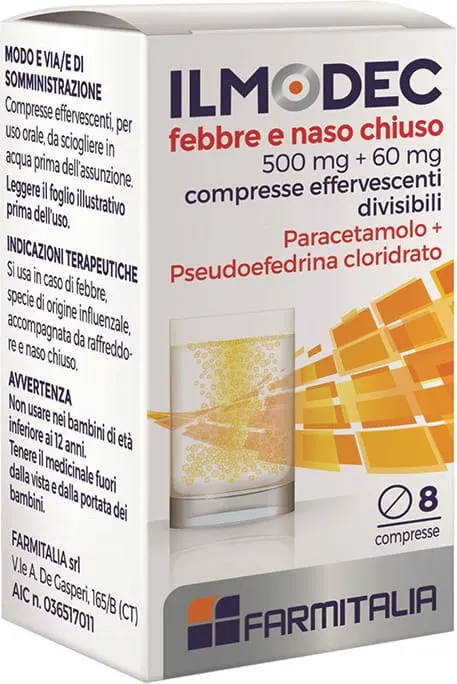
Effervescent tablets for fever with a cold and stuffy nose.
Indications
Ilmodec Fever and Stuffy Nose 500 mg + 60 mg is A medicine containing:
- Paracetamol
A pain reliever and antipyretic. - Pseudoephedrine Hydrochloride
A decongestant that clears the nasal passages and facilitates breathing.
Ilmodec Fever and Blocked Nose is used for fever, especially flu-like fever, accompanied by a cold and a blocked nose.
Ingredients
Active ingredients: One tablet contains 500 mg of Paracetamol and 60 mg of Pseudoephedrine hydrochloride.
Excipients: Citric acid, sodium bicarbonate, anhydrous sodium carbonate, sorbitol, lemon flavoring, aspartame,
Sodium saccharin, Simethicone, leucine, docusate sodium.
How to use Directions for Use and Dosage
Dosage Adults: 1 effervescent tablet (equivalent to 500 mg of paracetamol and 60 mg of pseudoephedrine hydrochloride) up to three times a day.
The medicine should be taken for a maximum of 5 days of treatment.
Pediatric population
Children over 12 years: 1 effervescent tablet (equivalent to 500 mg of paracetamol and 60 mg of pseudoephedrine hydrochloride) up to three times a day.
The medicine should be taken for a maximum of 3 days of treatment (pediatric population 12-18 years).
The medicine should be taken on a full stomach.
Do not exceed the recommended doses: Elderly patients in particular should stick to the minimum doses above. indicated.
Method of administration
Dissolve the tablet or half tablet in a glass of water and drink the resulting solution immediately.
Warnings
Administer with caution in patients with renal insufficiency and in elderly patients, as it may occasionally cause bladder sphincter spasm with urinary retention in the latter.
Paracetamol should be administered with caution to patients with mild to moderate hepatocellular insufficiency (including Gilbert's syndrome), severe hepatic insufficiency (Child-Pugh >9), acute hepatitis, concomitant treatment with drugs that alter liver function, glucose-6-phosphate dehydrogenase deficiency, or hemolytic anemia.
Use in patients with Gilbert's syndrome may be contraindicated. induce an accentuation of hyperbilirubinemia and its clinical manifestations, such as jaundice.
Patients suffering from liver disease or liver infections, such as viral hepatitis, should consult their doctor before taking this medicine.
Do not administer for more than three consecutive days without consulting your doctor.
High or prolonged doses of the product can cause blood changes, even serious ones.
Due to its hepatotoxicity, paracetamol should not be taken in higher doses or for longer periods than recommended.
Prolonged use can result in serious consequences for the liver, such as liver cirrhosis.
An acute or chronic overdose can cause serious hepatotoxicity, potentially with a fatal outcome.
During the administration of therapeutic doses of paracetamol, it may be necessary to consult a doctor. An elevation of serum alanine aminotransferase (ALT) may occur.
Patients with kidney disease should consult their doctor before taking this medicine, as dosage adjustment may be necessary.
In case of severe renal insufficiency (creatinine clearance <10 ml/min), the doctor must critically evaluate the risk/benefit ratio of using paracetamol.
The dosage must be appropriately adjusted and continuous monitoring must be ensured.
In general, continuous use of paracetamol, especially in combination with other analgesics, can lead to permanent kidney damage and renal failure (analgesic nephropathy).
Prolonged use of high doses may lead to renal insufficiency. cause liver and kidney damage.
All conditions that increase hepatic oxidative stress or reduce hepatic glutathione reserves, such as certain concomitant medications, alcoholism, infections, or diabetes mellitus, may increase the risk of liver toxicity even at therapeutic doses.
Very rare cases of serious skin reactions have been reported.
If skin manifestations such as redness, rash, blisters, and peeling occur, discontinue use of the medicine and consult a doctor immediately.
With drugs containing pseudoephedrine, in isolated cases, a rash may occur. A serious form of skin reaction, called Acute Generalized Exanthematous Pustulosis (AGEP), may occur.
If symptoms such as fever, erythema or small (generalized) pustules occur, patients should stop treatment and consult their doctor.
The medicine should be taken on a full stomach.
During treatment with oral anticoagulants, it is advisable to reduce the dose.
In case of an allergic reaction, administration should be suspended.
Avoid alcohol intake during therapy.
Moderate alcohol intake while taking paracetamol may in fact increase the risk of liver toxicity.
During treatment with paracetamol, before taking any other medicine, check that it does not contain the same active ingredient, since if paracetamol is taken in high doses, liver toxicity may occur. serious adverse reactions.
Instruct the patient to contact their doctor before taking any other medicine.
This medicine contains:
- Sorbitol.
Patients with rare hereditary problems of fructose intolerance should not take this medicine. - This medicine contains 260 mg sodium per tablet, equivalent to 13% of the WHO recommended maximum daily intake of 2 g sodium for an adult.
Contraindications
This medicine is contraindicated:
- In children under 12 years of age.
- In case of hypersensitivity to the active substances or to any of the excipients.
- During pregnancy or breastfeeding.
- Severe cardiovascular disease. hypertension, hyperthyroidism, glaucoma, and prostatic hypertrophy.
- In patients being treated with MAO inhibitors or tricyclic antidepressants, or if such treatment has not been discontinued for at least two weeks.
- In patients being treated with anti-inflammatory drugs.
- In patients with phenylketonuria, since the medicine contains aspartame.
- Paracetamol-based products, such as Saniduo Febbre e Naso chiuso, are contraindicated in patients with manifest glucose-6-phosphate dehydrogenase deficiency.
Interactions
Effects of other medicinal products on pseudoephedrine
The use of Saniduo Febbre e Naso chiuso concomitantly with sympathomimetic agents (such as decongestants, appetite suppressants, and (amphetamine-like drugs) or MAO inhibitors should be avoided, as they may occasionally cause increases in blood pressure.
Furazolidone causes a progressive inhibition of monoamine oxidase and therefore should not be taken at the same time as Saniduo fever and stuffy nose.
Effects of pseudoephedrine on other medicinal products
The effect of antihypertensives that interfere with sympathetic activity (e.g. methyldopa, beta-blockers, debrisoquine, guanethidine, betanidine and bretylium tosylate) may be partially cancelled out by Saniduo fever and stuffy nose.
Effects of other medicinal products on paracetamol
Drugs that slow gastric emptying (e.g. propantheline) may reduce the rate of gastric emptying. Paracetamol absorption, delaying its therapeutic effect;
On the contrary, drugs that increase the rate of gastric emptying (e.g., metoclopramide, domperidone) lead to an increase in the rate of absorption.
The concomitant use of drugs that induce liver enzymes, such as certain hypnotics and antiepileptics (glutethimide, phenobarbital, phenytoin, carbamazepine, etc.) or rifampicin, can cause liver damage even with otherwise harmless doses of paracetamol.
In case of alcohol abuse, taking paracetamol, even at low doses, can cause liver damage.
The simultaneous administration of NSAIDs or opioids determines a mutual potentiation of the analgesic effect.
Paracetamol can reduce the effectiveness of lamotrigine.
Effects of paracetamol on other medicinal products
The combination of paracetamol with chloramphenicol may prolong the half-life of the latter and therefore potentially increase its toxicity.
Paracetamol (or its metabolites) interferes with the enzymes involved in the synthesis of vitamin K-dependent coagulation factors.
The interaction between paracetamol and warfarin or coumarin derivatives may cause an increase in the international normalized ratio (INR) and an increased risk of bleeding.
Patients treated with oral anticoagulants should not take paracetamol for long periods without medical supervision.
Tropisetron and granisetron, serotonin 5-HT3 receptor antagonists, can completely inhibit the analgesic effect of paracetamol through a pharmacodynamic interaction.
/>The concomitant use of paracetamol and AZT (zidovudine) increases the tendency for a reduction in the white blood cell count (neutropenia).
Therefore, paracetamol should not be taken in combination with AZT (zidovudine) unless prescribed by a doctor.
Interference with laboratory tests
The administration of paracetamol may interfere with the determination of uric acid (using the phosphotungstic acid method) and blood glucose (using the glucose-oxidase-peroxidase method).
Undesirable effects
The following adverse reactions have been reported with the use of paracetamol and/or pseudoephedrine.
The adverse reactions listed below are derived from spontaneous reports and therefore cannot be organized by frequency category.
Pathologies Blood and lymphatic system disorders: Changes in blood counts, such as thrombocytopenia, thrombocytopenic purpura, leukopenia, anaemia (very rarely), agranulocytosis, pancytopenia.
Immune system disorders: Hypersensitivity reactions have been reported very rarely, such as allergic edema and angioedema, laryngeal edema, anaphylactic reaction, anaphylactic shock, asthma, sweating, nausea, hypotension, dyspnoea.
Psychiatric disorders: Hallucinations.
Nervous system disorders: Dizziness, drowsiness, hyperactivity, hyperexcitability, insomnia, anxiety, muscle tremors, headache, dysgeusia.
Cardiac disorders: Arrhythmias, palpitations, tachycardia.
Vascular disorders: Hypertension, hypotension.
Respiratory, thoracic and mediastinal disorders: Bronchospasm and asthma, including analgesic-induced asthma syndrome, dry nose and throat.
Gastrointestinal disorders: Nausea, vomiting, upset stomach, diarrhoea, abdominal pain, anorexia, ischemic colitis.
Hepatobiliary disorders: Impaired liver function, hepatitis, dose-dependent hepatic failure, life-threatening hepatic necrosis.
Skin and subcutaneous tissue disorders: Skin reactions of various types and severity, including rash, pruritus, urticaria, acute generalised exanthematous pustulosis, fixed erythema, erythema multiforme (rarely), Stevens-Johnson syndrome and toxic epidermal necrolysis (very rare and possibly fatal).
Very rare cases of serious skin reactions have been reported.
Renal and urinary disorders: Acute renal failure, interstitial nephritis, hematuria, anuria.
Pregnancy and breastfeeding
The product is contraindicated in pregnant and breastfeeding women.
Format
8 divisible effervescent tablets
Product Code:FRCM141826





 Richiedi info sul prodotto