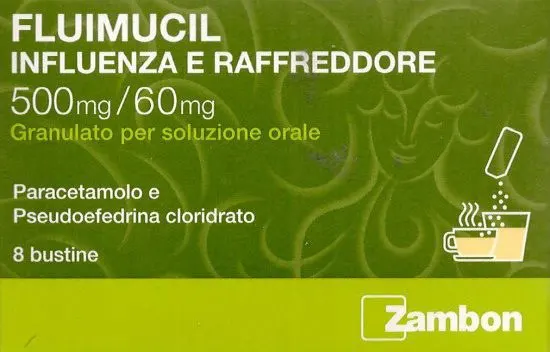
Preparation based on paracetamol and pseudoephedrine hydrochloride for the treatment of cold and flu symptoms.
Indications
Fluimucil Influenza e Freddore is a drug indicated for the treatment of flu and flu-like symptoms such as headache and nasal congestion. It provides rapid relief thanks to its triple action:
- analgesic;
- antipyretic;
- decongestant.
Dosage
Adults and children over 12 years of age: 2-3 sachets per day.
Duration of therapy:
- Maximum 5 days of therapy for the adult population;
- Maximum 3 days of therapy for the pediatric population (12-18 years).
Children: Fluimucil Influenza and Cold is NOT recommended for children under 12 years of age.
Directions for use
Dissolve the contents of one sachet in a glass of water, stirring with a teaspoon, and drink the resulting solution immediately. Warm water can also be used.
Storage: No special storage precautions.
Composition
Active ingredients: paracetamol 500 mg, pseudoephedrine hydrochloride 60 mg.
Excipients: sucrose, anhydrous citric acid, tropical fruit flavouring, grapefruit flavouring, sorbitol (E420), aspartame (E951), sucralose, sodium saccharin, polysorbate 20, beetroot red colouring, riboflavin sodium phosphate colouring.
Contraindications
Fluimucil Influenza e Cold should not be administered in case of:
- hypersensitivity to the active ingredients or to any of the excipients;
- pregnancy and breastfeeding;
- children under 12 years of age;
- patients with manifest glucose-6-phosphate dehydrogenase insufficiency.
Furthermore, it should not be administered to subjects who are being treated with monoamine oxidase inhibitors or who have stopped taking them. this treatment for less than two weeks, or in subjects suffering from a severe form of the following diseases:
- coronary heart disease (angina, previous heart attack);
- hypertension;
- arrhythmias;
- liver failure;
- renal failure;
- hyperthyroidism;
- asthma;
- diabetes;
- micturition disorders caused by prostatic hypertrophy or other diseases;
- glaucoma;
- haemolytic anaemia.
Warnings
During treatment with Fluimucil Influenza e Cold, before taking any other medicine, check that it does not contain paracetamol, since, if this active ingredient is taken in high doses, serious adverse reactions may occur. The risk of serious side effects is also increased when paracetamol is taken with other antipyretic analgesics; therefore, concomitant use of these medications should be avoided. The medicine should be used with caution in patients with mild/moderate forms of the following conditions: coronary artery disease (angina); hypertension; arrhythmias; liver failure; renal failure; hyperthyroidism; asthma; diabetes; urination disorders caused by prostatic hypertrophy or other conditions; glaucoma; and hemolytic anemia. Patients taking paracetamol should avoid alcoholic beverages because alcohol increases the risk of liver damage. During treatment with oral anticoagulants, it is recommended to reduce the dose. Patients should be advised to consult a doctor if they are already being treated with other medications. Do not administer for more than three consecutive days without consulting a doctor.
Important information about some of the ingredients
Fluimucil Influenza e Freddore 500 mg/60 mg granules for oral solution contains:
- Sucrose: patients with rare hereditary problems of fructose intolerance, glucose-galactose malabsorption or sucrase-isomaltase insufficiency should not take this medicine.
- Sorbitol: patients with rare hereditary problems of fructose intolerance should not take this medicine.
- Aspartame as a source of phenylalanine, therefore it may cause allergic reactions. be harmful for people with phenylketonuria.
Pregnancy
Fluimucil Influenza and Cold is contraindicated during pregnancy, whether confirmed or suspected, and during breastfeeding.
Side Effects
Side effects due to paracetamol
Skin reactions of various types and severity have been reported with the use of paracetamol, including cases of erythema multiforme, Stevens-Johnson syndrome, and epidermal necrolysis. Hypersensitivity reactions such as angioedema, laryngeal edema, and anaphylactic shock have also been reported with paracetamol. Additionally, the following side effects have been reported: thrombocytopenia, leukopenia, anemia, agranulocytosis, liver function abnormalities and hepatitis, renal disorders (acute renal failure, interstitial nephritis, hematuria, anuria), gastrointestinal reactions, and dizziness. In case of overdose, paracetamol can cause hepatic cytolysis, which can lead to massive and irreversible necrosis.
Side effects due to pseudoephedrine
Pseudoephedrine hydrochloride can cause dizziness, headache, nausea, vomiting, sweating, thirst, tachycardia, chest pain, palpitations, difficulty urinating, muscle weakness and tremors, anxiety, agitation, insomnia, hypertension, dry mouth, mydriasis, and gastric problems. Ventricular arrhythmias may occur. In patients with prostatic hypertrophy, urinary retention may occur.
Overdose
Paracetamol
In adults, the maximum daily dose of paracetamol is 4 g; above this limit there is a risk of dose-dependent hepatotoxicity. A dose of 10-15 g (20-30 sachets) or 150 mg/kg of paracetamol taken over 24 hours can cause severe hepatocellular necrosis and, much less frequently, renal tubular necrosis. Nausea and vomiting, the only early signs of intoxication, usually disappear within 24 hours. Persistence beyond this time, often associated with subcostal pain on the right flank and hyperesthesia, may indicate the development of hepatic necrosis. Liver damage is maximum 3-4 days after ingestion and may be delayed. Paracetamol overdose can lead to encephalopathy, haemorrhage, hypoglycemia, cerebral edema, and death. Therefore, despite the lack of significant early symptoms, patients who have taken a paracetamol overdose should be transferred urgently to hospital. Administration of activated charcoal should be considered if paracetamol is thought to have been ingested within the last hour in amounts greater than 150 mg/kg or 12 g (consider the lower limit). Acetylcysteine protects the liver if administered by infusion within 24 hours of paracetamol ingestion.
Pseudoephedrine
The most common signs/symptoms of pseudoephedrine overdose include: mydriasis, tachycardia, hypertension, agitation/anxiety, sinus arrhythmia, hallucinations, tremors/hyperreflexia, vomiting; Less frequently, hyperglycemia, rhabdomyolysis, and acute renal failure are observed. Most patients require only a short period of observation in hospital; pharmacological treatment is required in more severe cases (arrhythmias, hypertensive crisis, convulsions).
Interactions
Interactions related to paracetamol
Use with extreme caution and under close monitoring during chronic treatment with drugs that can induce hepatic monooxygenases or in case of exposure to substances that can have this effect (for example: rifampicin, cimetidine, ranitidine, antiepileptics such as glutethimide, phenobarbital, carbamazepine). The administration of paracetamol may interfere with the determination of uric acid (using the phosphotungstic acid method) and blood glucose (using the glucose-oxidase-peroxidase method).
Interactions related to pseudoephedrine
Due to the severity of possible reactions, the concomitant administration of pseudoephedrine and monoamine oxidase inhibitors (MAOIs) is contraindicated. The concomitant use of pseudoephedrine and MAOIs can trigger a serious hypertensive crisis (hypertension, hyperpyrexia, headache). The use of pseudoephedrine is also contraindicated in patients who have stopped treatment with MAOIs less than two weeks ago. Due to the possible effects caused by their interaction, the combination of pseudoephedrine with certain medicines is possible only under strict medical supervision, who will evaluate the risk/benefit ratio on an individual basis. In particular, use Fluimucil Influenza e Freddore only under strict medical supervision when you are already being treated with one of these drugs:
- methyldopa, reduction of the antihypertensive effect of methyldopa;
- midodrine, increase of the hypertensive effect of midodrine.
Due to the presence of pseudoephedrine, avoid the combination with other sympathomimetics (risk of hypertensive episodes) or with guanethidine (cancellation of the antihypertensive effect).
Format
Pack of 8 sachets.
Product Code:FRCM046633




 Richiedi info sul prodotto