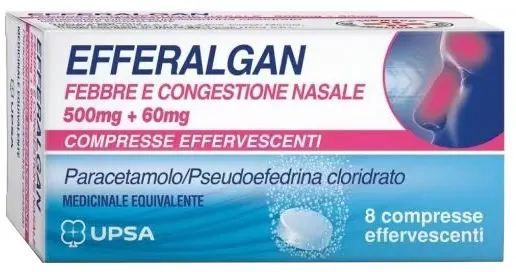
Efferalgan Fever and Nasal Congestion is a painkiller, antipyretic, and nasal decongestant used to treat cold and flu symptoms.
Indications
Efferalgan Fever and Nasal Congestion contains paracetamol, an analgesic that relieves pain and lowers fever, and pseudoephedrine, a decongestant that acts on the nasal mucosa to clear a stuffy nose.
Composition
Active ingredients
Paracetamol 500 mg. Pseudoephedrine hydrochloride 60 mg (equivalent to 49.15 mg of pseudoephedrine).
Excipients with known effect:
- Sodium bicarbonate: 700 mg (of which 191.56 mg of sodium);
- Sodium carbonate anhydrous: 300 mg (of which 130.14 mg of sodium);
- Sorbitol (E420): 296 mg;
- Aspartame (E951): 20 mg;
- Sodium saccharin: 20 mg (of which 2.24 mg of sodium);
- Docusate sodium: 4 mg (of which 0.21 mg of sodium).
Excipients
Citric acid anhydrous, sodium bicarbonate, Anhydrous sodium carbonate, sorbitol, lemon flavoring, aspartame, sodium saccharin, simethicone, leucine, sodium docusate.
Directions for use and Dosage
Always take this medicine exactly as described in this leaflet or as directed by your doctor or pharmacist. If you are unsure, consult your doctor or pharmacist.
The recommended dose for adults and children over 12 years of age is one effervescent tablet up to 3 times a day. The product should be taken on a full stomach, after meals. Dissolve the effervescent tablet in a glass of water and drink the resulting solution immediately. Do not exceed the indicated dose without medical advice. Warning:
- Use the medicine for a maximum of 5 days of therapy if you are an adult;
- Use the medicine for a maximum of 3 days of therapy if you are administering it to an adolescent (12-18 years).
Use in children and adolescents
EFFERALGAN FEVER AND NASAL CONGESTION is contraindicated in children under 12 years of age.
If you take more EFFERALGAN FEVER AND NASAL CONGESTION than you should
If you accidentally take more than the recommended dose, tell your doctor immediately or go to hospital urgently as an overdose of paracetamol can cause serious illness. cause irreversible damage to liver function and, less frequently, damage to kidney function.
In cases of overdose, the following symptoms have been observed: hypertension, extrasystoles (premature heartbeats), tachycardia (increased heart rate), nausea and vomiting, signs of acute hepatotoxicity, mydriasis (dilated pupils), hypertension, agitation/anxiety, sinus arrhythmia (irregular heartbeat), hallucinations, tremors/hyperreflexia (increased nerve reflexes); less frequently, hyperglycemia (increased blood sugar), rhabdomyolysis (breakdown of muscle cells), acute renal failure. Emergency treatment: rapid gastric emptying; administration of activated charcoal.
Early administration of the antidote paracetamol (N-acetylcysteine) is recommended.
If you have any further questions on the use of EFFERALGAN FEVER AND NASAL CONGESTION, ask your doctor or pharmacist.
If you forget to take EFFERALGAN FEVER AND NASAL CONGESTION
Do not take a double dose to make up for a forgotten dose.
If you stop taking EFFERALGAN FEVER AND NASAL CONGESTION
If you have any further questions on the use of EFFERALGAN FEVER AND NASAL CONGESTION, ask your doctor or pharmacist.
Warnings
Talk to your doctor or pharmacist before taking EFFERALGAN FEVER AND NASAL CONGESTION NASAL.
With EFFERALGAN FEVER AND NASAL CONGESTION, reduced blood flow to the optic nerve may occur. If you experience sudden vision loss, stop taking EFFERALGAN FEVER AND NASAL CONGESTION and contact your doctor or a healthcare facility immediately.
With EFFERALGAN FEVER AND NASAL CONGESTION, sudden abdominal pain or rectal bleeding may occur due to inflammation of the colon (ischaemic colitis). If these gastrointestinal symptoms occur, stop taking EFFERALGAN FEVER AND NASAL CONGESTION immediately and contact your doctor or seek medical advice.
During treatment with EFFERALGAN FEVER AND NASAL CONGESTION, before taking any other medicine, check that it does not contain paracetamol as it may cause serious eye problems. If this active ingredient is taken in high doses, serious side effects may occur. Hepatotoxicity (the ability of some substances to cause liver damage) can occur with paracetamol even at therapeutic doses, after short-term treatment and in patients without pre-existing liver dysfunction. Caution is also recommended in patients with a history of sensitivity to aspirin and/or nonsteroidal anti-inflammatory drugs (NSAIDs).
The use of the medicine requires careful evaluation in the elderly and in subjects who have or develop one of the following conditions:
- coronary artery disease (angina, previous heart attack);
- hypertension (high blood pressure);
- arrhythmias (disturbance of heart rhythm or heart rate);
- liver failure (alterations in liver function);
- renal failure (alterations in kidney function);
- hyperthyroidism (overactivity of the thyroid);
- asthma;
- diabetes;
- urinary disorders caused by prostatic hypertrophy or other diseases;
- glaucoma (increased pressure within the eye);
- hemolytic anemia (destruction of the blood vessels in the eye); of red blood cells in the blood);
- deficiency of the enzyme glucose-6-phosphate dehydrogenase (which can lead to the destruction of red blood cells in the blood).
Side effects
Side effects due to paracetamol.
Blood and lymphatic system disorders: thrombocytopenia, neutropenia, leukopenia; agranulocytosis, haemolytic anaemia in patients with basic glucose-6-phosphate dehydrogenase deficiency.
Nervous system disorders: dizziness.
Immune system disorders: hypersensitivity reactions such as angioedema, laryngeal edema, anaphylactic shock.
Cardiac disorders: Kounis syndrome.
Respiratory, thoracic and mediastinal disorders: bronchospasm, pneumonia.
Gastrointestinal disorders: gastrointestinal haemorrhage; Gastrointestinal reactions.
Renal and urinary disorders: nephrotoxicity; renal changes (acute renal failure, interstitial nephritis, hematuria, anuria).
Skin and subcutaneous tissue disorders: erythema, urticaria, rash, fixed drug eruption.
Very rare cases of serious skin reactions such as erythema multiforme, toxic epidermal necrolysis (TEN), Stevens-Johnson syndrome (SJS), and acute generalized exanthematous pustulosis have been reported.
Hepatobiliary disorders: hepatotoxic drugs; impaired liver function and hepatitis; cytolytic hepatitis which can lead to acute liver failure.
In case of overdose, paracetamol can cause hepatic cytolysis which can lead to liver failure. may evolve into massive and irreversible necrosis.
Undesirable effects due to pseudoephedrine.
Cardiac disorders: myocardial infarction, atrial fibrillation, tachyarrhythmia, hypertension, hypotension, ventricular extrasystoles, precordial pain, palpitations.
Nervous system disorders: convulsions, insomnia, tremors, ataxia, dizziness, headache.
Eye disorders: mydriasis, ischemic optic neuropathy (frequency not known).
Gastrointestinal disorders: ischemic colitis (frequency not known), taste disturbances, nausea, vomiting, dry mouth.
Skin and subcutaneous tissue disorders: eczema, fixed erythema, pseudoscarlet fever.
Metabolism and nutrition disorders: hyperthermia, thirst, sweating.
Disorders Psychiatric: anxiety, agitation, nervousness, irritability, confusion, hallucinations.
Difficulty urinating: urinary retention may occur in patients with prostatic hypertrophy.
Reporting of suspected adverse reactions.
Reporting suspected adverse reactions that occur after authorization of the medicinal product is important, as it allows continuous monitoring of the benefit/risk balance of the medicinal product.
Pregnancy and breastfeeding
EFFERALGAN FEVER AND NASAL CONGESTION is contraindicated in confirmed or suspected pregnancy and during breastfeeding. If you are pregnant, think you may be pregnant or are planning to have a baby, or are breastfeeding, ask your doctor or pharmacist for advice before taking EFFERALGAN FEVER AND NASAL CONGESTION.
Format
8 Effervescent Tablets
Product Code:FRCM199107




 Richiedi info sul prodotto