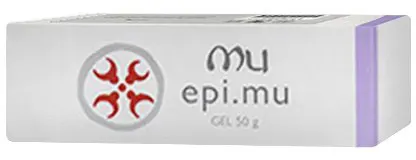
Gel useful in case of skin conditions, skin protection and regeneration.
Indications
Due to the action of the plants that compose it, the Epi Mu Gel is useful for the health and well-being of the skin: it can have a therapeutic effect on common skin conditions, reducing redness, irritation, cracking, itching, sunburn, and minor burns.
Adjuvant in the treatment of acne, eczema, and psoriasis.
Restores elasticity to the skin and improves its appearance.
Properties of the components:
- Calendula officinalis:
The main activities are linked to its anti-inflammatory, antiseptic, and antispasmodic action.
The anti-inflammatory properties are attributable to the triterpene alcohols and the simultaneous presence of high quantities of manganese and carotene, while the essential oils and flavonoids have an antiseptic and healing action.
The vulnerary property is determined by an increase in the phagocytic activity of the ERS, by the increase in fibrin which rapidly leads to the closure of wounds and the formation of granulation tissue.
The presence of mucilage ensures emollient, soothing, refreshing, and re-epithelializing properties and simultaneously isolates and protects the irritated areas and conditions their level of humidity.
External use is the most common use. Calendula is a common herb used in the treatment of dry, chapped, delicate, easily reddened, and itchy skin.
Its action is documented in all types of wounds and sores that are slow to heal and easily infected by bacteria, in delayed healing, ulcers, burns, boils, and eczema. - Arctium lappa:
An excellent liver-biliary drainer, it helps eliminate toxins from the body, especially from the skin.
Its local action is mainly aimed at treating skin problems by promoting the elimination of toxins produced by the body, as in the case of dermatoses such as acne, eczema, and cradle cap. - Hamamelis virginiana:
Its action is astringent, anti-inflammatory, hemostatic, and vasoconstrictor.
Its action Its anti-inflammatory action is expressed through the stabilization of vascular cells, while its astringent action is expressed by the closure of cell membranes and reduces capillary permeability.
At the beginning of its pharmacological history, it was used exclusively to soothe skin redness caused by the sun, prevent erythema and aging.
In fact, women dedicated to working in the fields have always found in it an effective aid in maintaining clear and velvety skin.
Even today, it offers an efficacy that is difficult to replace in spontaneous skin redness (rosacea). - Helichrysium italicum:
The main components of the plant are flavonoids (colorless flavonoids, helichrysins), colored chalcones, sequiterpene lactones, caffeic acid, chlorogenic acid, essential oils and phytosterols.
The use of the plant is traditionally known in Skin diseases, for its antiallergic, antieczematous, and antipsoriatic properties, as it relieves itching and promotes epidermal regeneration.
It helps soothe burns, treat sunburn, and acts to reverse chilblains and edema due to microcirculatory stasis. Studies have shown that helichrysum acts through an ACTH- and cortisone-like antireactive mechanism.
The sterol and triterpene compounds it contains are considered prehormones, as the body, especially in cases of deficiency, can produce these hormones. transform them into adrenal cortical hormones. - Hypericum perforatum:
It is therapeutically indicated for its anti-inflammatory, healing, and antiseptic properties.
For external use, in fact, it is particularly indicated in the treatment of retroviruses (stomatitis, gingivitis, labial and genital herpes simplex): the terpenoids, phenolic compounds, and alkaloids interfere with viral replication mechanisms and block virion maturation processes. - Mahonia aquifolium:
Its active ingredients are extracted from the root bark of the plant.
They inhibit the lipoxygenase enzyme, thus reducing the risk of virion damage. inflammation.
It also has antioxidant properties, antihistaminic and anticholinergic action, in particular it increases the production of T lymphocytes. It has a significant antimicrobial activity on bacteria, chlamydia, viruses, fungi and protozoa.
Thanks to these characteristics it is successfully used, among other things, in skin dysfunctions. - Malaleuca alternifolia:
It is known above all for its germicidal power.
It is successfully used in skin infections from both bacteria and fungi.
It stimulates the repair processes, has an anti-inflammatory and anti-itch action. - Mimosa tenuiflora:
It is mainly indicated in anti-inflammatory and anti-edematous treatments.
Thanks to the action of triterpenic saponins (also present in Calendula officinalis) it inhibits:
a) The migration of leukocytes towards inflamed sites, reducing inflammation.
b) The depolymerization of glycosaminoglycans in the perivascular connective tissue, preserving correct vascular permeability and limiting the risk of edema.
Phytosterols, on the other hand, possess anti-inflammatory properties due to the inhibition of the biosynthesis of prostaglandins PGE2 and PGF2±.
The anti-inflammatory and anti-edematous action of triterpene saponins and phytosterols is strengthened by the tannin component, particularly abundant in the bark and glycolic extracts of Mimosa tenuiflora.
In fact, tannins have marked astringent properties; These compounds interact with the surface proteins of the skin, forming a protective layer that limits both bacterial growth and secretion from the inflamed tissue.
The antibacterial and antifungal effect is nonspecific and targets fungi, yeasts, and Gram-positive and Gram-negative bacteria. - Oenotera biennis:
Among the therapeutic qualities of evening primrose, the contribution of gamma-linoleic acid, present in the oil obtained by pressing the seeds, is noteworthy.
A low intake of this acid, in fact, is responsible for problems such as eczema, growth retardation, hypercoagulation, and altered synthesis of prostaglandins (PGE1), substances responsible for inflammatory conditions.
Evening evening primrose oil is also used in the treatment of acne, atopic eczema, in the prevention of the appearance of wrinkles, and to promote skin elasticity. - Rosa moschata:
It grows spontaneously in the Andean region where it was brought by Europeans.
Its oil has a regenerating action on various types of scars.
After two/three weeks of application, it is possible to observe an increase in epidermal regeneration and epidermopoiesis, with an increase in the migration cycle of keratin from the basal layer to the superficial stratum corneum.
These actions allow epidermal regeneration and normalization of the pigment.
The trans-retinoic acid (an isomer of vitamin A) contained in Rosa moschata oil increases the number and activity of fibroblasts in the dermis, improves microvascularization, promoting intense angiogenesis of small, normal-sized vessels in the dermis, giving the skin a clearer and fresher appearance and more elastic skin. elastic.
It is also an excellent remedy for sunburn, smoothes scars, reduces expression lines and age spots, and regenerates dry, damaged skin. - Viola tricolor:
It contains mucilages that have anti-inflammatory, emollient, and anti-itch properties.
It is used in the treatment of skin conditions such as acne, eczema, psoriasis, and cradle cap, thanks to the presence of flavonoids.
It has an effective draining action that counteracts the poor functioning of the natural excretory organs: liver, kidneys, intestines, and especially the skin.
Composition
Calendula officinalis extract, Arctium lappa extract, Hamamelis virginiana extract, Helichrysium italicum extract, Hypericum perforatum extract, Juglans regia leaf extract, Mahonia aquifolium extract, Malaleuca alternifolia extract, Mimosa tenuiflora bark extract, Oenotera biennis extract, Rosa moschata oil extract and Viola tricolor extract.
Directions for use and dosage
We recommend three or four applications per day.
Format
50 g
Product Code:FRCM151699
Price Trend
This product has been on sale since 06/07/2021
In the last 30 days, the product's lowest price
was 19,95 €




 Richiedi info sul prodotto


