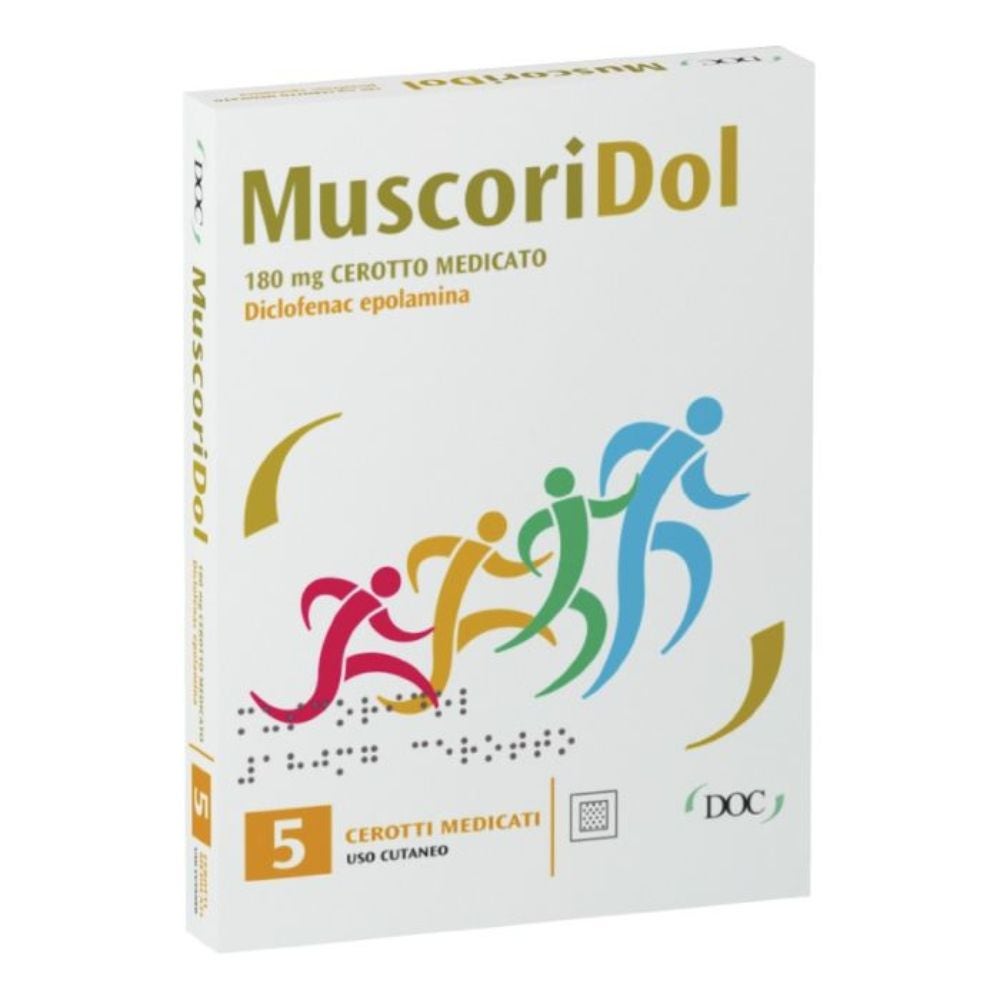
Muscoridol 180 mg medicated plaster is a local symptomatic treatment for rheumatic or traumatic pain and inflammation of joints, muscles, tendons, and ligaments.
Indications
Local symptomatic treatment of rheumatic or traumatic pain and inflammation of joints, muscles, tendons, and ligaments.
Composition
Active ingredients
Each medicated plaster measuring 10 cm x 14 cm contains a total of 180 mg of diclofenac epolamine equivalent to 140 mg of diclofenac sodium. Excipients with known effects: methyl parahydroxybenzoate (E218): 14 mg; Propylene glycol (E216): 420 mg; per patch. For a full list of excipients, see section 6.1.
Excipients
Backing layer: non-woven polyester backing. Adhesive layer (active gel): gelatin, povidone (K90), liquid sorbitol (non-crystallizing), heavy kaolin, titanium dioxide (E171), propylene glycol, methyl parahydroxybenzoate (E218), propyl parahydroxybenzoate (E216), disodium edetate, tartaric acid, aluminum glycinate, sodium carmellose, sodium polyacrylate, 1,3-butylene glycol, polysorbate 80, purified water. Protective layer: polypropylene film.
Directions for use
For cutaneous use only.
Dosage
- One (1) patch in the most painful area once or twice daily.
Duration of administration
- Zaranny should be used for the shortest possible time. The maximum duration of treatment is 14 consecutive days. Advise the patient to consult their doctor if they do not experience improvement after the recommended treatment period (see section 4.4).
Elderly
- This medicine should be used with caution in elderly patients as they are more susceptible to adverse effects (see section 4.4).
Paediatric population (Children and adolescents under 16 years)
- The use of this medicated plaster is not recommended since there are insufficient data on the safety and efficacy of the medicine in children and adolescents under 16 years of age (see section 4.3). In adolescents aged 16 years and older, if the product is used in children and adolescents under 16 years of age, the use of this medicated plaster is contraindicated. If more than 7 days of treatment is needed for pain relief, or if symptoms worsen, the patient/parent of the adolescent is advised to consult a physician, as re-evaluation is necessary.
Patients with hepatic or renal impairment
- For the use of Zaranny in patients with hepatic or renal impairment, see section 4.4.
Method of administration
- Cut the pouch containing the medicated plaster as directed. Remove a medicated plaster, remove the plastic film used to protect the adhesive surface, and apply the plaster to the painful joint or area. If necessary, the plaster can be held in place with an elastic mesh bandage. Carefully close the pouch with the sliding seal. The patch must be used whole.
Interactions
Do not administer another diclofenac-based medicine or other NSAIDs at the same time, topically or systemically.
The use of the product in combination with other diclofenac-containing medicines should be avoided as it may give rise to hypersensitivity reactions. in light, rash with vesicles, eczema, erythema, and, in rare cases, severe skin reactions (Stevens-Johnson syndrome, Lyell syndrome) (see sections 4.4 and 4.5).
Warnings
- The medicated plaster should be applied only to intact, healthy skin and should not be applied to broken skin or open wounds, and should not be applied while bathing or showering.
- The medicated plaster should not come into contact with or be applied to mucous membranes or eyes.
- Do not use with an occlusive dressing that does not allow air to pass through.
- Treatment should be discontinued immediately if a rash develops after applying the medicated plaster.
- Do not administer concomitantly, topically or systemically, a other diclofenac-based medicine or other NSAIDs.
- The possibility of systemic adverse events caused by topical diclofenac application cannot be ruled out if the preparation is used on a large area of skin and for a prolonged period (see product information for other systemic forms of diclofenac). Although systemic effects may be minimal, the patch should be used with caution in patients with impaired renal, cardiac, or hepatic function, a history of peptic ulcer, intestinal inflammation, or bleeding diathesis. Nonsteroidal anti-inflammatory drugs should be used with particular caution in elderly patients, as they are more susceptible to systemic reactions. susceptible to the onset of adverse effects.
- Patients should be advised not to expose themselves to direct sunlight or sunlamps for approximately one day after removing the medicated plaster to reduce the risk of photosensitivity.
- The medicated plaster should be used with caution in patients with asthma, chronic bronchial obstructive diseases, allergic rhinitis, or inflammation of the nasal mucosa (nasal polyp), who may react with asthma attacks, local inflammation of the skin or mucous membranes (Quincke's edema), urticaria, or acute rhinitis after treatment with acetylsalicylic acid or other nonsteroidal anti-inflammatory agents more often than other patients (see section 4.3).
- In order to minimize the occurrence of adverse effects, it is recommended to use the lowest effective dose for the longest duration. Short-term use necessary to control symptoms, without exceeding the approved maximum of 14 days (see sections 4.2 and 4.8).
- The use, especially if prolonged, of this and other topical products may give rise to sensitization phenomena. In this case, treatment should be discontinued and appropriate therapy instituted.
- Although systemic absorption is minimal, the use of the medicated plaster, as with any drug that inhibits prostaglandin synthesis and cyclooxygenase, is not recommended in women attempting to conceive (see section 4.6).
- Administration of the diclofenac medicated plaster should be discontinued in women who have fertility problems or who are undergoing investigation of fertility. (see section 4.6).
This medicine contains methyl parahydroxybenzoate and propyl parahydroxybenzoate. They may cause allergic reactions (possibly delayed); this medicine contains 420 mg of propylene glycol per patch.
Contraindications
- Hypersensitivity diclofenac, acetylsalicylic acid, other analgesics or other nonsteroidal anti-inflammatory drugs (NSAIDs), or any of the excipients listed in section 6.1.
- Patients who have had asthma attacks, urticaria, or acute rhinitis triggered by acetylsalicylic acid or other nonsteroidal anti-inflammatory drugs (NSAIDs).
- Broken skin, regardless of the type of lesion: exudative dermatitis, eczema, infected lesion, burns, or wounds.
- Third trimester of pregnancy (see section 4.6).
- Patients with active peptic ulcer.
- Children and adolescents aged 18 years and over. under 16 years of age.
Undesirable effects
Adverse reactions are listed by frequency, the most frequent first, using the following convention: very common (>1/10); common (>1/100, <1/10); uncommon (>1/1,000, <1/100); rare (>1/10,000, <1/1,000); very rare (<1/10,000); not known: frequency cannot be estimated from the available data.
| Infections and infestations | |
| Very rare | Pustular rash |
| Immune system disorders | |
| Very rare | Hypersensitivity (including urticaria), angioedema, anaphylactic reaction |
| Respiratory, thoracic, and mediastinal disorders | |
| Very rare | Asthma |
| Skin and subcutaneous tissue disorders | |
| Common | Rash, eczema, erythema, dermatitis (including allergic dermatitis and contact dermatitis), pruritus |
| Uncommon | Petechiae |
| Rare | Bullous dermatitis (e.g., erythema bullosa), dry skin |
| Very rare | Symptoms Photosensitivity |
| Unknown | Burning sensation at the application site |
| General disorders and administration site conditions | |
| Common | Administration site reactions |
| Uncommon | Feeling hot |
Systemic absorption of diclofenac is The plasma levels measured after oral administration of diclofenac are very low, and the probability of systemic side effects (such as gastric, hepatic, and renal disorders) is very low compared to the frequency of side effects associated with oral use of diclofenac. However, if Zaranny is used on large areas of skin and for long periods of time, systemic side effects may occur, especially at the gastrointestinal level, due to the amount of active ingredient that is absorbed. The use of the product in combination with other drugs containing diclofenac should be avoided as it may give rise to hypersensitivity phenomena. to light, rash with vesicles, eczema, erythema, and, in rare cases, severe skin reactions (Stevens-Johnson syndrome, Lyell syndrome) (see sections 4.4 and 4.5).
Reporting of suspected adverse reactions
Reporting suspected adverse reactions that occur after authorization of the medicinal product is important. It allows continued monitoring of the benefit/risk balance of the medicinal product. Healthcare professionals are asked to report any suspected adverse reactions via the national reporting system at https://www.aifa.gov.it/content/segnalazioni-reazioni-avverse.
Overdose
No cases of overdose have been reported with diclofenac medicated patches. Should systemic side effects occur due to incorrect use or accidental overdose (e.g., in children), the general supportive measures for intoxication with nonsteroidal anti-inflammatory drugs are recommended.
Pregnancy and breastfeeding
Pregnancy
The systemic concentration of diclofenac, compared to oral formulations, is lower after topical administration. Based on experience with systemic NSAIDs, the following is recommended:
Inhibition of prostaglandin synthesis may have adverse effects on pregnancy and/or embryo/fetal development. Results of epidemiological studies suggest an increased risk of miscarriage, cardiac malformation, and gastroschisis after use of a prostaglandin synthesis inhibitor in early pregnancy. The absolute risk of cardiac malformations increased from less than 1% to approximately 1.5%. The risk was believed to increase with dose and duration of therapy. In animals, administration of prostaglandin synthesis inhibitors has been shown to result in increased pre- and post-implantation loss and embryo-fetal mortality. Additionally, an increased incidence of various malformations, including cardiovascular, has been reported in animals administered prostaglandin synthesis inhibitors during the organogenetic period.
During the first and second trimesters of pregnancy, diclofenac should not be administered unless clearly necessary. If diclofenac is used by a woman attempting to conceive, or during the first and second trimesters of pregnancy, the dose should be kept as low as possible and the duration of treatment as short as possible.
During the third trimester of pregnancy, all prostaglandin synthesis inhibitors may expose the fetus to:
- cardiopulmonary toxicity (with premature closure of the ductus arteriosus and pulmonary hypertension);
- renal dysfunction, which may progress to renal failure with oligohydramnios;
the mother and newborn, at the end of pregnancy, to:
- possible prolongation of bleeding time, and antiplatelet effect that may increase the risk of serious complications. This may occur even at very low doses;
- Inhibition of uterine contractions resulting in delayed or prolonged labor.
Consequently, diclofenac is contraindicated during the third trimester of pregnancy.
Breastfeeding
Like other NSAIDs, diclofenac passes into breast milk in small amounts. However, at therapeutic doses of diclofenac medicated plaster, no effects on the infant are anticipated. Due to the lack of controlled studies in breastfeeding women, the product should be used during breastfeeding only under the advice of a healthcare professional. In this circumstance, Zaranny should not be applied to the breasts of nursing mothers, nor should it be used during breastfeeding. elsewhere on large areas of skin or for a prolonged period of time (see section 4.4).
Fertility
Administration of the medicated patch should be discontinued in women who have fertility problems or who are undergoing fertility investigations.
Storage
This medicine does not require any special temperature storage conditions.
Format
5 Patches
Product Code:FRCM234758




 Richiedi info sul prodotto


