Free shipping from 69,00 € and always free returns

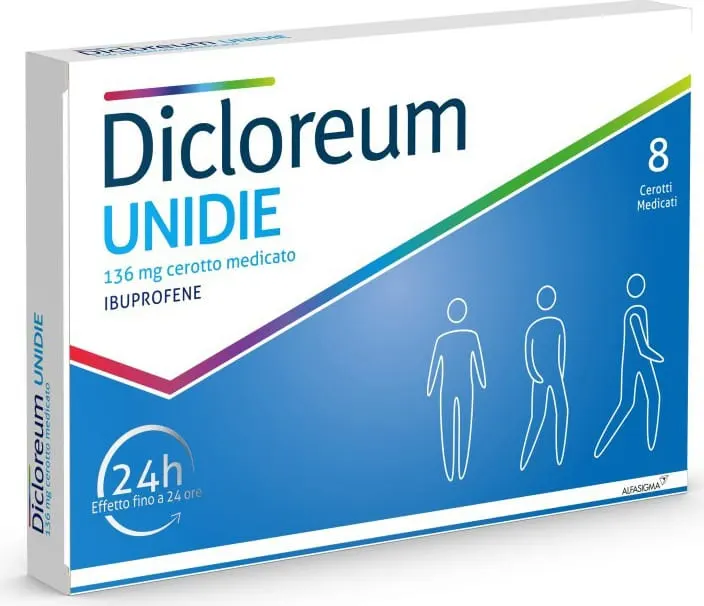
Dicloreum unidie 8 medicated plasters

4.5
(3)
Productor: Alfasigma
info prodotto Richiedi info sul prodotto

Estimated delivery: 1-3 business days

-30,8%
€18.89
Recommended price €27.30
Available in the following sizes
  • 8 Patches
    €18.89
  • 5 Patches
    €14.11
Extra quantity discount
from 5 Pieces You're saving: 1,00%
from 10 Pieces You're saving: 2,00%
info resi e spedizione

Information on returns and shipments

info pagamenti

Payment methods

Authorized company for online trading of
Medicines authorized by the Ministry of Health
99& satisfied customers
Product Description

Drug in the form of medicated plasters, indicated for the local treatment of pain and inflammation of rheumatic and traumatic nature of the joints, muscles, tendons and ligaments.

Indications

Dicloreum Unidie is a pharmaceutical formulation containing as active ingredient ibuprofen, a nonsteroidal anti-inflammatory drug (NSAID) with an anti-inflammatory and analgesic action, which is released transdermally.

Composition

Active ingredients

Ibuprofen 136 mg

Excipients

Potassium salt of copolymer of 2-ethylhexyl acrylate, methyl acrylate, acrylic acid, glycidyl methacrylate; oleic acid; Al+3.

How to use and Dosage

Warning: do not exceed the indicated doses without medical advice.

  • The recommended dose is only one medicated plaster at a time, to be replaced every 24 hours for a maximum duration of 7-10 days.
  • Do not apply two plasters in the same day.
  • Dicloreum Unidie is to be used exclusively for applications on intact skin.
  • It is advisable to wash and dry the painful area thoroughly before applying the medicated plaster.
  • If the medicated plaster must be placed on joints subject to wide mobility, such as the elbow or knee, it is advisable to apply it longitudinally and not transversally, taking care to attach the medicated plaster while keeping the joint partially flexed.
  1. To apply the medicated plaster, partially detach the two parts of transparent protective film in the central area of ​​the medicated plaster so as to have a free adhesive surface of 2-3 centimetres and make this part adhere to the skin in the central area of ​​the painful area.
  2. Slowly remove the two protective films one after the other, taking care to avoid the medicated plaster from creasing or sticking to itself.
  3. Immediately after attaching the medicated plaster, lightly massage the skin for about 20 seconds to ensure perfect adhesion of the medicated plaster.

Warnings

Analgesics, antipyretics, non-steroidal anti-inflammatory drugs, including ibuprofen, can cause hypersensitivity reactions, potentially serious even in subjects not previously exposed to this type of drug.

Dicloreum Unidie must be used with great caution and on the advice of a doctor.

  • In the elderly;
  • In patients with chronic bronchitis, allergic rhinitis or inflammation of the nasal mucosa (in whom asthma attacks, or severe inflammatory reactions of the skin and mucosa are more frequent);
  • In patients with a history of gastrointestinal diseases (such as gastrointestinal ulcer, ulcerative colitis or Crohn's disease);
  • In patients with a history of gastrointestinal bleeding even if not caused by the administration of NSAIDs or with other bleeding disorders;
  • In patients with liver or kidney dysfunction or heart failure;
  • If you suffer or have suffered from high blood pressure.

Contraindications

Do not use the product:

  • If you are allergic to the active substance or to any of the excipients;
  • On open wounds or lesions, but only on intact skin. Avoid contact with eyes and mucous membranes;
  • If you have had an episode of hypersensitivity (asthma, allergic rhinitis, skin rashes and anaphylactic reactions) or gastrointestinal bleeding from anti-inflammatory drugs in the past;
  • If you have an active peptic ulcer, if you have bronchial asthma or are taking anticoagulant therapy;
  • In the third trimester of pregnancy and if you are breastfeeding;
  • In children under 12 years of age;
  • In case of severe heart failure;
  • In case of severe kidney or liver failure.

Interactions

Inform your doctor or pharmacist if you are taking or have recently taken any other medicines, even those without a prescription.

The use of ibuprofen patches is unlikely to have interactions with other medicines, foods or drinks. However, the concomitant topical or systemic use of other drugs containing ibuprofen, other NSAIDs, corticosteroids, anticoagulants or antiplatelet agents is not recommended.

Side effects

Like all medicines, Dicloreum Unidie can cause side effects, although not everybody gets them. The frequency of possible side effects listed below is determined using the following convention:

  • Very common ≥1/10;
  • Common ≥1/100 - <1/10;
  • Uncommon ≥1/1,000 - <1/100;
  • Rare ≥1/10,000 - <1/1,000;
  • Very rare <1/10,000,
  • Not known can not be estimated from the available data. be defined on the basis of available data.

The following undesirable effects have been observed in controlled clinical studies with this product:

Nervous system disorders

  • Common: Dry mouth, headache, taste perversion.

Gastrointestinal disorders

  • Common: Nausea.

Skin and subcutaneous tissue disorders

  • Common: Facial oedema, blisters

Musculoskeletal and connective tissue disorders

  • Common: General malaise

General disorders and conditions related to the site of administration

  • Very Common: Mild skin redness or modest irritation at the application site, which rapidly disappear after the medicated plaster is removed.
  • Common: Itching, burning, evident skin irritation with redness of the skin, skin peeling and small skin lesions.

All the adverse effects observed in clinical studies were mild and transient in nature. In the literature, the following undesirable effects have been reported:

Immune system disorders

  • Not known: Local hypersensitivity.

General disorders and conditions related to the site of administration

  • Not known: Contact dermatitis, Numbness and tingling at the application site.

Rare cases of extensive and severe dermatological lesions such as erythema multiforme, Quincke's edema and, very rarely, bullous reactions including Stevens-Johnson Syndrome and Toxic Epidermal Necrolysis have also been reported with this type of medicine.

Photosensitivity reactions are possible.

A serious skin reaction known as DRESS syndrome may occur. Symptoms of DRESS include: rash, fever, swollen lymph nodes, and an increase in eosinophils (a type of white blood cell).

Systemic adverse reactions following topical use of ibuprofen are unlikely because the plasma levels of ibuprofen detected following the application of Dicloreum Unidie are much lower than those detected with the systemic administration of ibuprofen-based drugs. However, following applications for long periods of time, beyond the recommended duration, and failure to comply with contraindications and warnings, the appearance of systemic adverse effects, especially gastrointestinal, cannot be ruled out.

Following the instructions in the package leaflet reduces the risk of adverse effects. If any of the side effects gets serious, or if you notice any side effects not listed in this leaflet, please tell your doctor or pharmacist.

Overdose

Due to the characteristics of the pharmaceutical form, overdose is unlikely. If you have used more Dicloreum Unidie than you should, or if your child has used this medicine by mistake, always contact a doctor or the nearest hospital to receive an opinion on the risk and advice on what action to take. Symptoms may include nausea, stomach pain, vomiting (possibly with traces of blood), headache, ringing in the ears, confusion, and uncontrolled eye movements. At high doses, drowsiness, chest pain, palpitations, loss of consciousness, convulsions (especially in children), weakness and dizziness, blood in the urine, feeling cold all over, and breathing problems have been reported.

If you forget to use Dicloreum Unidie: Apply the forgotten patch as soon as you remember. However, if it is almost time to apply the next patch, apply only the next regularly scheduled one. Do not apply two patches on the same day.

Pregnancy and breastfeeding

Ask your doctor or pharmacist for advice before taking any medicine. Dicloreum Unidie is contraindicated during the third trimester of pregnancy and breastfeeding and is not recommended for women attempting to become pregnant. Based on experience with systemic NSAID treatment, the following is recommended:

  • Pregnancy: Inhibition of prostaglandin synthesis may adversely affect the pregnancy and/or embryo/fetal development. Data from epidemiological studies suggest an increased risk of miscarriage, cardiac malformation, and gastroschisis after use of a prostaglandin synthesis inhibitor during early pregnancy. The absolute risk of cardiac malformations increased from less than 1%, up to approximately 1.5%. The risk is believed to increase with dose and duration of therapy. In animals, administration of prostaglandin synthesis inhibitors has been shown to result in increased pre- and post-implantation loss and embryo-fetal mortality. Furthermore, an increased incidence of various malformations, including cardiovascular, has been reported in animals administered prostaglandin synthesis inhibitors during the organogenetic period. During the first and second trimesters of pregnancy, ibuprofen should not be administered unless clearly necessary. If used by women attempting to conceive or during the first and second trimesters of pregnancy, the dose and duration of treatment should be as low and as short as possible, respectively. During the third trimester of pregnancy, all prostaglandin synthesis inhibitors may expose the fetus to:
    • cardiopulmonary toxicity (with premature closure of the ductus arteriosus and pulmonary hypertension);
    • renal dysfunction that may progress to renal failure with oligohydramnios; the mother and the newborn, at the end of pregnancy, to:
    • possible prolongation of bleeding time, an antiaggregant effect that can occur even at very low doses;
    • inhibition of uterine contractions resulting in delayed or prolonged labor.

Consequently, ibuprofen is contraindicated during the third trimester of pregnancy.

  • Breastfeeding: Ibuprofen is excreted in breast milk; at therapeutic doses during short-term treatment the risk of influence on the newborn seems unlikely, while in case of long-term treatment early weaning should be considered. NSAIDs should be avoided during breastfeeding.
  • Fertility: The use of ibuprofen may impair female fertility and is not recommended in women attempting to conceive. This effect is reversible upon discontinuation of treatment. In women who have difficulties conceiving or who are undergoing investigation of infertility, discontinuation of ibuprofen treatment should be considered.

Driving and using machines

No specific studies are available. However, Dicloreum Unidie is unlikely to have any effect on the ability to drive or use machines.

Format

8 medicated plasters

Product Code:FRCM134179

Price Trend

This product has been on sale since 26/08/2020

In the last 30 days, the product's lowest price was 18,89 €

5% EXTRA DISCOUNT on FIRST ORDER! Register and discover the WELCOME Coupon!
To enhance your website experience, Farmacosmo.com uses different types of cookies. You can click OK, to allow them, or manage them individually. By clicking on the ''x'' you don't accept any cookies and other tracking methods other than technical ones. To read more see our Cookie Policy. Cookie Policy