Gel for muscle and joint pain.
Indications
Diclofenac Teva Bv 10 Mg/G is a gel used in the local treatment of painful and inflammatory conditions of a rheumatic or traumatic nature of joints, muscles, tendons and ligaments.
Composition
Active Ingredients: 1 g of gel contains diclofenac in the form of 11.6 mg of diclofenac diethylammonium equivalent to 10 mg of diclofenac sodium.
Excipients: Carbomer, Cocoyl caprylocaprate, Macrogol cetostearyl ether, Liquid paraffin, Diethylamine, Isopropyl alcohol, Propylene glycol (E1520), Perfume (contains citronellol, geraniol, benzyl alcohol, linalool, limonene, citral, farnesol, coumarin, eugenol), Purified water.
Directions for use and Dosage
Adults over 18 years:
Apply Teva Diclofenac Gel 3 or 4 times a day to the area to be treated, rubbing in lightly.
The amount to apply depends on the size of the affected area.
For example, 2-4 g of Teva Diclofenac Gel (an amount varying in size from a cherry to a walnut) is sufficient to treat an area of 400-800 cm2.
After application, wash your hands, otherwise they will also be treated with the gel.
Caution: use only for short periods of treatment.
The gel should not be used for more than 1 hour.
... For pain relief, consult a doctor for 7 days or if symptoms worsen.
Children under 14 years:
There are insufficient data on efficacy and safety in children and adolescents under 14 years of age.
Therefore, the use of the medicine is contraindicated in children under 14 years of age.
Elderly (over 65 years): The usual adult dosage can be used.
Warnings
The possibility of systemic adverse events with the application of the medicine cannot be excluded. be excluded if the preparation is used on large areas of skin and for a prolonged period.
The medicine should be applied only to intact, non-diseased skin, and not to skin wounds or open lesions.
It should not be allowed to come into contact with eyes or mucous membranes and should not be ingested.
Discontinue treatment if a skin rash develops after application of the product.
The product can be used with non-occlusive dressings, but should not be used with an occlusive dressing that does not allow air to pass through.
The medicine contains propylene glycol.
It may cause skin irritation.
The medicine contains butylhydroxytoluene.
It may cause skin irritation. cause local skin reactions (e.g. contact dermatitis) or irritation of the eyes and mucous membranes.
Contraindications
Hypersensitivity to the active substance or to any of the excipients;
History of asthma attacks, urticaria or acute rhinitis following the intake of acetylsalicylic acid or other nonsteroidal anti-inflammatory drugs (NSAIDs);
During the third trimester of pregnancy;
Use in children and adolescents under 14 years of age is contraindicated.
Pregnancy and Breastfeeding
Pregnancy:
The systemic concentration of diclofenac is lower after topical administration compared to oral formulations.
Inhibition of prostaglandin synthesis may occur. may adversely affect pregnancy and/or embryo/fetal development.
Results of epidemiological studies suggest an increased risk of miscarriage and cardiac malformation and gastroschisis after use of a prostaglandin synthesis inhibitor in early pregnancy.
The risk is believed to increase with dose and duration of therapy.
In animals, administration of prostaglandin synthesis inhibitors has been shown to result in increased pre- and post-implantation loss and embryo-fetal mortality;
Furthermore, an increased incidence of various malformations, including cardiovascular, has been reported in animals administered prostaglandin synthesis inhibitors during the organogenetic period.
During the first and second trimesters of pregnancy, diclofenac should not be administered unless clearly necessary.
If diclofenac is used by a woman attempting to conceive, or during the first and second trimesters of pregnancy, During the second trimester of pregnancy, the dose should be kept as low as possible and the duration of treatment as short as possible.
During the third trimester of pregnancy, all prostaglandin synthesis inhibitors may expose the fetus to:
- cardiopulmonary toxicity (with premature closure of the ductus arteriosus and pulmonary hypertension);
- renal dysfunction, which may progress to renal failure with oligo-hydroamniosis;
the mother and the newborn, at the end of pregnancy, to:
- possible prolongation of bleeding time, and antiplatelet effect which may may occur even at very low doses;
- inhibition of uterine contractions resulting in delayed or prolonged labor.
Diclofenac is contraindicated during the third trimester of pregnancy.
Breastfeeding:
Like other NSAIDs, diclofenac passes into breast milk in small amounts.
However, at therapeutic doses of the drug, no effects on the infant are expected.
Due to the lack of controlled studies in breastfeeding women, the product should be used during breastfeeding only under the advice of a healthcare professional.
In this circumstance, the medicine should not be applied to the breasts of nursing mothers, nor elsewhere on large areas of skin or for a prolonged period of time.
Storage
The expiry date indicated on the package refers to the product in its intact packaging, correctly stored.
Format
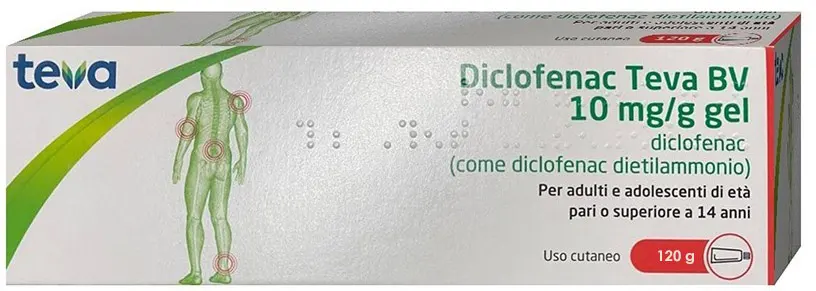
120 g tube
Product Code:FRCM159436





 Richiedi info sul prodotto