Antifungal For Fungi
Skin or nail infections caused by dermatophytes or Candida possibly complicated by superinfections by Gram-positive bacteria.
Contraindications/Side effects
Hypersensitivity to the active substance, to other imidazole derivatives or to any of the excipients. Infants and children (up to 12 years).
Dosage and method of use
Skin infections: Treatment should be continued daily and uninterruptedly for at least a week after the symptoms have disappeared, and can last from 2 to 6 weeks, depending on the type and extent of the infection. Wash the affected area and dry well. Treat not only the infected area, but also the surrounding area. Wash your hands thoroughly after each application to avoid transferring germs to other parts of the body or to other people. Generally, powder or skin spray, powder, and cream are used in combination. Skin powder - Skin spray, powder: These are indicated for treating moist lesions. Apply enough powder to cover the affected area twice a day. If using the cream in combination, it is sufficient to use both the powder and the cream once a day. For foot infections, it is recommended to dust the feet with powder daily during and after treatment with another topical formulation (cream), especially between the toes, and also on socks and shoes. Cream: Apply 1 centimeter of cream (or more depending on the extent of the lesion) to the lesion twice a day, then spread it with your fingers until completely absorbed. If using the powder as well, it is recommended to apply both formulations once a day. Nail infections: Cut infected nails as short as possible. Continue treatment uninterruptedly even after the infected nail falls off (usually after 2-3 weeks), until it grows back completely and the lesions are completely healed (rarely before 3 months). It may be necessary to combine treatment with other medications. Skin solution: Apply with the brush inserted into the bottle cap. Brush the solution onto the infected nail, all around it, and, if possible, underneath it, once or twice a day, and let it dry. Once dry, the solution forms an occlusive film on the nail. Before the next application, clean the nail with acetone. If this is not done, the overlapping layers become too thick and the solution can no longer reach the nail. Cream: Apply a small amount of cream to the infected nail once or twice a day, then spread it with your fingers; Cover the nail with a non-perforated occlusive dressing.
Storage
Cream, skin spray, powder, skin solution: store at a temperature not exceeding 25 degrees C. Skin powder: no special storage conditions.
Warnings
If sensitization or irritation occurs, discontinue treatment and initiate appropriate therapy. Avoid contact with eyes. Wash your hands thoroughly after each application, unless the hands are being treated. Since the skin solution contains alcohol, avoid contact with open wounds and mucous membranes. In these cases, use the cream. The skin powder contains talc: avoid inhaling the dust which could cause irritation of the respiratory tract. It is advisable to apply the following hygiene measures to avoid sources of infection or reinfection: keep towels and underwear for personal use to avoid infecting others; regularly change clothing that comes into contact with the infected area to avoid reinfection. It does not stain skin or clothing. Severe hypersensitivity reactions, including anaphylaxis and angioedema, have been reported during treatment with topical miconazole formulations. If a reaction due to hypersensitivity or irritation occurs, treatment should be discontinued. The drug should not come into contact with the mucous membranes of the eyes. The cream contains benzoic acid, which may be mildly irritating to the skin, eyes, and mucous membranes. The cutaneous solution contains propylene glycol, which may cause skin irritation. The solution also contains ethyl alcohol: avoid contact with open wounds and mucous membranes.
Interactions
Systemically administered miconazole is known to inhibit CYP3A4/2C9. Since the drug's presence in the blood following local application is limited, interactions considered clinically relevant are very rare. However, in patients treated with oral anticoagulants, such as warfarin, caution should be exercised and the anticoagulant effect monitored. The efficacy and adverse effects of other drugs (e.g., oral hypoglycemics and phenytoin) when administered concomitantly with miconazole may be increased, and therefore particular caution is required.
Undesirable effects
Undesirable effects considered drug-related reported by 834 patients administered miconazole 2% cream (426 patients) vs. placebo (cream base) (408 patients), enrolled in 21 double-blind clinical studies. Skin and subcutaneous tissue disorders: burning sensation of the skin, skin inflammation, hypopigmentation of the skin. General disorders and administration site conditions: application site irritation, application site burning, application site itching, application site reactions, application site warmth. Post-marketing data. Adverse reactions are classified by frequency using the following convention: very common >= 1/10 common >= 1/100 and <1/10 uncommon >= 1/1,000 and <1/100 rare >= 1/10,000 and <1/1,000 very rare <1/10,000, including isolated reports. Immune system disorders. Very rare: anaphylactic reactions, hypersensitivity, and angioneurotic edema. Skin and subcutaneous tissue disorders. Very rare: urticaria, contact dermatitis, rash, erythema, pruritus, burning sensation of the skin. General disorders and administration site conditions. Very rare: irritation or other reactions at the application site. Report any suspected adverse reactions via the national reporting system at.
Pregnancy and breastfeeding
The drug, applied topically, is minimally absorbed into the systemic circulation (bioavailability <1%). However, although there is no evidence of embryotoxicity or teratogenicity in animals, the potential risks of prescribing during pregnancy must be weighed against the potential therapeutic benefits. Miconazole, applied topically, is minimally absorbed into the systemic circulation and it is not known whether miconazole is excreted in human milk. Caution is advised when using topical products containing miconazole during breastfeeding.
Active ingredients
2% cutaneous powder: 100 grams of powder contain 2 g of miconazole nitrate. 2% cream: 100 g of cream contain 2 g of miconazole nitrate. 2% cutaneous solution: 100 ml of solution contain 2 g of miconazole. 2% cutaneous spray, powder: 100 grams of powder contain 2 g of miconazole nitrate.
Excipients
Cutaneous powder: zinc oxide, precipitated silica, talc. Skin spray, powder: talc, sorbitan sesquioleate, anhydrous ethanol, steralkonium hectorite, propellant (mixture of propane and butane). Cream: polyethylene glycol palmito stearate, macrogol, glycerol oleate, liquid paraffin, butylated hydroxyanisole, benzoic acid, purified water. Skin solution: acrylic resin (Carboset 525), polymerized acrylic resin (Carboset 515), propylene glycol, alcohol.
Format
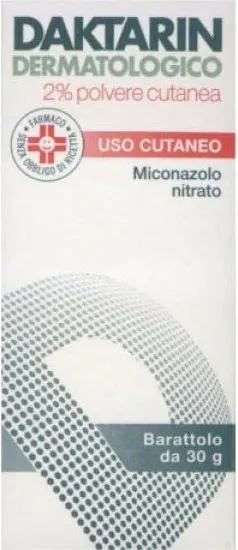
30g jar.
Product Code:FRCM046546




 Richiedi info sul prodotto