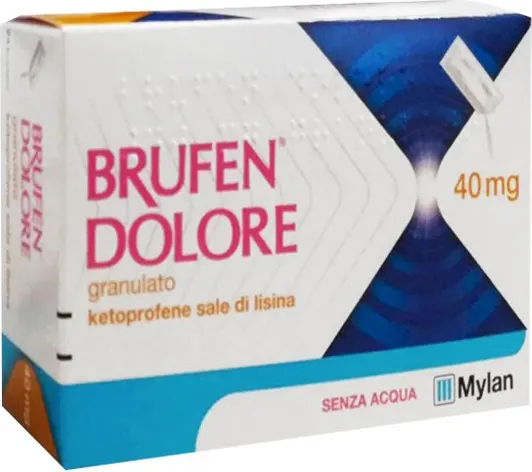
Drug based on ketoprofen with pain-relieving action.
Indications
Brufen Dolore 40 Mg granules are indicated for the symptomatic treatment of acute pain of mild to moderate severity.
Composition
Active ingredients
ketoprofen lysine salt 40 mg (corresponding to 25 mg of ketoprofen) Excipient with known effects: aspartame.
Excipients
Mannitol, xylitol, lime flavoring, lemon flavoring, frescofort flavoring, aspartame, talc, basic butylated methacrylate copolymer, magnesium stearate, hydrated colloidal silica, hypromellose, stearic acid, povidone, sodium lauryl sulfate.
Directions for use and dosage
- Adults and adolescents over 15 years: 1 sachet, as a single dose, or repeated 2-3 times a day, in the most intense forms of pain. The duration of therapy should be limited to the resolution of the painful episode.
- Special populations Elderly: elderly patients should adhere to the minimum dosages indicated above.
- Patients with mild or moderate renal impairment: it is advisable to monitor the volume of diuresis and renal function.
- Patients with mild or moderate hepatic impairment: they should be monitored carefully and treated with the minimum effective daily dose (see section 4.4).
- Paediatric population: is contraindicated in children and adolescents under 15 years of age.
The contents of the sachet can be placed directly on the tongue. It dissolves in saliva: this allows it to be used without water. It is preferable to take the medicine on a full stomach.
Warnings
Contraindications
Brufen Dolore must not be administered in the following cases:
- hypersensitivity to the active substance, to other non-steroidal anti-inflammatory drugs (NSAIDs) or to any of the excipients.
- patients with a history of hypersensitivity reactions, such as bronchospasm, asthma attacks, acute rhinitis, nasal polyps, urticaria, angioneurotic edema or other allergic-type reactions to ketoprofen or substances with a similar mechanism of action. [for example acetylsalicylic acid (ASA) or other nonsteroidal anti-inflammatory drugs (NSAIDs)]. Severe, rarely fatal, anaphylactic reactions have been reported in these patients.
- active peptic ulcer/haemorrhage, or a history of gastrointestinal bleeding, ulceration or perforation (two or more distinct, proven episodes of bleeding or ulceration), or chronic dyspepsia.
- gastrointestinal bleeding or gastrointestinal perforation resulting from previous NSAID therapy or other active bleeding or bleeding disorders.
- severe cardiac failure.
- severe hepatic failure.
- severe renal failure.
- haemorrhagic diathesis and other coagulation disorders, or patients undergoing anticoagulant therapy.
- patients undergoing major surgery.
- third trimester of pregnancy and breastfeeding.
- children and adolescents under 15 years of age.
Interactions
- Other NSAIDs (including selective cyclooxygenase-2 inhibitors), including high doses of salicylates (? 3g/day): the concomitant administration of several NSAIDs may increase the risk of gastrointestinal ulcers and bleeding, due to a synergistic effect.
- Anticoagulants (e.g. heparin and warfarin) and antiplatelet agents (e.g. ticlopidine and clopidogrel): increased risk of bleeding due to inhibition of platelet function and damage to the gastrointestinal mucosa. If concomitant administration cannot be avoided, patients should be carefully monitored.
- Lithium: risk of increased plasma lithium levels, which can sometimes reach toxic levels due to reduced renal excretion of lithium. Where necessary, plasma lithium levels should be carefully monitored with possible dosage adjustment during and after NSAID therapy.
- Methotrexate, used at high doses (greater than 15 mg/week): increased risk of haematological toxicity of methotrexate, particularly when administered at high doses (>15 mg/week), probably due to displacement of methotrexate from protein binding and reduction of its renal clearance.
- Hydantoins and sulfonamides: the toxic effects of these substances may be increased.
Pregnancy and breastfeeding
The use of NSAIDs may impair fertility and is not recommended in women attempting to conceive. Ketoprofen administration should be discontinued in women who have difficulties conceiving or who are undergoing investigation of fertility.
Format
24 sachets
Product Code:FRCM134107
Price Trend
This product has been on sale since 20/08/2020
In the last 30 days, the product's lowest price
was 6,44 €




 Richiedi info sul prodotto