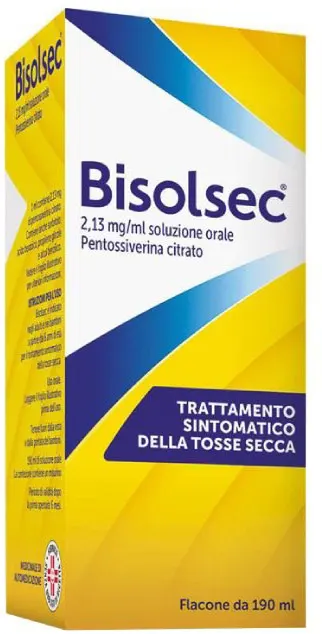
PENTOXIVERIN-based syrup for dry cough.
Indications
Bisolsec is indicated in adults and children aged 6 years and older for the symptomatic treatment of non-productive (dry) cough.
Composition
Active ingredients
1 ml of oral solution contains 2.13 mg of pentoxyverin citrate, equivalent to 1.35 mg of pentoxyverin.
Excipients with known effects:
1 ml contains:
- 300 mg of sorbitol
- 0.75 mg of benzoic acid
- 0.0472 mg of benzyl alcohol
- 100 mg of propylene glycol
- 0.393 mg sodium
Excipients
Benzoic acid, Sorbitol liquid (non-crystallizing) (E420), Glycerol, Propylene glycol, Citric acid monohydrate, Sodium citrate dihydrate, Sodium saccharin, Pear flavouring, Gin flavouring (contains flavouring substances, benzyl alcohol [E1519] and alpha-tocopherol [E307]), Purified water.
Directions for use and Dosage
| Age | Body weight (kg) | Dosage (ml) |
| Children aged 6 to 15 years | 20 - 26 | 5 ml 3-4 times a day |
| 27 - 45 | 7.5 ml 3-4 times a day | |
| 46 - 60 | 15 ml 3-4 times a day | |
| Adolescents aged > 15 years | > 60 | 15 ml 3-4 times a day |
| Adults* | > 60 | 15 ml 3-4 times a day |
*If necessary, the daily dose for adults can be adjusted. The recommended daily dose may be increased to 90 ml (equivalent to 120 mg of pentoxiverin per day), with individual doses distributed evenly throughout the day.
Paediatric population
Bisolsec is contraindicated in children under 6 years of age.
Method of administration
Use the measuring cup included in the package. In case of sore throat, it is recommended to gargle with the dose of oral solution before swallowing. Bisolsec should not be taken for more than 2 weeks. If the irritating cough causes sleep problems, the last dose should be taken shortly before going to bed.
Warnings
Bisolsec is indicated for the treatment of symptoms; appropriate therapy must be implemented to treat any pathology that is causing it.
Since Bisolsec is indicated for the treatment of symptoms, appropriate therapy must be implemented to treat the underlying disease.
Since there is limited information on the safe use in patients with hepatic impairment, this drug is not recommended for use in such patients (see also warnings on propylene glycol and benzyl alcohol in this section).
Caution is advised in patients with renal impairment and in elderly subjects with reduced renal function, as there are insufficient safety and elimination data to support the use of this product in these special patient populations (see also warnings on propylene glycol and benzyl alcohol in this section).
Caution is advised in patients with chronic cough (e.g., due to asthma, pulmonary emphysema, smoking). Suppression of the cough reflex is not permitted in this patient population, as it may increase the risk of coughing. alter expectoration and increase airway resistance.
Due to its anticholinergic effects, pentoxiverin should be administered with caution in patients with:
- increased intraocular pressure
- prostatic hypertrophy
- urinary bladder obstruction
- arterial hypertension
- cardiac arrhythmia
- myasthenia gravis
- stenosing peptic ulcer
- intestinal obstruction with esophageal, intestinal or bladder involvement.
Information specifically relating to the excipients in this formulation
Bisolsec oral solution contains:
- 11.25 mg of benzoic acid in each 15 ml dosage unit.
- 4.5 g of Sorbitol in each 15 ml dosage unit. Patients with hereditary fructose intolerance (HFI) should not take/receive this medicine. Sorbitol may cause gastrointestinal discomfort and a mild laxative effect.
- 1.5 g of propylene glycol in each 15 ml dosage unit. Medical monitoring is required in patients with renal or hepatic impairment as various adverse events attributed to propylene glycol have been reported, such as renal dysfunction (acute tubular necrosis), acute renal failure, and hepatic dysfunction (see warnings for patients with hepatic impairment and for patients with renal impairment previously in this section).
- 0.708 mg of benzyl alcohol in each 15 ml dosage unit. Benzyl alcohol may cause allergic reactions. Large volumes should be used with caution and only if necessary, especially in patients with hepatic or renal insufficiency due to the risk of accumulation and toxicity (metabolic acidosis) (see warnings for patients with hepatic insufficiency and patients with renal insufficiency earlier in this section).
- Less than 1 mmol sodium (23 mg) in each 15 ml dosage unit. This medicinal product is essentially "sodium-free".
Paediatric population
Children known to be predisposed to convulsions should be monitored during therapy with pentoxyverin. Suppression of the cough reflex in children with cough accompanied by significant hypersecretion is not permitted.
Interactions
Pentoxyverin may cause serious side effects. potentiate the effects of central nervous system depressants (e.g., alcohol, sedatives and tranquilizers, hypnotics, antihistamines).
Based on in vitro data, CYP2D6 and CYP3A4 are involved in the hepatic metabolism of pentoxiverin. No in vivo drug-drug interaction studies have been conducted evaluating the effect of CYP2D6 and CYP3A4 inhibitors on pentoxiverin metabolism. Caution should be exercised when used concomitantly with strong CYP3A4 or CYP2D6 inhibitors.
It is not known whether pentoxiverin can inhibit or induce enzymes or transporters. Therefore, the potential effect of pentoxiverin on other drugs is unknown. Caution should be exercised in case of concomitant use with other drugs, particularly those with a narrow therapeutic index.
Undesirable effects
Within each frequency category, adverse reactions are presented in order of decreasing seriousness:
- Very common (> 1/10)
- Common (> 1/100, <1/10)
- Uncommon (> 1/1,000, <1/100)
- Rare (> 1/10,000, <1/1,000)
- Very rare (<1/10,000)
- Frequency not known (cannot be estimated from the available data)
Blood and lymphatic system disorders
Immune system disorders
- Very rare: anaphylactic shock, hypersensitivity
Psychiatric disorders
- Frequency not known: restlessness, hallucinations, confusional state
Nervous system disorders
- Uncommon: somnolence
- Very rare: hypotonia, convulsions (particularly in young children)
Eye disorders
- Frequency not known: blurred vision
Respiratory, thoracic and Mediastinal disorders
- Very rare: apnoea, shortness of breath, respiratory depression (particularly in young children), other respiratory disorders
Gastrointestinal disorders
- Common: upper abdominal pain, diarrhoea, dry mouth, nausea, vomiting
Skin and subcutaneous tissue disorders
- Very rare: angioneurotic oedema, pruritus, dermatitis, urticaria, exanthema
- Frequency not known: transient exanthema
General disorders and administration site conditions
Reporting of suspected adverse reactions
Reporting suspected adverse reactions that occur after authorisation of the medicinal product is important. It allows continued monitoring of the benefit/risk balance of the medicinal product. Healthcare professionals are asked to report any suspected adverse reactions via the national reporting system.
Overdose
Possible symptoms of overdose due to pentoxiverin are:
- drowsiness
- nausea
- anticholinergic effects, such as:
- urinary retention
- dry mouth
- increased intraocular pressure
- dry skin
- thirst
- facial flushing
- tachycardia
- tachypnoea
- mydriasis
- blurred vision
- fever
- reduced intestinal motility
- motor restlessness
- convulsions
- agitation
- hallucinations
- loss of consciousness
- increased blood pressure
Following an overdose, CNS and respiratory depression may occur, especially in children.
Treatment in case of overdose
There is no specific antidote. Treatment is symptomatic. Both respiratory and cardiovascular function should be carefully monitored.
Pregnancy and breastfeeding
Pregnancy
Animal studies are insufficient to demonstrate reproductive toxicity. The potential risks for humans are unknown. Therefore, pentoxiverin is contraindicated during pregnancy. In case of accidental ingestion during pregnancy, treatment must be stopped immediately.
Breastfeeding
The active substance is excreted in breast milk. The use of Bisolsec is contraindicated during breastfeeding, mainly due to the risk of respiratory depression in breast-fed infants.
Fertility
No preclinical studies have been conducted with pentoxiverin regarding fertility. No studies have been conducted to evaluate the effects on fertility in humans.
Storage
This medicinal product does not require any special storage conditions.
Format
190 ml bottle
Product Code:FRCM220685




 Richiedi info sul prodotto